SHS1 Mathematics · Semester 2, Week 4
Measurement
Lesson notes
Learning Objectives
Indicator: 1.3.2.LI.2 Represent a vector in two-space geometrically as a directed line segment, with directions expressed in different ways (e.g., 320°, N40°W) and algebraically; then recognise vectors with the same magnitude and direction but different positions as equal vectors.
By the end of the lesson, learners can:
- Represent a given vector geometrically as a directed line segment on a Cartesian plane, clearly marking its tail (initial point) and head (terminal point).
- Express the direction of a vector in three different forms: bearing (e.g., 320°), compass notation (e.g., N40°W), and quadrant bearing (e.g., S50°E), and convert between these forms.
- Determine the algebraic components (a₁, a₂) of a vector by translating it so its tail is at the origin, given the coordinates of its initial and terminal points.
- Calculate the magnitude (length) of a vector using the Pythagorean Theorem, given its components.
- Identify vectors that are equal by verifying they have the same magnitude and the same direction, even when they start at different positions in the plane.
Sign in with your phone number to read the full note and download the GES plan - free.
Sign in with phone numberCurriculum details
- Strand
- Geometry Around Us (Strand 3)
- Sub-strand
- Measurement (3.2)
- Content standard
- 1.3.2.CS.1 - Demonstrate knowledge and understanding of the concept of measurement with respect to bearings and vectors. 1.3.2.LO.1 Interpret information about realworld applications of vectors and recognise vectors with the same magnitude and direction but different positions as equal vectors.
- Indicator
- 1.3.2.LI.2 - Represent a vector in two-space geometrically as a directed line segment, with directions expressed in different ways (e.g., 320°, N40°W) and algebraically; then recognise vectors with the same magnitude and direction but different positions as equal vectors.
- Suggested placement
-
Semester 2, Week 4
(Week 24 of the year)
Our suggestion, laid out in curriculum order across three terms of twelve weeks. NaCCA does not fix the week, so follow your school's scheme of learning.
- Curriculum reference
- NaCCA curriculum document, p. 111
Exemplars (from the NaCCA curriculum)
Using Talk for Learning strategy, learners in pairs discuss the representation of vectors.
Example: Vectors in the plane By this stage, learners are familiar with the standard (x, y) Cartesian coordinate system in the plane. That is, each point P in the plane is identified with its x and y components: P (p 1 , p 2 ).
To determine the coordinates of a vector a in the plane, the first step is to translate the vector so that its tail is at the origin of the coordinate system. Then, the head of the vector will be at some point (a 1 , a 2 ) in the plane. We call (a 1 , a 2 ) the coordinates or the components of the vector a. We often write a ∈ R 2 to denote that it can be described by two real coordinates.
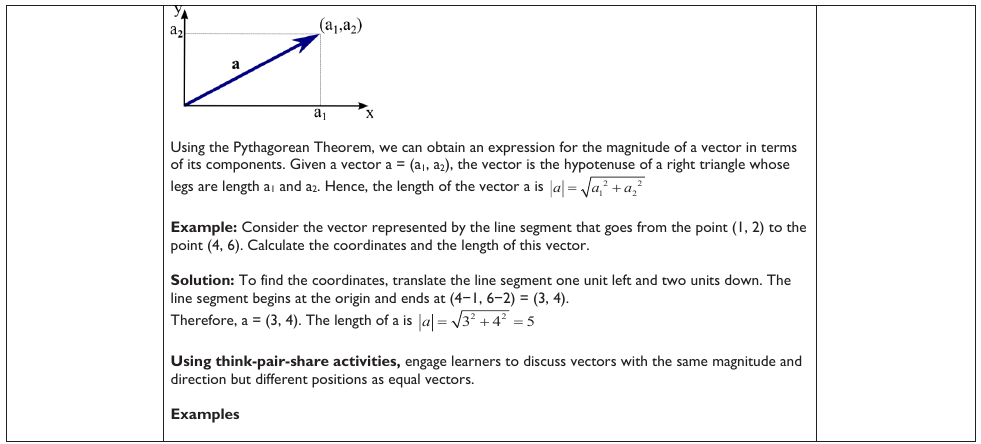
Using the Pythagorean Theorem, we can obtain an expression for the magnitude of a vector in terms of its components. Given a vector a = (a 1 , a 2 ), the vector is the hypotenuse of a right triangle whose legs are length a 1 and a 2 . Hence, the length of the vector a is = a a 1 2 + a 2 2
Example: Consider the vector represented by the line segment that goes from the point (1, 2) to the point (4, 6). Calculate the coordinates and the length of this vector.
Solution: To find the coordinates, translate the line segment one unit left and two units down. The line segment begins at the origin and ends at (4−1, 6−2) = (3, 4). Therefore, a = (3, 4). The length of a is a = 3 2 + 4 2 = 5
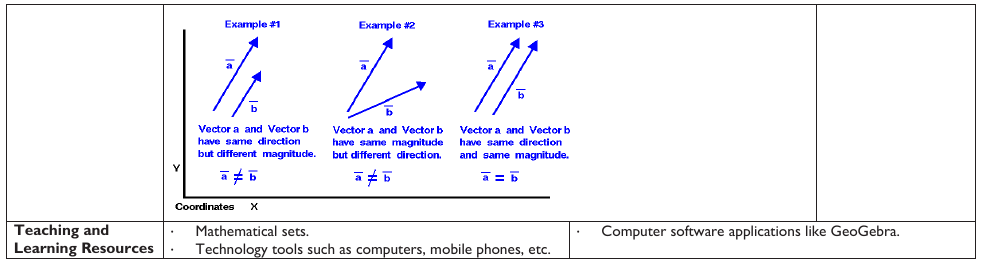
Using think-pair-share activities, engage learners to discuss vectors with the same magnitude and direction but different positions as equal vectors.
Examples
Teaching and Learning Resources:
- Mathematical sets.
- Technology tools such as computers, mobile phones, etc.
- Computer software applications like GeoGebra.
Assessment (1.3.2.AS.2). The document marks these depth-of-knowledge levels for this indicator: Level 3 Strategic reasoning.