B5 Mathematics · Term 2, Week 12
Variables and Equations
Lesson notes
Learning Objectives
Indicator: B5.2.3.1.2 - Identify the unknown in a problem; represent the problem with an equation; and solve the problem concretely, pictorially or symbolically.
By the end of the lesson, learners can:
- Identify the unknown quantity in a given word problem and state what the letter represents.
- Represent a word problem as a one-step equation with a single variable and whole number coefficients.
- Solve one-step equations concretely using counters, blocks or balance scales.
- Solve one-step equations pictorially by drawing simple diagrams.
- Solve one-step equations symbolically by applying inverse operations, and check their answers by substitution.
Sign in with your phone number to read the full note and download the GES plan - free.
Sign in with phone numberCurriculum details
- Strand
- Algebra (Strand 2)
- Sub-strand
- Variables and Equations (2.3)
- Content standard
- B5.2.3.1 - Solve problems involving single- variable, one-step equations with whole number coefficients
- Indicator
- B5.2.3.1.2 - Identify the unknown in a problem; represent the problem with an equation; and solve the problem concretely, pictorially or symbolically.
- Suggested placement
-
Term 2, Week 12
(Week 24 of the year)
Our suggestion, laid out in curriculum order across three terms of twelve weeks. NaCCA does not fix the week, so follow your school's scheme of learning.
- Source document note
-
The official curriculum document has a fault in this entry, so the curriculum text above is transcribed exactly as printed:
- exemplars - p.93
- Curriculum reference
-
Mathematics Curriculum for Primary Schools (Basic 4-6), 2019, p. 93
Transcribed from the official NaCCA publication. Check this page against the source.
Exemplars (from the NaCCA curriculum)
E.g.1 Learners use concrete materials, such as blocks or counters and the balance scales, to find the value of p in the following equations. If necessary, model the use of guess and test as one strategy. By observing patterns in their results, students become more systematic in the guesses they make
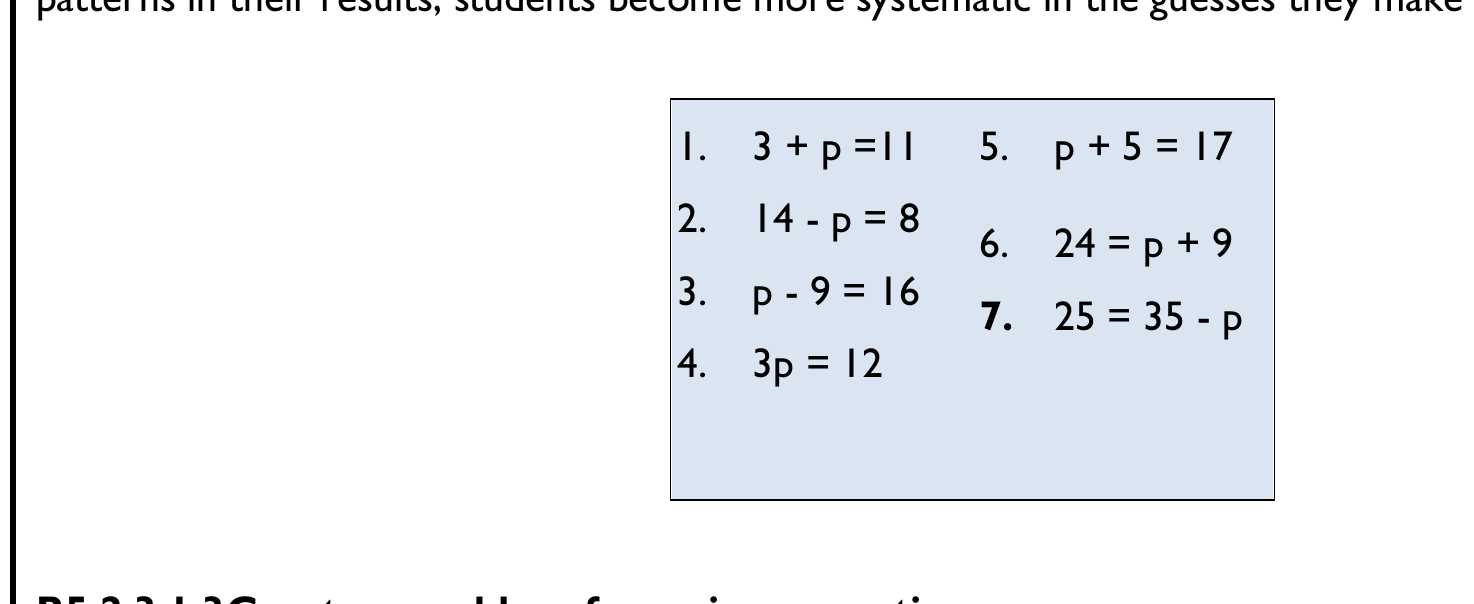
The seven equations (1. 3 + p =11 ... 7. 25 = 35 - p) are set in a two-column box below the exemplar and interleave in the text layer; the figure shows them.