JHS2 Physical Education And Health · Term 2, Week 1
Traditional Rhythmic Gymnastics, Games and Dance
Lesson notes
Learning Objectives
Indicator: B8.2.1.3.1 - Classify and perform global and traditional rhythmic gymnastics movements (e.g., group dance movements- nobabie, hoo-londoreho! etc.) and adaptation for creativity, communication and cultural identity
By the end of the lesson, learners can:
- Identify and classify given rhythmic gymnastics movements as either traditional Ghanaian or global in origin.
- Perform at least two traditional group dance movements (e.g., nobabie, hoo-londoreho!) with correct rhythm and coordination in small groups.
- Synchronise individual movements with group members to create a short, original rhythmic sequence that blends traditional and global movements.
- Record the estimated duration of their group performance in their self-journal, noting their personal effort and involvement.
- Demonstrate respect and appreciation for the cultural origins of the dances performed by peers from different regions.
This lesson builds directly on the classification and performance of socio-relational games (B8.2.1.1.1) and individual and group traditional dance movements (B8.2.1.2.1) covered in Term 1, where learners already explored dances such as kpanlogo and wan tiadoone. It now extends that work by adding global rhythmic movements and emphasising synchronisation and adaptation.
Sign in with your phone number to read the full note and download the GES plan - free.
Sign in with phone numberCurriculum details
- Strand
- Physical Activity Education (Strand 2)
- Sub-strand
- Traditional Rhythmic Gymnastics, Games and Dance (2.1)
- Content standard
- B8.2.1.3 - Demonstrate understanding and apply skills and movement techniques in global and traditional rhythmic gymnastics movements and adaptations for coordination and appreciation of global cultures Refer to Visual Arts and Design CS B7.2.1.3 for cross-referencing
- Indicator
- B8.2.1.3.1 - Classify and perform global and traditional rhythmic gymnastics movements (e.g., group dance movements- nobabie, hoo-londoreho! etc.) and adaptation for creativity, communication and cultural identity
- Suggested placement
-
Term 2, Week 1
(Week 13 of the year)
Our suggestion, laid out in curriculum order across three terms of twelve weeks. NaCCA does not fix the week, so follow your school's scheme of learning.
- Curriculum reference
-
Physical Education and Health, Common Core Programme (JHS1-JHS3), 2023, p. 27
Transcribed from the official NaCCA publication. Check this page against the source.
Exemplars (from the NaCCA curriculum)
1. Research and synchronise traditional individual and group dance movements and global rhythmic dance movements and perform.
2. Create and perform combinations of global and traditional rhythmic dance gymnastics movements in small and large groups.
3. Record estimate of duration/measure of performance in your self-journal as your effort to increase involvement in physical activity.
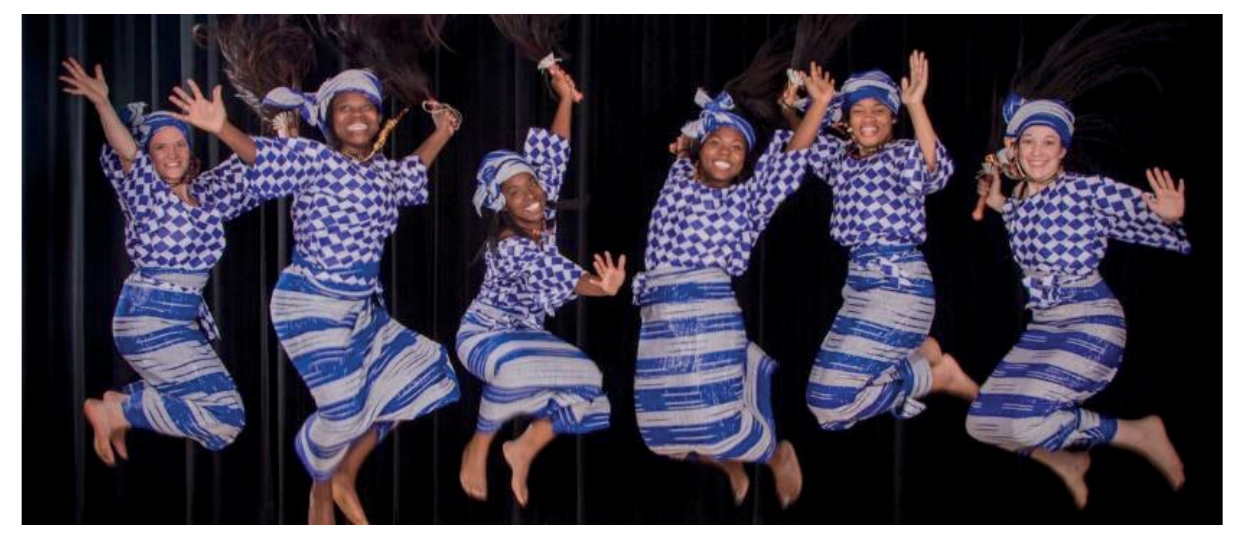
Select rhythmic dance movements from the various regions to expose learners to the wide range of cultures that exist in Ghana.