SHS1 Mathematics · Semester 2, Week 1
Spatial Sense
Lesson notes
Learning Objectives
Indicator: 1.3.1.LI.4 - Solve problems on Pythagorean theorem by identifying situations that involve right triangles, verify the formula and apply it.
By the end of the lesson, learners can:
- State the Pythagorean theorem in their own words and identify the hypotenuse, base, and height of a right-angled triangle.
- Verify the formula a² + b² = c² using both the area model (squares on the sides) and the algebraic rearrangement of four congruent triangles.
- Determine whether a given triangle is right-angled by checking whether the squares of the two shorter sides sum to the square of the longest side.
- Apply the Pythagorean theorem to find an unknown side of a right-angled triangle in routine exercises and real-life problems.
- Explain, with at least one illustration, why the Pythagorean theorem applies only to right-angled triangles and not to acute or obtuse triangles.
Sign in with your phone number to read the full note and download the GES plan - free.
Sign in with phone numberCurriculum details
- Strand
- Geometry Around Us (Strand 3)
- Sub-strand
- Spatial Sense (3.1)
- Content standard
- 1.3.1.CS.1 - Demonstrate a conceptual understanding of spatial sense with respect to angles, parallel lines, transversal and polygons, and apply their properties to solve everyday life problems. 1.3.1.LO.1 Draw and describe angles of various measures; solve problems on the Pythagorean theorem, parallel lines, perpendicular lines and transversal; use the exterior angle theorem of a triangle and calculate the sums of interior and exterior angles of polygons.
- Indicator
- 1.3.1.LI.4 - Solve problems on Pythagorean theorem by identifying situations that involve right triangles, verify the formula and apply it.
- Suggested placement
-
Semester 2, Week 1
(Week 21 of the year)
Our suggestion, laid out in curriculum order across three terms of twelve weeks. NaCCA does not fix the week, so follow your school's scheme of learning.
- Curriculum reference
- NaCCA curriculum document, p. 95
Exemplars (from the NaCCA curriculum)
Collaborative learning: In small groups, engage learners to research and discuss to come out with an explanation, using illustrations, why the Pythagorean theorem only applies to right triangles.
Collaborative Learning: In groups, using examples and counterexamples, engage learners to discuss and verify the Pythagorean theorem, including drawings, concrete materials and the use of technology.
Activity 1: Pythagoras' theorem using the following figure shows that the area of the square formed by the longest side of the right triangle (the hypotenuse) is equal to the sum of the area of the squares formed by the other two sides of the right triangle.
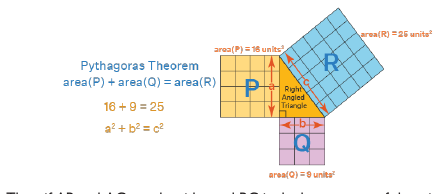
Thus, if AB and AC are the sides and BC is the hypotenuse of the triangle, then BC 2 = AB 2 + AC 2 . In this case, AB is the base, AC is the altitude or the height, and BC is the hypotenuse.
Activity 2: Using convenient groups, task learners to investigate the Pythagorean theorem formula using the algebraic method. Use the values a, b, and c as shown in the following figure and follow the steps given below:
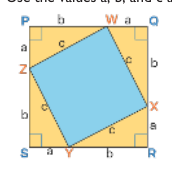
Step 1: Arrange four congruent right triangles in the given square PQRS, whose side is a + b. The four right triangles have 'b' as the base, 'a' as the height and 'c' as the hypotenuse. Step 2: The 4 triangles form the inner square WXYZ, as shown, with 'c' as the four sides. Step 3: The area of the square WXYZ by arranging the four triangles is c 2 .
Step 4: The area of the square PQRS with side (a + b) = Area of 4 triangles + Area of the square WXYZ with side 'c'. This means (a + b) 2 = = [4 × 1/2 × (a × b)] + c 2 . This leads to a 2 + b 2 + 2ab = 2ab + c 2 . Therefore, a 2 + b 2 = c 2 . Hence proved. Experiential Learning: In convenient groups, task learners to research and make presentations on the real-life (both historical and contemporary) applications of the Pythagorean theorem.
Activity 3: Real-life uses of the Pythagorean theorem
- The Pythagorean Theorem is useful for two-dimensional navigation.
- Painting on a Wall: To paint tall structures, painters make use of ladders, and they frequently employ Pythagoras' theorem to carefully position the base away from the wall so it does not topple over.
- What Size of TV Should You Buy: The size of a television is always specified in terms of its diagonal. If a television is specified as 43 inches in size, its true size is the diagonal's or hypotenuse's measurement.
Think-pair-share: In pairs, task learners to determine if a given triangle is a right-angled triangle using the Pythagorean theorem.
Activity 4: Pythagoras' theorem can be used to determine whether a triangle has a right angle. The triangle contains a right angle if the squares of the two shorter sides equal the square of the hypotenuse.
E.g. Does the triangle ABC contain a right angle?
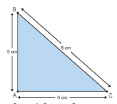
a 2 + b 2 = c 2 5 2 + 6 2 = c 2 61 = c 2 The hypotenuse of the triangle is 8. 8 2 = 64 61 does not equal 64. Therefore, the triangle does not contain a right angle.
Think-pair-share: In pairs, task learners to brainstorm and come out with an explanation on why a triangle with a side length ratio of 3:4:5 is a right triangle.
Example: We can prove this by using the Pythagorean Theorem as follows:
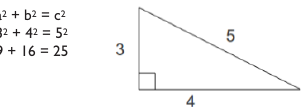
 ⇒ a 2 + b 2 = c 2 ⇒ 3 2 + 4 2 = 5 2 ⇒ 9 + 16 = 25
Think-pair-share: In pairs, engage learners with task sheets to solve problems using the Pythagorean theorem.
Example: Solve the following problems using the Pythagorean theorem. i. A rectangular playing field is 20 metres long. A straight path is cut across the field along one of its diagonals. If the length of the path in metres is 25m, how wide is the playing field? Solution: This is a right-angled triangle.
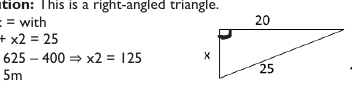
 Let x = with 202 + x2 = 25 x2 = 625 - 400 ⇒ x2 = 125 x = 15m
ii. An animal shed with a pent roof needs to have some new roof beams fitted. The width of the shed is 10m, and the height of the pent roof is 1.3m. Work out the length of the roof beams needed. iii. An army captain is on a hunt for a criminal. Her GPS tells her that she is 50m away from the criminal. She walks 34m due west. The GPS compass now tells her that the criminal is due south from where she is standing. How far south does she need to go to find the criminal? iv. An anchor line for a tower needs to be replaced. The tower is 96ft tall. The anchor line is 105ft long. How far from the tower can it be placed to the nearest foot?
Teaching and Learning Resources:
- * Mathematical sets. * Technology tools such as computers, mobile phones, etc.
- * Computer software applications like GeoGebra. * Tape measure, carpenters square, compass, clock face, etc.
Assessment (1.3.1.AS.4). The document marks these depth-of-knowledge levels for this indicator: Level 1 Recall; Level 2 Skills of conceptual understanding; Level 3 Strategic reasoning.