SHS1 Mathematics · Semester 1, Week 18
Spatial Sense
Lesson notes
Learning Objectives
Indicator: 1.3.1.LI.1
By the end of the lesson, learners can:
- Draw and describe acute, right, straight, obtuse and reflex angles with accurate free-hand sketches and identify each type by its measure.
- Identify referents (familiar objects such as room corners, human palms, tree branches, and adjustable chairs) for various angle measures and use them to estimate the size of unknown angles.
- Measure angles of various orientations using a protractor with reasonable accuracy, reading the correct scale direction.
- Replicate and bisect given angles using at least two different methods, such as a protractor, compass and straightedge, or geometry software like GeoGebra.
- Solve contextual problems involving angle measures, including finding unknown angles on a straight line and finding unknown angles in a triangle.
Sign in with your phone number to read the full note and download the GES plan - free.
Sign in with phone numberCurriculum details
- Strand
- Geometry Around Us (Strand 3)
- Sub-strand
- Spatial Sense (3.1)
- Content standard
- 1.3.1.CS.1 - Demonstrate a conceptual understanding of spatial sense with respect to angles, parallel lines, transversal and polygons, and apply their properties to solve everyday life problems. 1.3.1.LO.1 Draw and describe angles of various measures; solve problems on the Pythagorean theorem, parallel lines, perpendicular lines and transversal; use the exterior angle theorem of a triangle and calculate the sums of interior and exterior angles of polygons.
- Indicator
- 1.3.1.LI.1 - Draw and describe angles with various measures, including acute, right, straight, obtuse and reflex angles and solve problems on them. Experiential Learning: In convenient groups, engage learners to identify referents for angles.
- Suggested placement
-
Semester 1, Week 18
(Week 18 of the year)
Our suggestion, laid out in curriculum order across three terms of twelve weeks. NaCCA does not fix the week, so follow your school's scheme of learning.
- Curriculum reference
- NaCCA curriculum document, p. 88
Exemplars (from the NaCCA curriculum)
Example: A referent is an object/item that can be used to help understand/represent a concept. Some referents of angles are corners of rooms and doors, the human palm, tree branches, and adjustable chairs.

Experiential Learning: In convenient groups, engage learners to sketch a given angle.
Example: Make a free-hand sketch of angles such as acute, right, straight, obtuse and reflex angles and verify the closeness of their sketch with the actual angle.
Experiential Learning: Using 30°, 45°, 60°, 75 o , 90° and 180° as referent angles, engage learners in convenient groups or pairs/squares to make estimations of the measure/size of given angles.
Using think-pair-share activities: In pairs, task learners to measure angles in various orientations using a protractor.
Examples

Experiential Learning: In mixed-ability groups, learners explain and illustrate how angles can be replicated in a variety of ways, e.g., Mira, protractor, compass and straightedge, carpenter's square, and geometry software (e.g., GeoGebra).
In mixed groupings (gender/ability), learners replicate angles, with and without technology, in various ways.
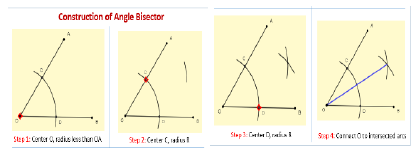
In mixed-ability groups, engage learners to use various methods (including the use of feasible IT tools) to bisect given angles.
Example
In pairs, learners should solve a contextual problem that involves angles.
Example: Kwabena cut a piece of wood to make a 45 0 angle. At what angle was the other piece cut?
Solution
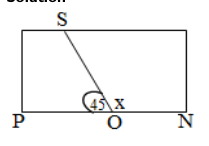
Think: We need to find ∠𝑆𝑂𝑁 Since PON is a straight line, its angle is 180 0 . Therefore: ∠𝑃𝑂𝑁 = ∠𝑃𝑂𝑆 + ∠ 𝑆𝑂𝑁 ∠𝑃𝑂𝑁 − ∠𝑃𝑂𝑆 = ∠𝑆𝑂𝑁 180º - 45º = 135º Therefore, the angle was the other piece cut is 45 0 .
Example 2: In a triangle, one angle is twice the measure of the second angle. The third angle is three times the measure of the second angle. What is the measure/size of each angle?
Solution
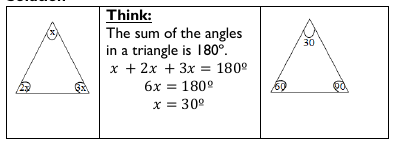
Think: The sum of the angles in a triangle is 180º. 𝑥 + 2𝑥 + 3𝑥 = 180º 6𝑥 = 180º 𝑥 = 30º

 Example: Determine the measure of the angles represented by x
Teaching and Learning Resources:
- * Mathematical sets. * Technology tools such as computers, mobile phones, etc.
- * Computer software applications like GeoGebra. * Tape measure, carpenters square, compass, clock face, etc.
Assessment (1.3.1.AS.1). The document marks these depth-of-knowledge levels for this indicator: Level 3 Strategic reasoning.