JHS2 Mathematics · Term 3, Week 1
Shapes and Space
Lesson notes
Learning Objectives
Indicator: B8.3.1.2.2 - Construct scalene triangles, isosceles triangles, equilateral triangles, obtuse-angled triangle, and acute-angled triangles in different orientations under given conditions.
By the end of the lesson, learners can:
- Construct an equilateral triangle given one side, using a pair of compasses and a ruler, and verify its properties with a protractor.
- Construct an isosceles triangle given the base and the equal sides (or base angles), using a pair of compasses and a ruler.
- Construct a scalene triangle given all three sides, using a pair of compasses and a ruler.
- Construct acute-angled, obtuse-angled and right-angled triangles given a side and two angles, using a pair of compasses and a ruler.
- Justify why a constructed triangle is equilateral, isosceles or scalene by measuring its sides and angles.
Sign in with your phone number to read the full note and download the GES plan - free.
Sign in with phone numberCurriculum details
- Strand
- Geometry and Measurement (Strand 3)
- Sub-strand
- Shapes and Space (3.1)
- Content standard
- B8.3.1.2 - Demonstrate the ability to perform geometric constructions of the angles (75˚, 105˚, 60˚, construct triangles and find locus of points under given conditions.
- Indicator
- B8.3.1.2.2 - Construct scalene triangles, isosceles triangles, equilateral triangles, obtuse-angled triangle, and acute-angled triangles in different orientations under given conditions.
- Suggested placement
-
Term 3, Week 1
(Week 25 of the year)
Our suggestion, laid out in curriculum order across three terms of twelve weeks. NaCCA does not fix the week, so follow your school's scheme of learning.
- Curriculum reference
-
Mathematics, Common Core Programme (JHS1-JHS3), 2023, p. 127
Transcribed from the official NaCCA publication. Check this page against the source.
Exemplars (from the NaCCA curriculum)
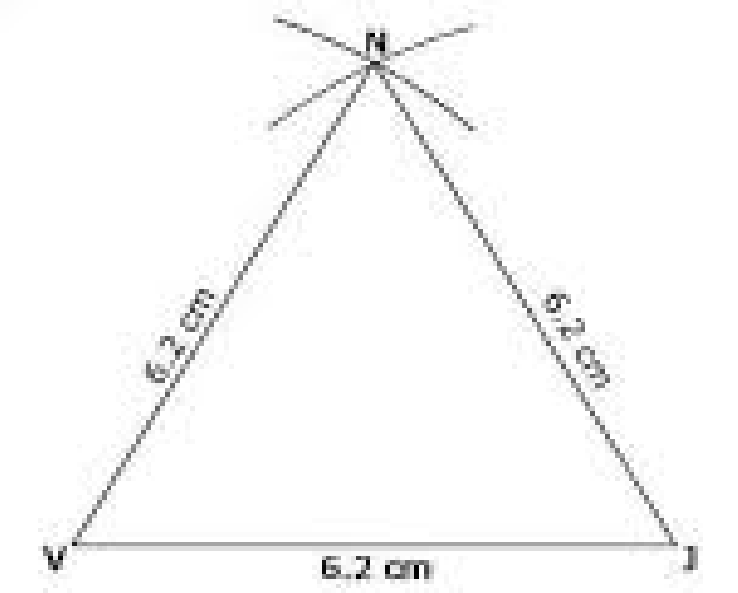
E.g.1: Use a pair of compasses and a ruler to construct an equilateral triangle when a side is given and justify why it is an equilateral triangle (i.e. draw the line segment VJ = 6.2cm and use this radius at V and J respectively to strike arcs to intersect in N. Verify the measure of the size of the angle with a protractor)
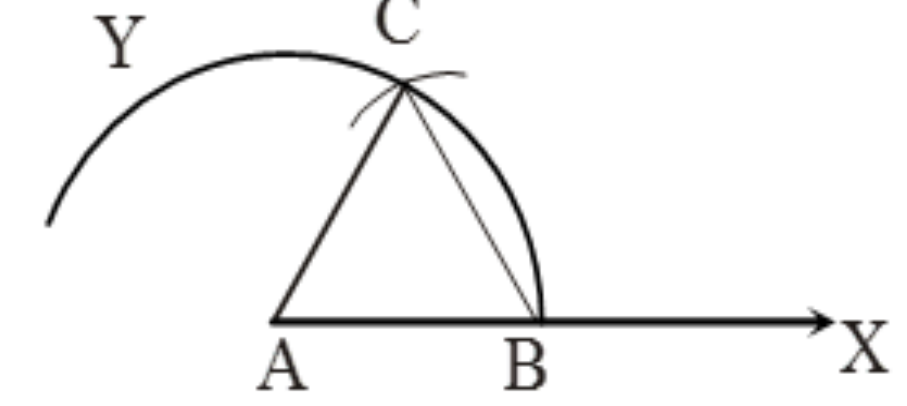
E.g.2 : Use a pair of compasses and a ruler to construct an equilateral triangle by using point A as a centre and constructing an arc to meet ⃗ AX in B, and then using the same radius to inscribe an arc (construct 60 0 angle) at point C and joining A to C and B to C.
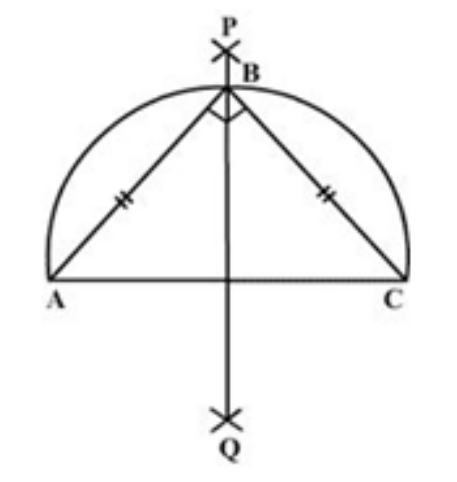
E.g.3: Use a pair of compasses and a ruler to perform geometric construction of an isosceles right-angled triangle when the base line is given.
E.g.4: Use a pair of compasses and a ruler to perform geometric construction of an isosceles triangle when all the sides are given.
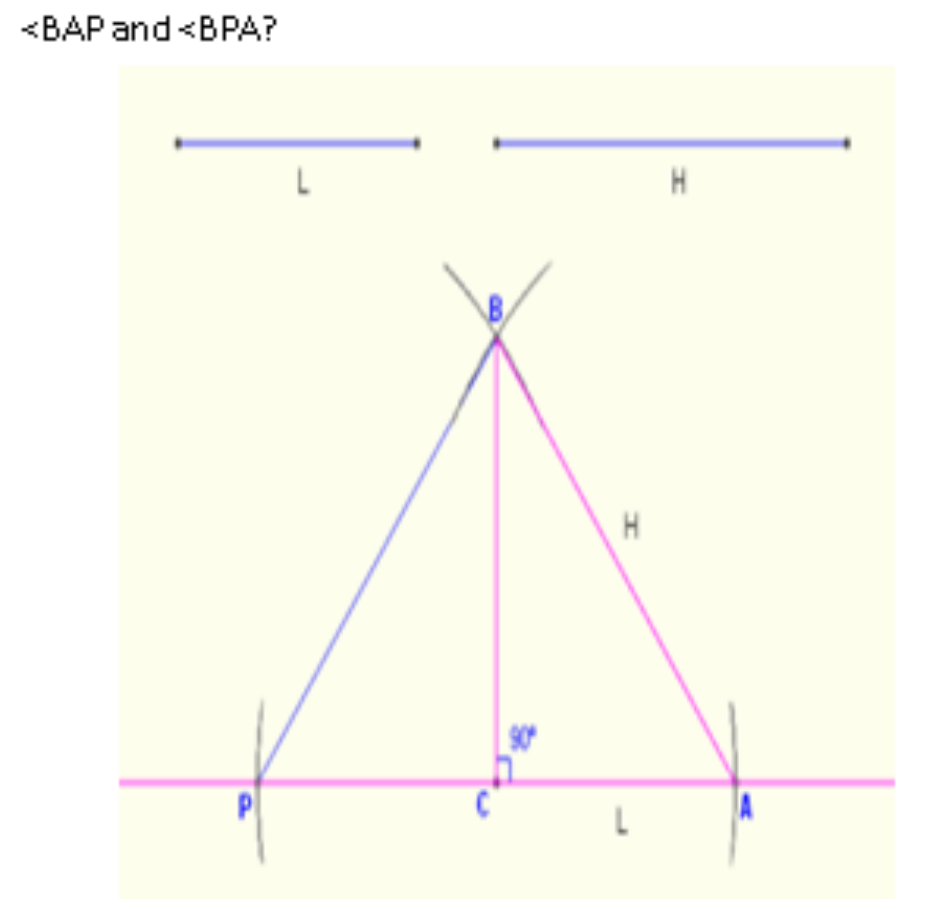
E.g.5: Use a pair of compasses and a ruler to perform geometric construction of an isosceles triangle when the base angles and base side are known.
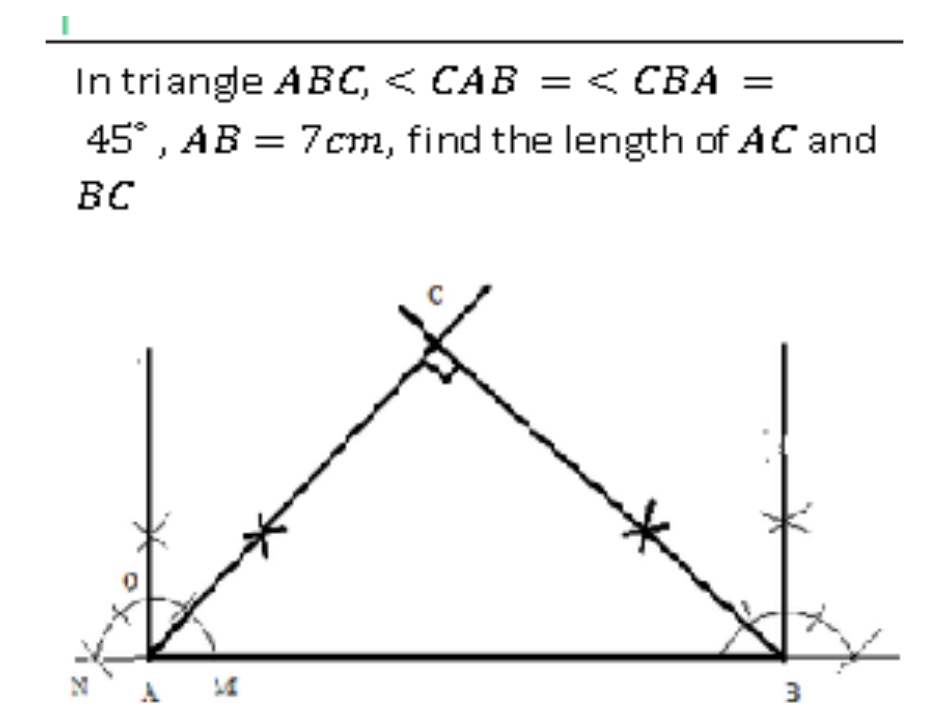
E.g.6: Use a pair of compasses and a ruler to construct acute-angled triangles, obtuse-angled triangles and right-angled triangles when a side and two angles are given.
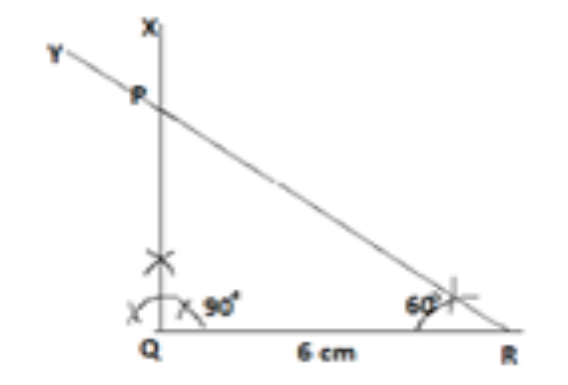
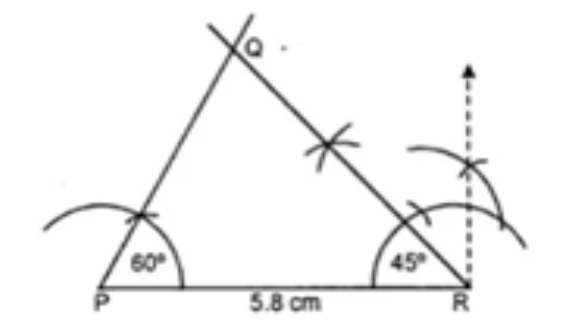
E.g.7: Use a pair of compasses i. Draw the line segment LM = 6cm. and a ruler to construct
ii. Taking a radius of 8cm, draw an arc of
triangles when all the sides are circle with centre L.
given.
iii. Draw another arc of circle with centre M and radius 7cm to intersect the first arc. Name the point of intersection N.
iv. Join the point L and N. Join the points M and N. hence triangle MNL is the required triangle.
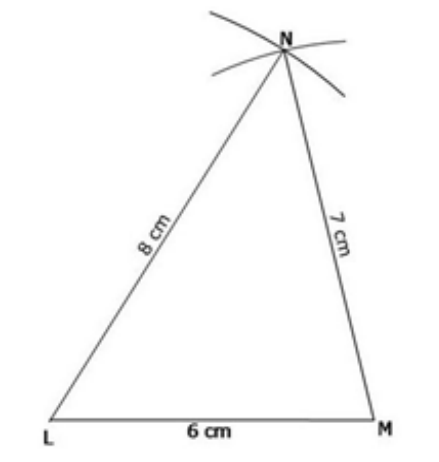
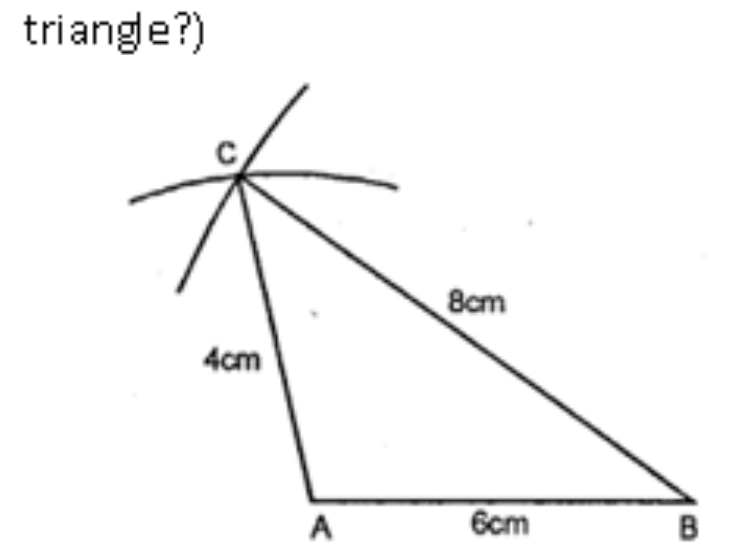
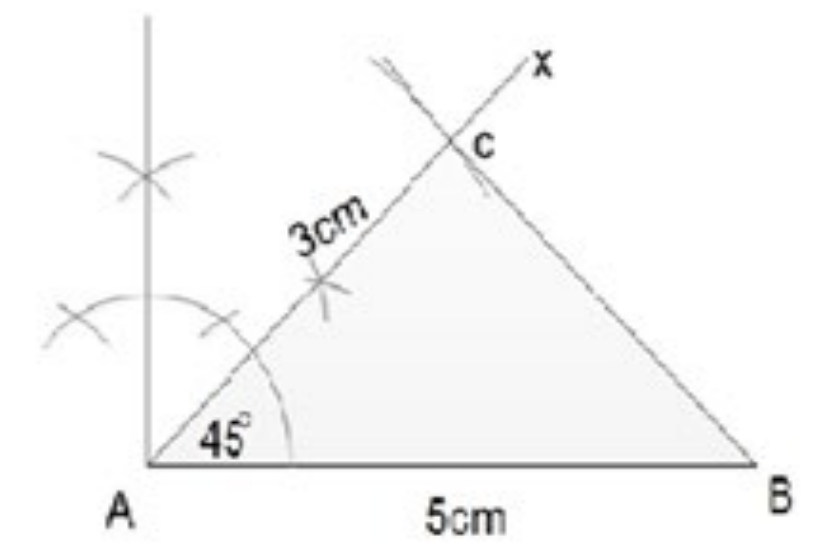
E.g.8: Use a pair of compasses and a ruler to construct triangles when two sides and one angle are given In triangle ABC, ∠CAB = 450 , AC =3cm and AB=5cm