JHS2 Mathematics · Term 2, Week 12
Shapes and Space
Lesson notes
Learning Objectives
Indicator: B8.3.1.2.1 - Construct and bisect angles of 120˚, 105˚, 135˚ and 150˚
By the end of the lesson, learners can:
- Use a pair of compasses and a ruler to construct an angle of 120˚ accurately, following the correct sequence of steps.
- Construct angles of 105˚, 135˚, and 150˚ using the relationship between known angles (60˚, 90˚, 120˚, 180˚) and their sums or differences.
- Bisect a given angle of 120˚, 105˚, 135˚, or 150˚ using a pair of compasses and a ruler to obtain the required half-angle.
- Verify constructed angles using a protractor and confirm their accuracy to within 2 degrees.
- Explain in their own words why constructing an angle of 150˚ can be done by constructing 60˚ and 90˚ side by side, or by extending a 30˚ angle.
Sign in with your phone number to read the full note and download the GES plan - free.
Sign in with phone numberCurriculum details
- Strand
- Geometry and Measurement (Strand 3)
- Sub-strand
- Shapes and Space (3.1)
- Content standard
- B8.3.1.2 - Demonstrate the ability to perform geometric constructions of the angles (75˚, 105˚, 60˚, construct triangles and find locus of points under given conditions.
- Indicator
- B8.3.1.2.1 - Construct and bisect angles of 120˚, 105˚, 135˚ and 150˚
- Suggested placement
-
Term 2, Week 12
(Week 24 of the year)
Our suggestion, laid out in curriculum order across three terms of twelve weeks. NaCCA does not fix the week, so follow your school's scheme of learning.
- Curriculum reference
-
Mathematics, Common Core Programme (JHS1-JHS3), 2023, p. 125
Transcribed from the official NaCCA publication. Check this page against the source.
Exemplars (from the NaCCA curriculum)
E.g.1: Use a pair of compasses and a ruler to perform geometric construction of an angle (∠CBA) =120˚ [Draw a semi-circle over the point B to meet ⃒BC⃒ in Q and using the same radius and Q as centre to make the arcs R and P respectively) and
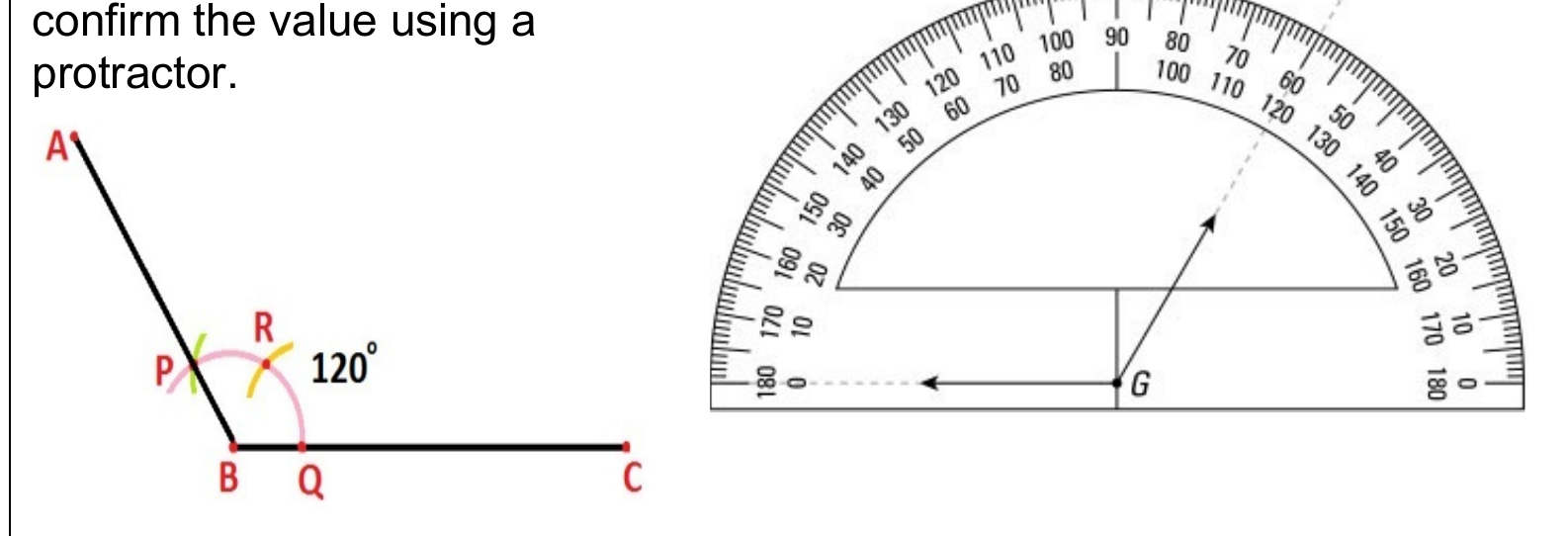
confirm the value using a protractor.
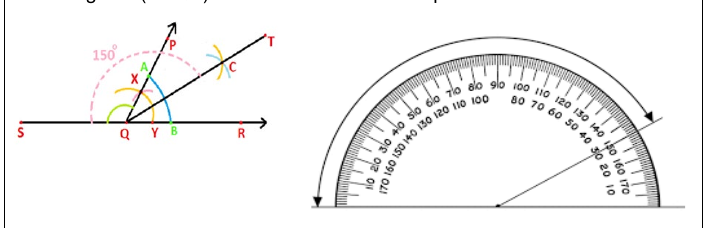
E.g.2: Use a pair of compasses and a ruler to perform geometric construction of an angle of (∠SQC) 150˚ and measure with aprotractor to confirm.
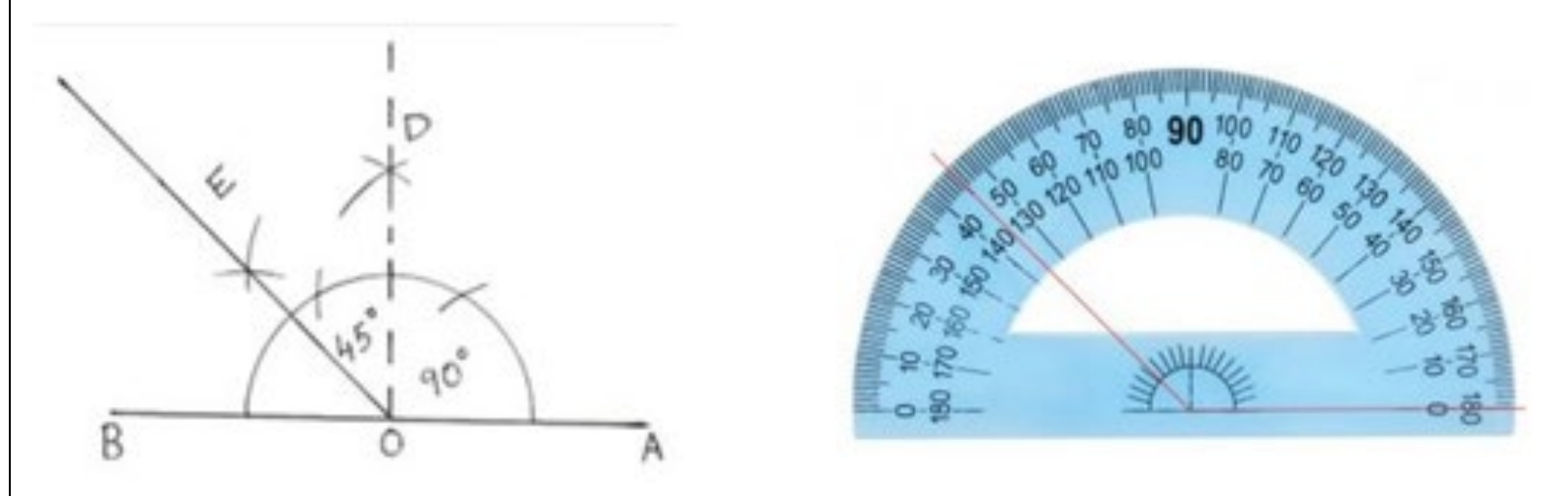
E.g.3: Use a pair of compasses and a ruler to perform the geometric construction of an angle(∠AOE) 135˚ and measure with a protractor to confirm.
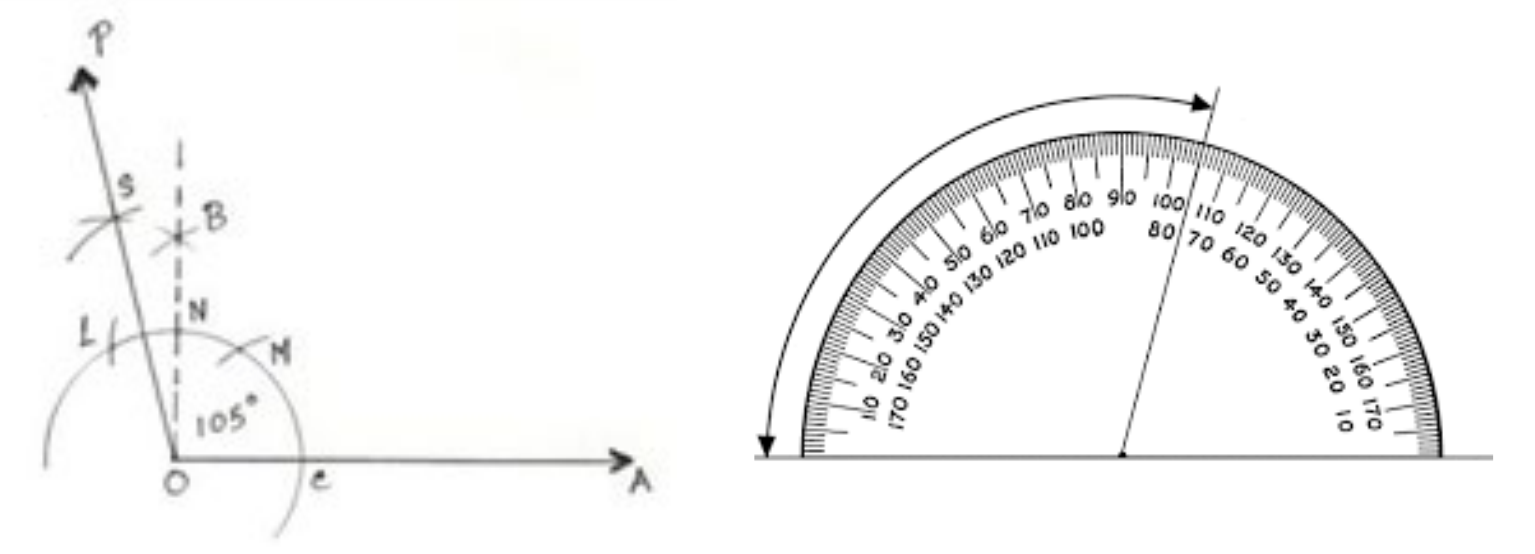
E.g.4: Use a pair of compasses and a ruler to perform geometric construction of an angle of 105˚ and measure with a protractor to verify.