JHS2 Mathematics · Term 2, Week 11
Shapes and Space
Lesson notes
Learning Objectives
Indicator: B8.3.1.1.2 - Determine the values of angles in a triangle using knowledge of the sum of interior angles in a triangle and other properties.
By the end of the lesson, learners can:
- State the sum of interior angles of a triangle as 180 degrees and use it to find a missing angle when two angles are given.
- Apply the properties of isosceles and equilateral triangles (equal sides, equal base angles) to set up and solve equations for unknown angles.
- Use the exterior angle property of a triangle (exterior angle equals the sum of the two opposite interior angles) to find unknown angles.
- Combine the sum of interior angles of a triangle with other angle facts, such as vertically opposite angles and angles on a straight line, to solve multi-step problems.
- Justify each step in their working by stating which angle property they are using.
Sign in with your phone number to read the full note and download the GES plan - free.
Sign in with phone numberCurriculum details
- Strand
- Geometry and Measurement (Strand 3)
- Sub-strand
- Shapes and Space (3.1)
- Content standard
- B8.3.1.1 - Demonstrate understanding and use of the relationship between parallel lines and alternate and corresponding angles and use the sum of angles in a triangle to deduce the angle sum in any polygon.
- Indicator
- B8.3.1.1.2 - Determine the values of angles in a triangle using knowledge of the sum of interior angles in a triangle and other properties.
- Suggested placement
-
Term 2, Week 11
(Week 23 of the year)
Our suggestion, laid out in curriculum order across three terms of twelve weeks. NaCCA does not fix the week, so follow your school's scheme of learning.
- Curriculum reference
-
Mathematics, Common Core Programme (JHS1-JHS3), 2023, p. 124
Transcribed from the official NaCCA publication. Check this page against the source.
Exemplars (from the NaCCA curriculum)
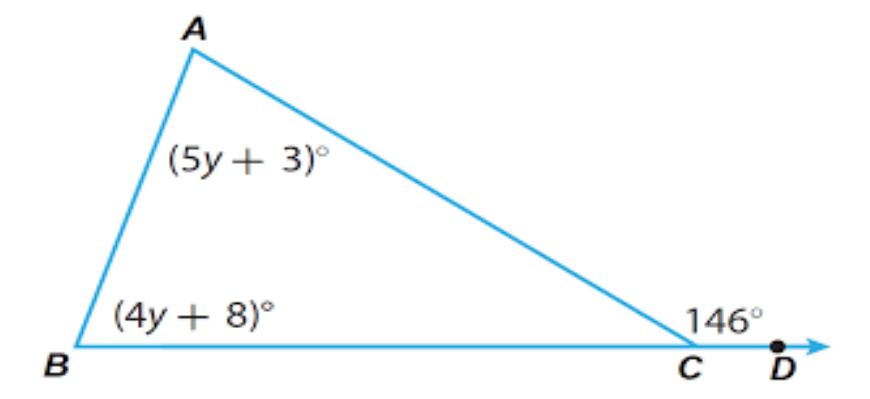
E.g. 1 Calculate the values of y and the angles in the triangle
E.g. 2 Deduce the formula for the sum of interior angles in a polygon and determine the value of an angle in a regular hexagon.
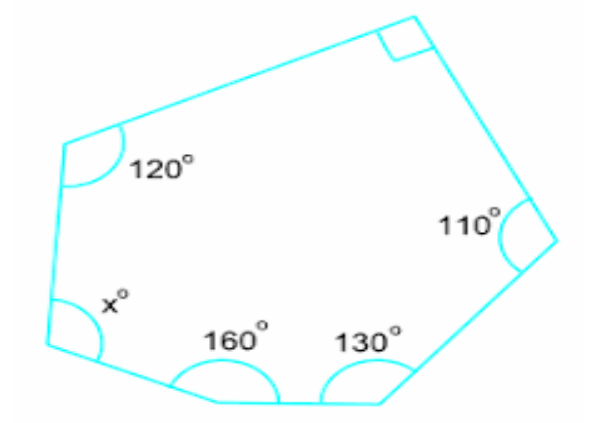
E.g. 3 Use the formula for finding the sum of interior angles in a polygon (n- 2)180 to determine the value of x in the hexagon.