JHS1 Mathematics · Term 2, Week 12
Shape and Space
Lesson notes
Learning Objectives
Indicator: B7.3.1.2.4 - Construct angles of 90 0 and 45 0
By the end of the lesson, learners can:
- Construct an angle of 90° by raising a perpendicular at a point on a given line segment using a ruler and a pair of compasses.
- Verify a constructed 90° angle using a protractor.
- Construct an angle of 45° by bisecting a constructed 90° angle using a ruler and a pair of compasses.
- Construct and bisect a given angle such as ∠ABC = 45° on a specified triangle (e.g., AB = 5 cm, BC = 6 cm).
- Apply the construction of 90° and 45° angles to draw accurate diagrams of simple shapes such as rectangles and right-angled triangles.
Sign in with your phone number to read the full note and download the GES plan - free.
Sign in with phone numberCurriculum details
- Strand
- Geometry and Measurement (Strand 3)
- Sub-strand
- Shape and Space (3.1)
- Content standard
- B7.3.1.2 - Demonstrate how to construct a perpendicular to a line from a given point, bisect a line, bisect angles, and construct angles of the following sizes: 30˚, 45˚, 60˚, 75˚
- Indicator
- B7.3.1.2.4 - Construct angles of 90 0 and 45 0
- Suggested placement
-
Term 2, Week 12
(Week 24 of the year)
Our suggestion, laid out in curriculum order across three terms of twelve weeks. NaCCA does not fix the week, so follow your school's scheme of learning.
- Source document note
-
The official curriculum document has a fault in this entry, so the curriculum text above is transcribed exactly as printed:
- indicator text - p.55: the code is printed '7.3.1.2.4:' with no grade token, and the two angle sizes are printed with a superscript zero for the degree sign, which the text layer renders as a separate '0' -- read '90 degrees and 45 degrees'. Printed pp 56 and 57 drop the grade token the same way
- Curriculum reference
-
Mathematics, Common Core Programme (JHS1-JHS3), 2023, p. 55
Transcribed from the official NaCCA publication. Check this page against the source.
Exemplars (from the NaCCA curriculum)
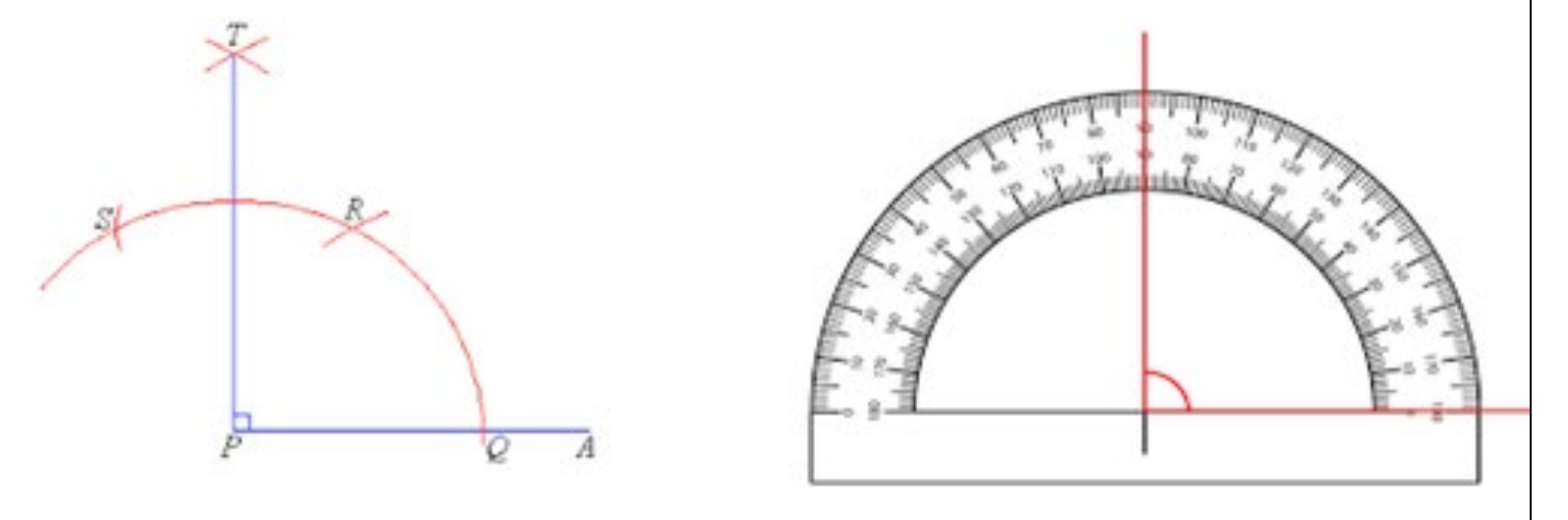
E.g.1: Use a pair of compasses and a ruler to construct an angle of 90˚ (raise a perpendicular at a point) on a given line segment and verify using the protractor. (The line segment PT is perpendicular to PA therefore ∠APT = 90˚)
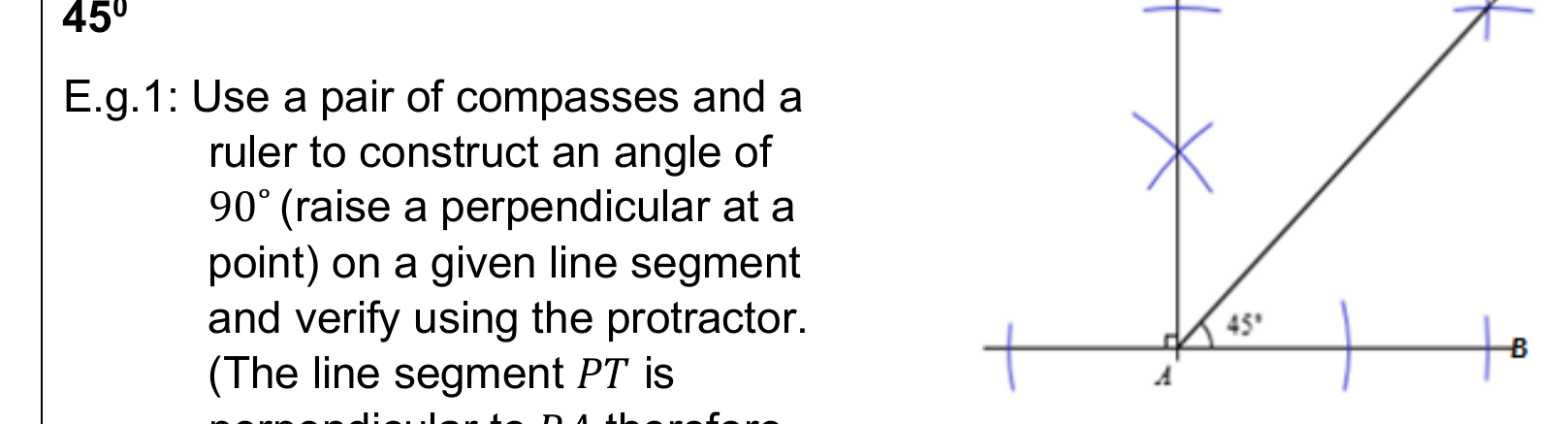
E.g.2: Construct an angle of 45˚ by bisecting an angle of 90˚ (i.e. bisect ∠BAC = 90˚ to obtain ∠BAD = 45˚: line ⃒AD is the angle bisector of the right angle).
(i) Construct ∠ABC = 45˚ such that ⃒AB[] = 5cm and ⃒BC = 6cm: bisect ∠ABC = 45˚
(ii) Construct ∠ABC = 90˚ and bisect it. [UNCLEAR p.55: one glyph in 'such that [] AB [] = 5cm' has no mapping in the font at all and is written []; from the rendered page it is the closing vertical bar of the length notation |AB|, whose opening bar is the combining mark before AB]