SHS1 Mathematics · Semester 1, Week 2
Real Number System
Lesson notes
Learning Objectives
Indicator: 1.1.1.LI.3 - Establish the properties of real numbers with respect to commutative, associative, identity, inverse, distributive, etc.
By the end of the lesson, learners can:
- State the commutative, associative, distributive, identity, and inverse properties of real numbers using correct mathematical vocabulary.
- Verify each property holds for given sets of real numbers by substituting numerical values and showing that both sides of the equation are equal.
- Apply the distributive property to simplify expressions and solve problems involving multiplication and division, such as 108 ÷ 12.
- Identify the additive identity (0), multiplicative identity (1), additive inverse (−a), and multiplicative inverse (1/a) of given real numbers.
- Justify, through pair and group discussions, why each property is true for all real numbers and explain situations where a property does not apply.
Sign in with your phone number to read the full note and download the GES plan - free.
Sign in with phone numberCurriculum details
- Strand
- Numbers for Everyday Life (Strand 1)
- Sub-strand
- Real Number System (1.1)
- Content standard
- 1.1.1.CS.1 - Demonstrate knowledge and understanding of real number systems and the operations of the various subsets. 1.1.1.LO.1 Apply the relationships and differences between the set of rational and irrational numbers and use them to solve problems.
- Indicator
- 1.1.1.LI.3 - Establish the properties of real numbers with respect to commutative, associative, identity, inverse, distributive, etc.
- Suggested placement
-
Semester 1, Week 2
(Week 2 of the year)
Our suggestion, laid out in curriculum order across three terms of twelve weeks. NaCCA does not fix the week, so follow your school's scheme of learning.
- Source document note
-
The official curriculum document has a fault in this entry, so the curriculum text above is transcribed exactly as printed:
- exemplars - p.31: the equation text on this page is set in a CambriaMath subset whose /ToUnicode map doubles every letter and gets many of them wrong, and the glyph ids could not be lined up with the extraction to repair it, so any italic variable here may be doubled or be the wrong letter; read the page
- exemplars - p.31: this exemplar sets a two-dimensional construct - a stacked fraction, an index or a column vector - which the text layer flattens into separate lines, so the parts are present but their vertical arrangement is lost; read the page
- Curriculum reference
- NaCCA curriculum document, p. 31
Exemplars (from the NaCCA curriculum)
Talk for Learning, Think-pair-share, and Group Work/Collaborative Learning.
Enumerate the properties of operations with respect to commutative, associative, distributive, identity, inverse, etc., through Think-pair-share and Group work/collaborative activities. Employ differentiated content and ensure learners' tolerance, truth, honesty, respect for others' views, etc.
Example: Establish (individually, in pairs and in groups) that for any given set of numbers 𝑎𝑎, 𝑏𝑏 𝑎𝑎𝑎𝑎𝑎𝑎 𝑐𝑐 i. 𝑎𝑎 ∗ 𝑏𝑏 = 𝑏𝑏 ∗ 𝑎𝑎; 𝑎𝑎𝑎𝑎𝑎𝑎 𝑎𝑎 + 𝑏𝑏 = 𝑏𝑏 + 𝑎𝑎. 𝑖𝑖𝑖𝑖. 2 ∗ 7 = 7 ∗ 2 = 14; 2 + 7 = 7 + 2 = 9 ii. 𝑎𝑎 ∗ 𝑏𝑏 ∗ 𝑐𝑐 = 𝑐𝑐 ∗ 𝑏𝑏 ∗ 𝑎𝑎; 𝑎𝑎𝑎𝑎𝑎𝑎 𝑎𝑎 + 𝑏𝑏 + 𝑐𝑐 = 𝑐𝑐 + 𝑏𝑏 + 𝑎𝑎. 𝑖𝑖𝑖𝑖. 2 ∗ 3 ∗ 4 = 4 ∗ 3 ∗ 2 = 24; 𝑎𝑎𝑎𝑎𝑎𝑎 2+3+4=4+3+2=9
Example: Investigate using multi-base blocks, Geodot and YouTube videos to establish that for a given set of numbers 𝒂𝒂, 𝒃𝒃 𝑎𝑎𝑎𝑎𝑎𝑎 𝒄𝒄; 1 is the multiplicative identity, and 0 is the additive identity, and extend the knowledge to identity elements, additive and multiplicative inverses as: i. Multiplicative identity element 𝑎𝑎 ∗ 𝑏𝑏 = 𝑏𝑏 ∗ 𝑎𝑎 = 𝑎𝑎, 𝑖𝑖𝑖𝑖. 4 ∗ 1 = 1 ∗ 4 = 4 ( 1 is multiplicative ID element) ii. Additive identity element 𝑎𝑎 + 𝑏𝑏 = 𝑏𝑏 + 𝑎𝑎 = 𝑎𝑎, 𝑖𝑖𝑖𝑖. 4 + (0) = (0) + 4 = 0 (0 is additive ID element) iii. Multiplicative inverse 𝑎𝑎 ∗ 𝑏𝑏 = 𝑏𝑏 ∗ 𝑎𝑎 = 1, 𝑖𝑖𝑖𝑖. 4 ∗ = ∗ 4 = 1 ( is the multiplicative inverse of 4) 1 1 1 4 4 4 iv. Additive inverse 𝑎𝑎 + 𝑏𝑏 = 𝑏𝑏 + 𝑎𝑎 = 0, 𝑖𝑖𝑖𝑖. 4 + (−4) = (−4) + 4 = 0 ((-4) is additive inverse of 4. 𝑖𝑖𝑖𝑖 𝑎𝑎 ∗ 1 = 1 ∗ 𝑎𝑎 = 𝑎𝑎; 𝑎𝑎𝑎𝑎𝑎𝑎 𝑎𝑎 + 0 = 0 + 𝑎𝑎 = 𝑎𝑎.
In small learning groups, using worksheets, establish the distributive property operation and investigate its applications in other areas of knowledge.
Example 1 i.e., Establish that for any three numbers 𝒂𝒂, 𝒃𝒃 𝑎𝑎𝑎𝑎𝑎𝑎 𝒄𝒄, the distributive property connects (∗) 𝑎𝑎𝑎𝑎𝑎𝑎 (+) or (∗) 𝑎𝑎𝑎𝑎𝑎𝑎 (−) as follows i. 𝑎𝑎 ∗ (𝑏𝑏 + 𝑐𝑐) = 𝑎𝑎 ∗ 𝑏𝑏 + 𝑎𝑎 ∗ 𝑐𝑐 , [* is distributed over +) 𝑖𝑖𝑖𝑖. 10 ∗ (6 + 4) = (10 ∗ 6) + (10 ∗ 4) = 100 ii. 𝑎𝑎 ∗ − 𝑐𝑐) = ∗ 𝑏𝑏) − (𝑎𝑎 ∗ 𝑐𝑐), ['*' is distributed over ' -'). (𝑏𝑏 (𝑎𝑎 i.e., solve 108 ÷ 12 Rewrite 108 ÷ 12 as (120 − 12) ÷ 12 This gives 10 - 1 = 9 ∴ 108 ÷ 12 = 9
Example 2: Find the area of the shaded portion in the figure below using the distributive property of operation.
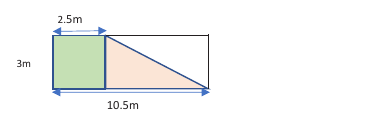
Applying the distributive property, the area of the shaded portion is realised from A= ℎ ∗ (𝑎𝑎 + 𝑏𝑏) = ℎ ∗ 𝑎𝑎 + ℎ ∗ 𝑏𝑏 → 3𝑚𝑚 (2.5𝑚𝑚 + 4𝑚𝑚) = 3𝑚𝑚 ∗ 2.5𝑚𝑚 + 3𝑚𝑚 ∗ 4𝑚𝑚 → 3𝑚𝑚(6.5𝑚𝑚) = 7.5𝑚𝑚 2 + 12𝑚𝑚 2 2 2 19.5𝑚𝑚 =19.5𝑚𝑚 LHS=RHS
Example 3: Using distributive property, solve 108 ÷ 12 Rewrite 108 ÷ 12 as (108 + 12 − 12) ÷ 12 = (120 − 12) ÷ 12 = 10 − 1 = 9 108 ÷ 12 = 9
Teaching and Learning Resources:
- Fractional boards
- square or grid paper
- multi-base blocks
- algebraic tiles
- video clips
- cardboards
- models
- SHS Mathematics curriculum
- Technology tools: computer, mobile phone, calculator, YouTube videos, etc.
- Number line
- Number track
- Wheel of Theodorus.
- Twine
- cylinders
- Tape measure or rule.
Assessment (1.1.1.AS.3). The document marks these depth-of-knowledge levels for this indicator: Level 3 Strategic reasoning.