SHS1 Mathematics · Semester 1, Week 5
Real Number System
Lesson notes
Learning Objectives
Indicator: 1.1.1.LI.3 - Establish the relationship between and among three sets, including set equations and de Morgan’s law.
By the end of the lesson, learners can:
- State de Morgan’s laws for two sets and three sets using complement, union and intersection notation.
- Verify set identities (commutative, associative, distributive, and de Morgan’s laws) using Venn diagrams and set algebra with three sets.
- Apply the inclusion-exclusion principle n(A ∪ B ∪ C) = n(A) + n(B) + n(C) − [n(A∩B) + n(A∩C) + n(B∩C)] + n(A∩B∩C) to solve problems involving three sets.
- Use set equations to solve real-world problems involving up to three sets and present solutions clearly.
- Justify the truth of a set identity by showing each algebraic step or by shading Venn diagrams correctly.
Sign in with your phone number to read the full note and download the GES plan - free.
Sign in with phone numberCurriculum details
- Strand
- Numbers for Everyday Life (Strand 1)
- Sub-strand
- Real Number System (1.1)
- Content standard
- 1.1.1.CS.2 - Demonstrate knowledge and understanding of real number systems with respect to the concepts and vocabulary of sets, establish their relationships and carry out simple surveys using the properties of sets. 1.1.1.LO.2 Analyse and solve real world problems involving union, intersection and complements of sets and apply these to three sets of problems using simple surveys.
- Indicator
- 1.1.1.LI.3 - Establish the relationship between and among three sets, including set equations and de Morgan's law.
- Suggested placement
-
Semester 1, Week 5
(Week 5 of the year)
Our suggestion, laid out in curriculum order across three terms of twelve weeks. NaCCA does not fix the week, so follow your school's scheme of learning.
- Curriculum reference
- NaCCA curriculum document, p. 35
Exemplars (from the NaCCA curriculum)
Using Think-pair-share in an interactive and learner-centred classroom, model and resolve real-life problems using equations involving two and three sets and de Morgan's law. Employ
differentiated assessment and ensure values such as tolerance, truth, honesty, respect for others' views, etc., among learners.
Example Note: 1. (𝐴 ∪ 𝐵) ' = 𝐴 ' ∩ 𝐵 ' 2. (𝐴 ∩ 𝐵) ' = 𝐴' ∪ 𝐵' 3. (𝐴 ∪ 𝐵 ∪ 𝐶) ' = 𝐴 ' ∩ 𝐵 ' ∩ 𝐶 ' 4. (𝐴 ∩ 𝐵 ∩ 𝐶) ' = 𝐴' ∪ 𝐵' ∪ 𝐶'
In mixed groupings (gender/ability), engage learners to establish set identities, including commutative, associative, and distributive properties on set operations, sets algebra and apply them.
Experiential Learning: Learners will collaboratively be engaged in hands-on activity to create set problems and apply set identities, algebra and operations to solve them.
Example 1: Use algebra to verify that for any three Sets A, B and C, the following properties are true.
i. Commutative Properties AUB = BUA A∩B = B∩A
Distributive Properties: A∪(B∩ C) = (A ∪B)∩(A ∪C); A∩(B∪C) = (A∩ B)∪(A ∩C ii.
iii. Associative properties: A∩(B∩ C) = (A ∩B)∩ C; A∪(B∪C) = (A∪B)∪C)
iv. Other properties: n(A∪B)=n(A)+n(B)−n(A∩B)
n(A∪B∪C)=n (A)+n(B)+n(C)−[n(A∩B)+n(A∩C)+n(B∩C)]+n(A∩B∩C)
Example 2: Learners in small convenient groups (mixed gender, mixed-ability, etc.) investigate and establish set identities and use Venn diagrams to verify that for any three Sets A, B and C:
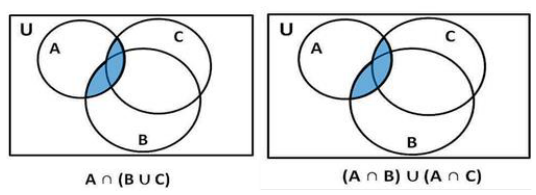
i. AUB = BUA ii. A∪(B∩ C) = (A ∪B)∩(A ∪C) A∩(B∪C) = (A∩ B)∪(A ∩C) iii.
Example of illustration of A∩(B∪C) = (A∩ B)∪(A ∩C) in the Venn diagram
Inter-group competition: Learners from one group create real-life problems involving up to 3 sets whilst the other group applies set algebra, set operations and set identities to solve the problems. Group switch roles.
Example: A pharmaceutical company is considering manufacturing new toothpaste. They are considering two charcoal flavours, strawberry and mint. In a sample of 74 people, it was found that
45 liked strawberry 37 liked mint 21 liked both types
Create a Venn diagram to model the information.
How many liked only strawberries?
How many liked only mint?
How many liked exactly one of the two (that is, they liked one but not the other)?
Using collaborative strategy, engage learners to apply the knowledge of the Venn diagram to solve everyday set-related problems. Encourage differentiation.
Example: Carry out a survey (school or community-based) to establish the blood groups of humans using the antigens A, B and RhD+. i.e., Blood groups: 𝑈 = { 𝑔𝑟𝑜𝑢𝑝 𝑨, 𝑔𝑟𝑜𝑢𝑝 𝑩, 𝑔𝑟𝑜𝑢𝑝 𝑹𝒉𝑫} 𝑨 = { 𝐴 + , 𝐴 − , 𝐴𝐵 + 𝐴𝐵 − } 𝑩 = { 𝐵 + , 𝐵 − , 𝐴𝐵 + 𝐴𝐵 − } + RhD = { 𝑅ℎ𝐷 } and to present their findings in class to be peer-reviewed by colleagues.
Note: The Biology Department/ health facility needs to be involved in order to further interpret the concepts for lifelong usage.
Teaching and Learning Resources:
- * GeoGebra (free software) * video clips * cardboards
- * models * SHS Mathematics curriculum * Fractional boards
- * square or grid paper * multi-base blocks * algebraic tiles
Assessment (1.1.1.AS.3). The document marks no depth-of-knowledge level for this indicator.