B4 Mathematics · Term 2, Week 4
Ratios and Proportion
Lesson notes
Learning Objectives
Indicator: B4.1.4.1.3 - Use models to explain the result of addition and subtraction of decimals (up to hundredths)
By the end of the lesson, learners can:
- Convert decimals to fractions with denominator 100 (or 10) in order to add or subtract them.
- Use a 100-square grid model to show the sum or difference of two decimals up to hundredths.
- Line up decimal points correctly when adding or subtracting decimals in vertical form, then add or subtract as whole numbers.
- Solve word problems involving addition and subtraction of decimals up to hundredths in everyday situations.
Sign in with your phone number to read the full note and download the GES plan - free.
Sign in with phone numberCurriculum details
- Strand
- Number (Strand 1)
- Sub-strand
- Ratios and Proportion (1.4)
- Content standard
- B4.1.4.1 - Develop an understanding of decimals (tenths and hundredths) using concrete and pictorial representations and write decimal fractions as base ten numbers with place value.
- Indicator
- B4.1.4.1.3 - Use models to explain the result of addition and subtraction of decimals (up to hundredths) 64 39 64+39 103
- Suggested placement
-
Term 2, Week 4
(Week 16 of the year)
Our suggestion, laid out in curriculum order across three terms of twelve weeks. NaCCA does not fix the week, so follow your school's scheme of learning.
- Source document note
-
The official curriculum document has a fault in this entry, so the curriculum text above is transcribed exactly as printed:
- exemplars - p.27
- Curriculum reference
-
Mathematics Curriculum for Primary Schools (Basic 4-6), 2019, p. 27
Transcribed from the official NaCCA publication. Check this page against the source.
Exemplars (from the NaCCA curriculum)
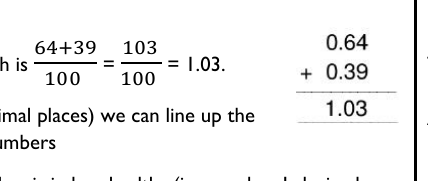
E.g. 1. To add 0.64 and 0.39, means sum 64/100 + 39/100 which is 64+39/100 = 103/100 = 1.03. That is, since both are hundredths fractions (i.e. have 2 decimal places) we can line up the decimal points to align the place values and add as whole numbers
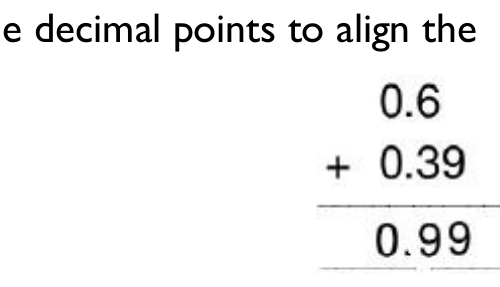
E.g. 2. To add 0.6 and 0.39, one number is in tenths and other is in hundredths (i.e. one has 1 decimal place and the other 2 decimal places) it is important to line up the decimal points to align the place values and add as whole numbers
E.g. 3. To subtract 0.6 from 1.39, means 139/100 - 6/10 = 139/100 - 60/100 = 139-60/100 = 79/100 = 0.79. That is, since one number is in tenths and other is in hundredths (i.e. one has 1 decimal place and the other 2 decimal places) it is important to line up the decimal points to align the place values and subtract as whole numbers.

The fractions are stacked and are written inline. The three column sums (0.64 + 0.39, 0.6 + 0.39, 1.39 - 0.6) are set to the right of the exemplars and are shown in the figures.