SHS1 Mathematics · Semester 1, Week 6
Proportional Reasoning
Lesson notes
Learning Objectives
Indicator: 1.1.2.LI.1 - Establish the concept of fractions and investigate the connections between fractions and decimal numbers.
By the end of the lesson, learners can:
- Define a fraction as a part of a whole and identify the numerator and denominator in both proper and improper fractions.
- Convert terminating decimals to fractions and fractions to terminating decimals using the place value of digits and equivalent fractions.
- Convert terminating decimals to percentages and percentages to terminating decimals by using the fact that percent means “out of 100”.
- Convert fractions to percentages (and vice versa) by first converting to decimal form, then scaling by 100.
- Model and solve at least one daily-life problem involving conversion between fractions, decimals, and percentages, showing all working steps clearly.
Sign in with your phone number to read the full note and download the GES plan - free.
Sign in with phone numberCurriculum details
- Strand
- Numbers for Everyday Life (Strand 1)
- Sub-strand
- Proportional Reasoning (1.2)
- Content standard
- 1.1.2.CS.1 - Demonstrate an understanding of proportional reasoning involving fractions and its operations and use it to solve real-life problems, including rounding off (decimal places and significant figures). 1.1.2.LO.1 Make connections between fractions and decimals and use them to solve daily problems.
- Indicator
- 1.1.2.LI.1 - Establish the concept of fractions and investigate the connections between fractions and decimal numbers.
- Suggested placement
-
Semester 1, Week 6
(Week 6 of the year)
Our suggestion, laid out in curriculum order across three terms of twelve weeks. NaCCA does not fix the week, so follow your school's scheme of learning.
- Source document note
-
The official curriculum document has a fault in this entry, so the curriculum text above is transcribed exactly as printed:
- exemplars - p.45: this exemplar sets a two-dimensional construct - a stacked fraction, an index or a column vector - which the text layer flattens into separate lines, so the parts are present but their vertical arrangement is lost; read the page
- Curriculum reference
- NaCCA curriculum document, p. 45
Exemplars (from the NaCCA curriculum)
Problem-based Learning; Collaborative Learning: In an interactive and collaborative grouping, establish the connections among fractions, decimals and percentages, then model and solve problems on daily transactions using these connections. Employ differentiated assessment and ensure values such as tolerance, truth, honesty, respect for others' views, etc., among learners.
Example: Identify decimal names of given fractions; convert fractious to decimals (and vice versa); and convert decimals to percentages (and vice versa) 1. Convert fractions to decimals and percentages (and vice versa) and use these representations in estimations, computations, and applications. i.e. 0.5 5 1 i. If 0.5 = = = ; then 0.25 = ? 1 10 2 1 1 5 5 0.5 1 ii. If = ∗ = = = 0.5 ; then = ? 2 2 5 10 1 4 iii. Convert 0,5454... into a fraction.
2. Establish percentage as the number of parts in every 100; use fractions and percentages to describe parts of shapes, quantities and measures. i.e. 1 100 a) = 0.5, =; 0.5 ∗ = 50% 2 100 1 100 b) = 0.25, ; 0.25 ∗ = 25% 4 100 5 15 1 i. Convert , , 1.45, 3 into percentages. 9 75 4 ii. Suglo has 20 items on her shopping list. She checks her list and finds that she has completed 40% of her shopping. Determine how many more items she has to buy.
Through collaborative group activity, enumerate the steps for converting mixed number percent into fractions and solve real life problems involving mixed numbers.
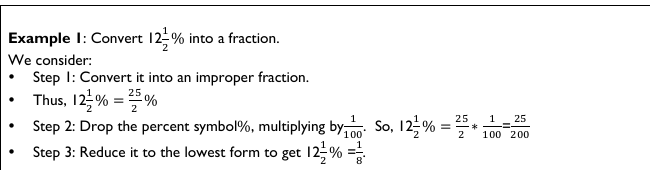
1 Example 1: Convert 12 % into a fraction. 2 We consider:
- Step 1: Convert it into an improper fraction. 1 25
- Thus, 12 % = % 2 2 1 1 25 1 25
- Step 2: Drop the percent symbol%, multiplying by . So, 12 % = ∗ = 100 2 2 100 200 1 1
- Step 3: Reduce it to the lowest form to get 12 % = . 2 8
Example 2 i. Add, subtract, multiply, and divide rational numbers (integers, fractions). Express positive rational numbers to whole-number powers. 2 2 i.e., To add mixed fractions, such as. 2 and 1 , we first add the whole numbers and then add the 5 3 fractions; 2 2 6 10 6+10 16 1 i.e. 2 + 1 + + = 3 + + = 3 = 3 = 4 5 3 15 15 15 15 15
ii. Solve a variety of word problems involving addition or subtraction of fractions.
Teaching and Learning Resources:
- fractional boards
- square or grid paper
- multi-base blocks
- algebraic tiles
- video clips
- cardboards
- models
- SHS Mathematics curriculum
Assessment (1.1.2.AS.1). The document marks these depth-of-knowledge levels for this indicator: Level 3 Strategic reasoning.