SHS1 Mathematics · Semester 1, Week 7
Proportional Reasoning
Lesson notes
Learning Objectives
Indicator: 1.1.2.LI.2 - Establish additive and multiplicative inverses of fractions using multi-purpose model charts.
By the end of the lesson, learners can:
- Use a multi-purpose model chart to locate the additive inverse of a given fraction and explain the pattern they observe.
- Use a multi-purpose model chart to locate the multiplicative inverse (reciprocal) of a given fraction and explain the pattern they observe.
- State the additive inverse and multiplicative inverse of any given fraction without a chart, and verify by performing the relevant operation.
- Apply additive and multiplicative inverses to solve simple equations involving fractions in everyday contexts.
Sign in with your phone number to read the full note and download the GES plan - free.
Sign in with phone numberCurriculum details
- Strand
- Numbers for Everyday Life (Strand 1)
- Sub-strand
- Proportional Reasoning (1.2)
- Content standard
- 1.1.2.CS.1 - Demonstrate an understanding of proportional reasoning involving fractions and its operations and use it to solve real-life problems, including rounding off (decimal places and significant figures). 1.1.2.LO.1 Make connections between fractions and decimals and use them to solve daily problems.
- Indicator
- 1.1.2.LI.2 - Establish additive and multiplicative inverses of fractions using multi-purpose model charts.
- Suggested placement
-
Semester 1, Week 7
(Week 7 of the year)
Our suggestion, laid out in curriculum order across three terms of twelve weeks. NaCCA does not fix the week, so follow your school's scheme of learning.
- Source document note
-
The official curriculum document has a fault in this entry, so the curriculum text above is transcribed exactly as printed:
- exemplars - p.47: this exemplar sets a two-dimensional construct - a stacked fraction, an index or a column vector - which the text layer flattens into separate lines, so the parts are present but their vertical arrangement is lost; read the page
- Curriculum reference
- NaCCA curriculum document, p. 47
Exemplars (from the NaCCA curriculum)
Through collaborative group activity, find the multiplicative inverse of a chosen number. Example:
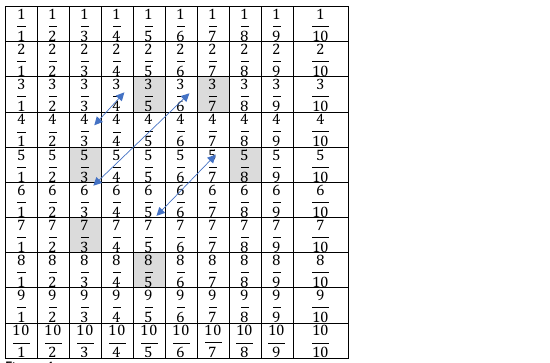
 1 1 1 1 1 1 1 1 1 1 1 2 3 4 5 6 7 8 9 10 2 2 2 2 2 2 2 2 2 2 1 2 3 4 5 6 7 8 9 10 3 3 3 3 3 3 3 3 3 3 1 2 3 4 5 6 7 8 9 10 4 4 4 4 4 4 4 4 4 4 1 2 3 4 5 6 7 8 9 10 5 5 5 5 5 5 5 5 5 5 1 2 3 4 5 6 7 8 9 10 6 6 6 6 6 6 6 6 6 6 1 2 3 4 5 6 7 8 9 10 7 7 7 7 7 7 7 7 7 7 1 2 3 4 5 6 7 8 9 10 8 8 8 8 8 8 8 8 8 8 1 2 3 4 5 6 7 8 9 10 9 9 9 9 9 9 9 9 9 9 1 2 3 4 5 6 7 8 9 10 10 10 10 10 10 10 10 10 10 10 1 2 3 4 5 6 7 8 9 10 Figure:6
Teaching and Learning Resources:
- fractional boards
- square or grid paper
- multi-base blocks
- algebraic tiles
- video clips
- cardboards
- models
- SHS Mathematics curriculum
Assessment (1.1.2.AS.2). The document marks these depth-of-knowledge levels for this indicator: Level 2 Skills of conceptual understanding.