B4 Mathematics · Term 3, Week 3
Position / Transformation
Lesson notes
Learning Objectives
Indicator: B4.3.2.1.1 - Tell the position and motion of objects in space using the cardinal points north, south, east and west
By the end of the lesson, learners can:
- Identify the four cardinal points (north, south, east, west) and state their positions relative to one another on a simple diagram.
- Describe the position of a given object or point using the cardinal points, for example, “Point P is to the west of Point T.”
- Describe the motion of an object from one location to another using directional language, such as “moving north” or “travelling east.”
- Locate and name points on a coordinate grid using ordered pairs, such as (2, 3) and (−2, 4).
- Use cardinal directions to solve simple problems involving movement between places on a map or grid.
Sign in with your phone number to read the full note and download the GES plan - free.
Sign in with phone numberCurriculum details
- Strand
- Geometry and Measurement (Strand 3)
- Sub-strand
- Position / Transformation (3.2)
- Content standard
- B4.3.2.1 - Describe the position of objects in space using the cardinal points
- Indicator
- B4.3.2.1.1 - Tell the position and motion of objects in space using the cardinal points north, south, east and west
- Suggested placement
-
Term 3, Week 3
(Week 27 of the year)
Our suggestion, laid out in curriculum order across three terms of twelve weeks. NaCCA does not fix the week, so follow your school's scheme of learning.
- Source document note
-
The official curriculum document has a fault in this entry, so the curriculum text above is transcribed exactly as printed:
- exemplars - p.38
- Curriculum reference
-
Mathematics Curriculum for Primary Schools (Basic 4-6), 2019, p. 38
Transcribed from the official NaCCA publication. Check this page against the source.
Exemplars (from the NaCCA curriculum)
E.g. 1. Put pupils in convenient groups a give each group with a worksheet on graph with different labelled coordinates; some with axes labelled and other not etc. Pupils discuss their worksheets in their groups, then with whole class, describing coordinates, axes and pointing out errors on graphs if any
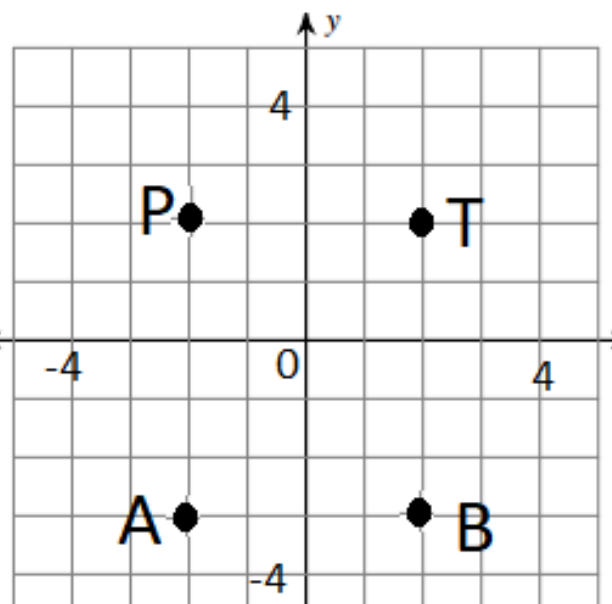
E.g. 2. Pupils describe the position and motion of objects: e.g. The point P is to the west of point T but to the north of the A
E.g. 3. Ask learners to locate the coordinates (i.e. ordered pairs of the location) of the Points; e.g. B is (2,- 3) and T is (2,2)
Printed p.46 reprints this whole row - the same content standard text, the same indicator text and the same three exemplars - under a second heading also numbered "Sub-strand 3", and codes it B4.3.3.1 / B4.3.3.1.1, which collides with the perimeter standard on printed p.39. It is transcribed once, from p.38, where the code B4.3.2.1.1 agrees with the Sub-strand 2 heading above it.