JHS1 Mathematics · Term 3, Week 8
Position and Transformation
Lesson notes
Learning Objectives
Indicator: B7.3.3.1.4
By the end of the lesson, learners can:
- State the conditions that make two shapes congruent and two shapes similar, using the properties of corresponding sides and angles.
- Verify whether given pairs of shapes in the coordinate plane are congruent, similar, or neither, by comparing side lengths and angle sizes.
- Identify congruent and similar shapes in real-life Ghanaian designs such as kente cloth patterns, carpets, tiles, and building decorations.
- Apply their understanding to describe the relationship between an object and its image after reflection or translation in terms of congruence.
- Justify their reasoning using coordinate geometry, explaining which properties (side length, angle size, orientation) were compared.
Sign in with your phone number to read the full note and download the GES plan - free.
Sign in with phone numberCurriculum details
- Strand
- Geometry and Measurement (Strand 3)
- Sub-strand
- Position and Transformation (3.3)
- Content standard
- B7.3.3.1 - Perform a single transformation (i.e. reflection and translation) on a 2D shape using graph paper (including technology) and describe the properties of the image under the transformation (i.e. congruence, similarity, etc.)
- Indicator
- B7.3.3.1.4 - Verify the concept of congruent and similar shapes in coordinate plane using properties of both the object(s) and image(s); and in real life situations (carpet designs, fabric pattern)
- Suggested placement
-
Term 3, Week 8
(Week 32 of the year)
Our suggestion, laid out in curriculum order across three terms of twelve weeks. NaCCA does not fix the week, so follow your school's scheme of learning.
- Curriculum reference
-
Mathematics, Common Core Programme (JHS1-JHS3), 2023, p. 76
Transcribed from the official NaCCA publication. Check this page against the source.
Exemplars (from the NaCCA curriculum)
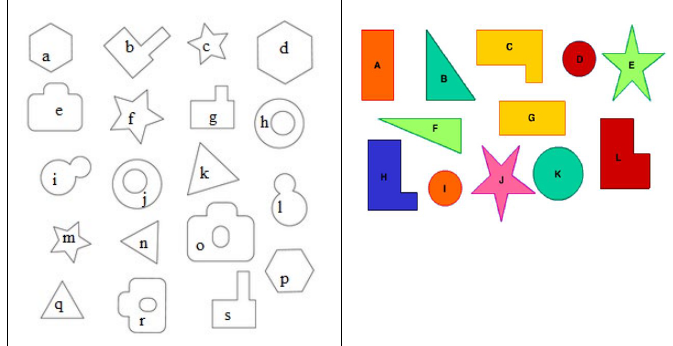
E.g. 1: Verify which shapes are similar and which are congruent.
E.g. 2. Which of the following shapes are congruent?