JHS3 Mathematics · Term 2, Week 1
Number: Ratios and Proportion
Lesson notes
Learning Objectives
Indicator: B9.1.4.1.2 - Use proportional relationships to solve multistep ratio and percent problems, examples: simple interest, tax, discount and commissions, NHIL, depreciation, insurance, etc.
By the end of the lesson, learners can:
- Apply the simple interest formula (I = PRT/100) to calculate interest and total amount on deposits and loans.
- Determine the original (basic) price of an item when given a VAT-inclusive price and the VAT rate, and compute the VAT paid.
- Calculate the new price of an item after a discount and compute the commission earned on a sale.
- Compute the value of an asset after depreciation over multiple years using given percentage rates.
- Solve multistep problems involving NHIL and insurance premiums by setting up and solving proportional equations.
Sign in with your phone number to read the full note and download the GES plan - free.
Sign in with phone numberCurriculum details
- Strand
- Number (Strand 1)
- Sub-strand
- Number: Ratios and Proportion (1.4)
- Content standard
- B9.1.4.1 - Apply the understanding of ratio, rate and proportions to solve problems that involve rates, ratios, and proportional reasoning and use it to solve real- world mathematical problems.
- Indicator
- B9.1.4.1.2 - Use proportional relationships to solve multistep ratio and percent problems, examples: simple interest, tax, discount and commissions, NHIL, depreciation, insurance, etc.
- Suggested placement
-
Term 2, Week 1
(Week 13 of the year)
Our suggestion, laid out in curriculum order across three terms of twelve weeks. NaCCA does not fix the week, so follow your school's scheme of learning.
- Curriculum reference
-
Mathematics, Common Core Programme (JHS1-JHS3), 2023, p. 175
Transcribed from the official NaCCA publication. Check this page against the source.
Exemplars (from the NaCCA curriculum)
E.g.1 Solve problems on simple interest.
i. A girl deposited GH₵ 4500 at the bank at a rate of 3% per annum for three years. Find the simple interest. What is the amount at the end of the fifth year?
E.g.2 Solve problems on tax (VAT).
i. The VAT rate of Ghana is 12.5%. A man bought an item at GH₵ 4500.00, VAT inclusive. Calculate:
b) the basic cost of the item.
c) the VAT paid by the man.
E.g.3 Solve problems on discount.
i. If a car costs GH₵ 80,500.00,what is its new value if there is a discount of 10%?
E.g.4 Solve problems on commission.
ii. A car agent's commission on the sale of a car is 3 1 %. Calculate the 2
commission on a car sold for GH₵68,000.00.
E.g.5 solve problems involving depreciation. The value of a mobile phone depreciates at the following rate:
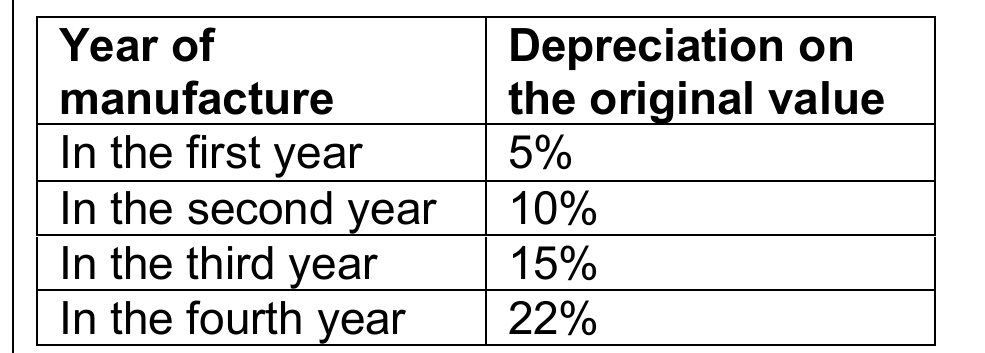
Year of Depreciation on manufacture the original value In the first year 5% In the second year 10% In the third year 15% In the fourth year 22%
The original value of the mobile phone is GH₵ 1800.00. Find the value of the mobile phone at the end of each of the first four years.
E.g.6 Solve problems involving NHIL.
i. The NHIL inclusive price of a television set is GH₵1200.00. If the NHIL is charged at a rate of 2.5%, find
b) the cost of the television set (NHIL exclusive).
c) the NHIL charged.
E.g.7 Solve problems involving insurance.
i. Kofi Mereku insured his house and paid a premium of GH₵ 30,000.00. If the insurance company fixed the rate at 5% of the value of the house, calculate the insured value of the house.