JHS2 Mathematics · Term 1, Week 11
Number Operations
Lesson notes
Learning Objectives
Indicator: B8.1.2.3.4 - Solve real life problems involving powers of natural numbers.
By the end of the lesson, learners can:
- Identify situations in real life where powers of natural numbers are used, such as population growth, family trees, and business expansion.
- Represent real-life problems using expressions in the form aⁿ, and state clearly what the base (a) and the exponent (n) represent in that context.
- Construct tables of values and draw graphs to show how quantities grow according to powers of natural numbers.
- Write equations of the form y = aⁿ to model a given real-life situation and use them to calculate unknown values.
- Apply the laws of indices learned in Week 10 (such as aᵐ × aⁿ = aᵐ⁺ⁿ) to simplify and solve real-life problems involving powers of natural numbers.
Sign in with your phone number to read the full note and download the GES plan - free.
Sign in with phone numberCurriculum details
- Strand
- Number (Strand 1)
- Sub-strand
- Number Operations (1.2)
- Content standard
- B8.1.2.3 - Demonstrate understanding and the use of the laws of indices in solving problems (including real life problems) involving powers of natural numbers
- Indicator
- B8.1.2.3.4 - Solve real life problems involving powers of natural numbers.
- Suggested placement
-
Term 1, Week 11
(Week 11 of the year)
Our suggestion, laid out in curriculum order across three terms of twelve weeks. NaCCA does not fix the week, so follow your school's scheme of learning.
- Curriculum reference
-
Mathematics, Common Core Programme (JHS1-JHS3), 2023, p. 101
Transcribed from the official NaCCA publication. Check this page against the source.
Exemplars (from the NaCCA curriculum)
E.g.1: Solve real-life problems on populations. While studying her family's history, Saratu discovers records of ancestors 12 generations back. She wonders how many ancestors she has had in the past 12 generations. She starts to make a diagram to help her figure this out. The diagram soon becomes very complex.
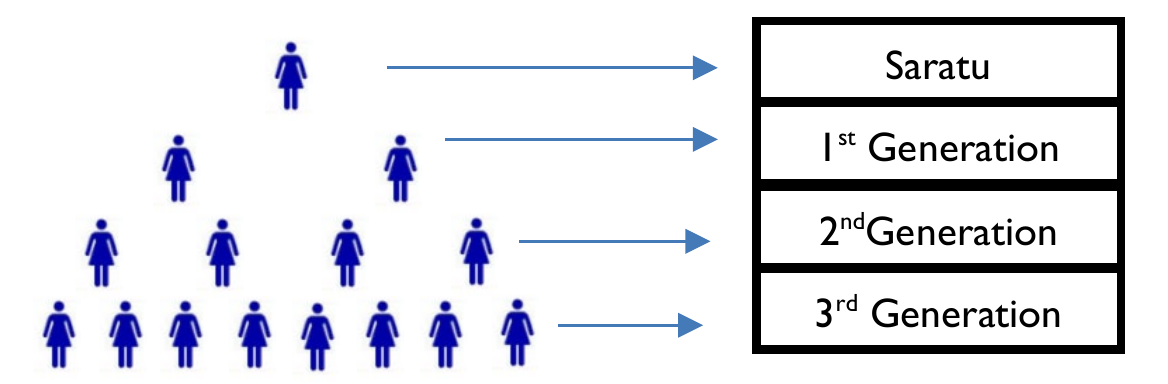
Saratu
1 st Generation 2 nd Generation 3 rd Generation
i. Make a table and a graph showing the number of ancestors in each of the 12 generations.
ii. Write an equation for the number of ancestors in a given generation n.