JHS1 Mathematics · Term 1, Week 5
Number Operations
Lesson notes
Learning Objectives
Indicator: B7.1.2.2.2 - Multiply or divide multi-digit numbers by 1- and 2- digit numbers
By the end of the lesson, learners can:
- Multiply multi-digit whole numbers by 1-digit numbers using partitioning and the vertical place value method.
- Multiply multi-digit whole numbers by 2-digit numbers using the vertical place value method and the distributive property.
- Use divisibility tests for 2, 3, 4, 5, 6, 9 and 10 to determine whether a given number is divisible by another.
- Divide multi-digit numbers by 1- and 2-digit numbers using long division, checking answers by multiplication.
- Apply multiplication and division of multi-digit numbers to solve real-life problems involving quantities and money.
Sign in with your phone number to read the full note and download the GES plan - free.
Sign in with phone numberCurriculum details
- Strand
- Number (Strand 1)
- Sub-strand
- Number Operations (1.2)
- Content standard
- B7.1.2.2 - Demonstrate an understanding of addition, subtraction, multiplication and division of (i) whole numbers, and (ii) decimal numbers, to solve problems.
- Indicator
- B7.1.2.2.2 - Multiply or divide multi-digit numbers by 1- and 2- digit numbers
- Suggested placement
-
Term 1, Week 5
(Week 5 of the year)
Our suggestion, laid out in curriculum order across three terms of twelve weeks. NaCCA does not fix the week, so follow your school's scheme of learning.
- Source document note
-
The official curriculum document has a fault in this entry, so the curriculum text above is transcribed exactly as printed:
- indicator text - p.10: the code is printed 'B71.2.2.2', with the stop after the grade token missing
- Curriculum reference
-
Mathematics, Common Core Programme (JHS1-JHS3), 2023, p. 10
Transcribed from the official NaCCA publication. Check this page against the source.
Exemplars (from the NaCCA curriculum)
E.g.1 Use partitioning/expanded form to multiply and divide efficiently
i) Multiply 584 by 8 584 = (500+ 80+4) × 8 = x8 4,000+640+32
4,672 = 4,672
E.g.2. Multiply whole numbers using the vertical place value method or lattice method:
i. Place value method: 345 x 27 = 345 x27 2,415
+ 6,900 9,315
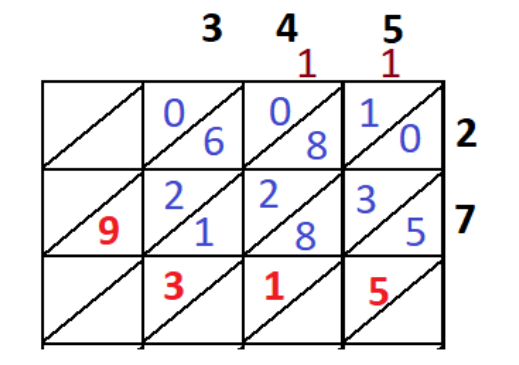
Lattice method: Draw a 2 by 3 lattice for solving 345 × 27.
E.g.3 Use the distributive property to multiply 325 by 15. =325 x (10 + 5) = (325 x 10) + (325 x 5) =3,250 + 1,625 =4,875
E.g.4 Investigate and determine basic division facts including divisibility test.
(i) determine how a given number is divisible by 2,3, 4, 5, 6, 7 8, 9,10, etc. For example, a number is divisible by 3 if the sum of its digits is divisible by 3. So, 72 is divisible by 3 because 7+2 = 9. Hence since 9 is divisible by 3, then 72 is divisible by 3. Also, to find out if a number is divisible by 7, take the last digit in the number then double it and subtract from the rest of the number. If the answer is 0 or a multiple of 7, then the number is divisible by 7. So, 595 is divisible by 7 because 5 x 2 =10. 59 - 10 = 49. Therefore, 595 is divisible by 7.