JHS1 Mathematics · Term 1, Week 8
Number Operations
Lesson notes
Learning Objectives
Indicator: B7.1.2.3.5 - Apply the concept of powers of numbers (product of prime) to find Highest Common Factor (HCF).
By the end of the lesson, learners can:
- Express a given natural number as a product of its prime factors using the factor tree or division method.
- Identify common prime factors from the product of prime forms of two or more numbers.
- Find the Highest Common Factor (HCF) of two or more numbers using the product of prime factors approach.
- Solve real-life problems involving the HCF, such as cutting items into equal pieces or grouping items evenly.
- Justify why the HCF is the largest number that divides each given number without leaving a remainder.
Sign in with your phone number to read the full note and download the GES plan - free.
Sign in with phone numberCurriculum details
- Strand
- Number (Strand 1)
- Sub-strand
- Number Operations (1.2)
- Content standard
- B7.1.2.3 - Demonstrate understanding and the use of powers of natural numbers in solving problems.
- Indicator
- B7.1.2.3.5 - Apply the concept of powers of numbers (product of prime) to find Highest Common Factor (HCF).
- Suggested placement
-
Term 1, Week 8
(Week 8 of the year)
Our suggestion, laid out in curriculum order across three terms of twelve weeks. NaCCA does not fix the week, so follow your school's scheme of learning.
- Curriculum reference
-
Mathematics, Common Core Programme (JHS1-JHS3), 2023, p. 15
Transcribed from the official NaCCA publication. Check this page against the source.
Exemplars (from the NaCCA curriculum)
E.g.1 Expand a given number using product of prime concept.
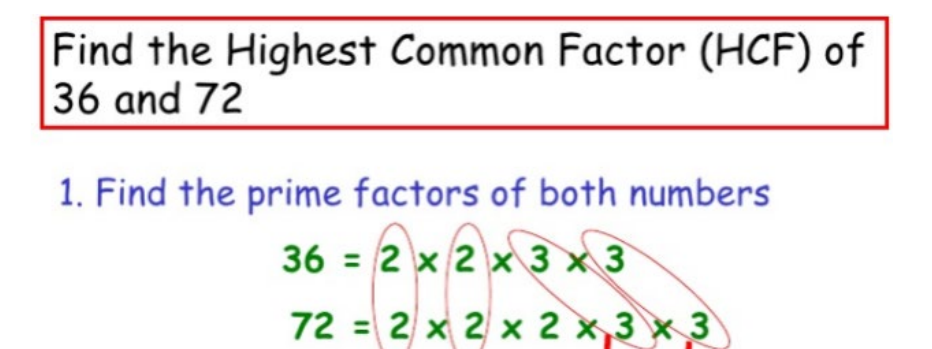
E.g. 2 HCF Real life example: Akweley has two pieces of paper. One piece is 24 cm wide and the other piece is 30 cm wide. She wants to cut both pieces into strips of equal width that are as wide as possible. How wide should she cut the strips? Answer: This problem can be solved using H.C.F. because we are cutting or "dividing" the strips of cloth into smaller pieces (Factor) of 24 and 30 (Common) and we are looking for the widest possible strips (Highest). So, H.C.F. of 24 and 30 is 6 So we can say that Akweley should cut each piece to be 18 cm wide.
E.g. 3. LCM Real life example Baba exercises every 12 days and Serwa every 8 days. Baba and Serwa both exercised today. How many days will it be until they exercise together again? Answer: This problem can be solved using Least Common Multiple because we are trying to figure out when the soonest (Least) time will be that as the event of exercising continues (Multiple), it will occur at the same time (Common). So, L.C.M. of 12 and 8 is 24. So, they will exercise together again in 24 day