B6 Mathematics · Term 1, Week 9
Number Operations
Lesson notes
Learning Objectives
Indicator: B6.1.2.1.2 - Apply mental mathematics strategies for multiplication, such as annexing then adding zero halving and doubling using the distributive property
By the end of the lesson, learners can:
- Determine products when one factor is a multiple of 10, 100, or 1000 by annexing zeros, explaining the pattern they see (e.g., 3 × 200 = 600 by thinking 3 × 2 then adding two zeros).
- Apply the halving and doubling strategy to find products mentally, showing how a simpler fact can replace a harder one (e.g., 32 × 5 = 16 × 10 = 160).
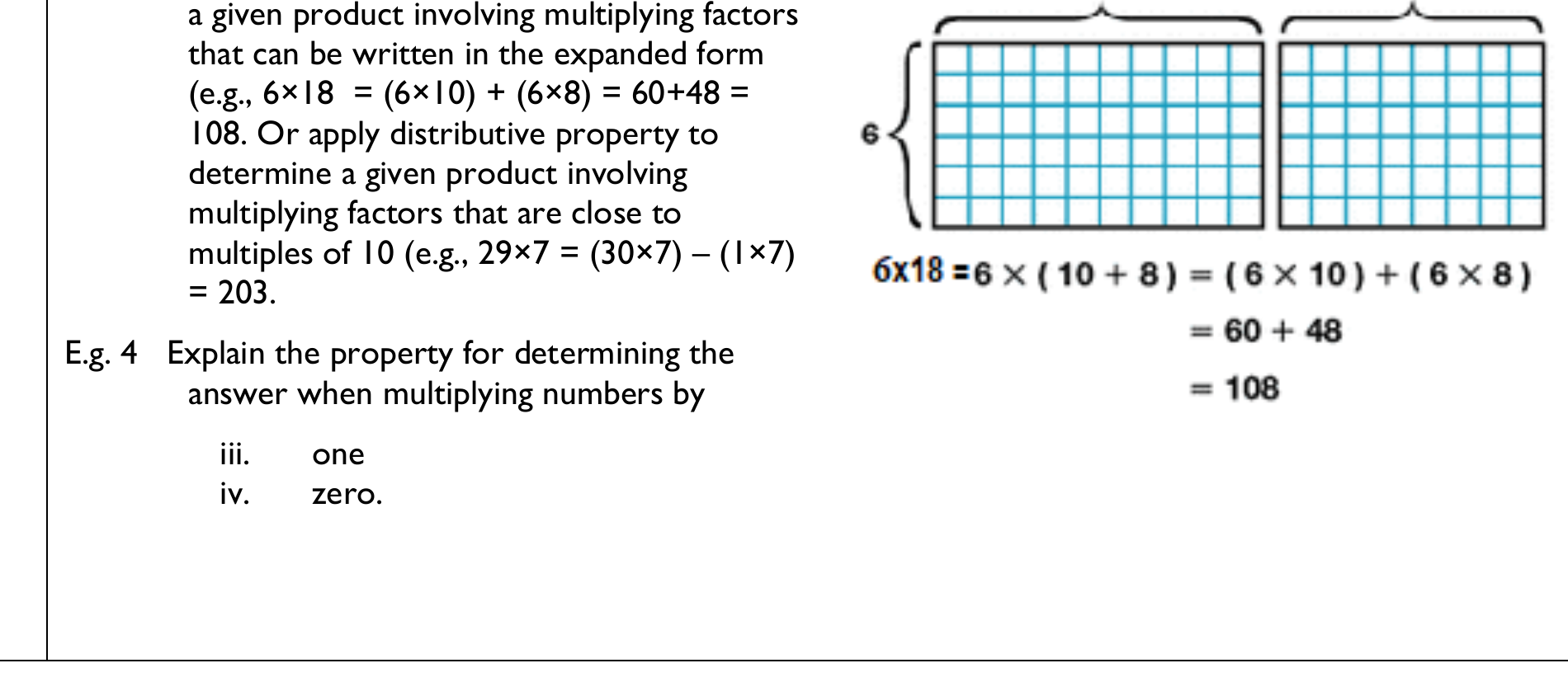
- Use the distributive property in expanded form to multiply a 1-digit number by a 2-digit number (e.g., 6 × 18 = (6 × 10) + (6 × 8)).
- Use the distributive property with numbers close to multiples of 10 to find products (e.g., 29 × 7 = (30 × 7) - (1 × 7)).
- State and apply the identity property (multiplying by 1) and the zero property (multiplying by 0) when simplifying mental calculations.
Sign in with your phone number to read the full note and download the GES plan - free.
Sign in with phone numberCurriculum details
- Strand
- Number (Strand 1)
- Sub-strand
- Number Operations (1.2)
- Content standard
- B6.1.2.1 - Describe and apply mental mathematics strategies and number properties to determine answers for basic multiplication facts to 144 and related division facts
- Indicator
- B6.1.2.1.2 - Apply mental mathematics strategies for multiplication, such as annexing then adding zero halving and doubling using the distributive property
- Suggested placement
-
Term 1, Week 9
(Week 9 of the year)
Our suggestion, laid out in curriculum order across three terms of twelve weeks. NaCCA does not fix the week, so follow your school's scheme of learning.
- Curriculum reference
-
Mathematics Curriculum for Primary Schools (Basic 4-6), 2019, p. 124
Transcribed from the official NaCCA publication. Check this page against the source.
Exemplars (from the NaCCA curriculum)
E.g. 1 Determine the products when one factor is a multiple of 10, 100, or 1000 by annexing zero or adding zeros (e.g., for 3×200 think of 3×2 and then add two zeros)
E.g. 2 Apply halving and doubling when determining a given product (e.g., 32×5 is the same as 16×10)
E.g. 3 Apply the distributive property to determine a given product involving multiplying factors that can be written in the expanded form (e.g., 6×18 = (6×10) + (6×8) = 60+48 = 108. Or apply distributive property to determine a given product involving multiplying factors that are close to multiples of 10 (e.g., 29×7 = (30×7) - (1×7) = 203.
E.g. 4 Explain the property for determining the answer when multiplying numbers by iii. one iv. zero.