B5 Mathematics · Term 1, Week 8
Number Operations
Lesson notes
Learning Objectives
Indicator: B5.1.2.1.2 - Apply mental mathematics strategies for multiplication, such as annexing then adding zero halving and doubling using the distributive property
By the end of the lesson, learners can:
- Determine products when one factor is a multiple of 10, 100, or 1000 by annexing zeros (e.g., 3 × 200 = 600)
- Apply the halving and doubling strategy to find products mentally (e.g., 32 × 5 = 16 × 10 = 160)
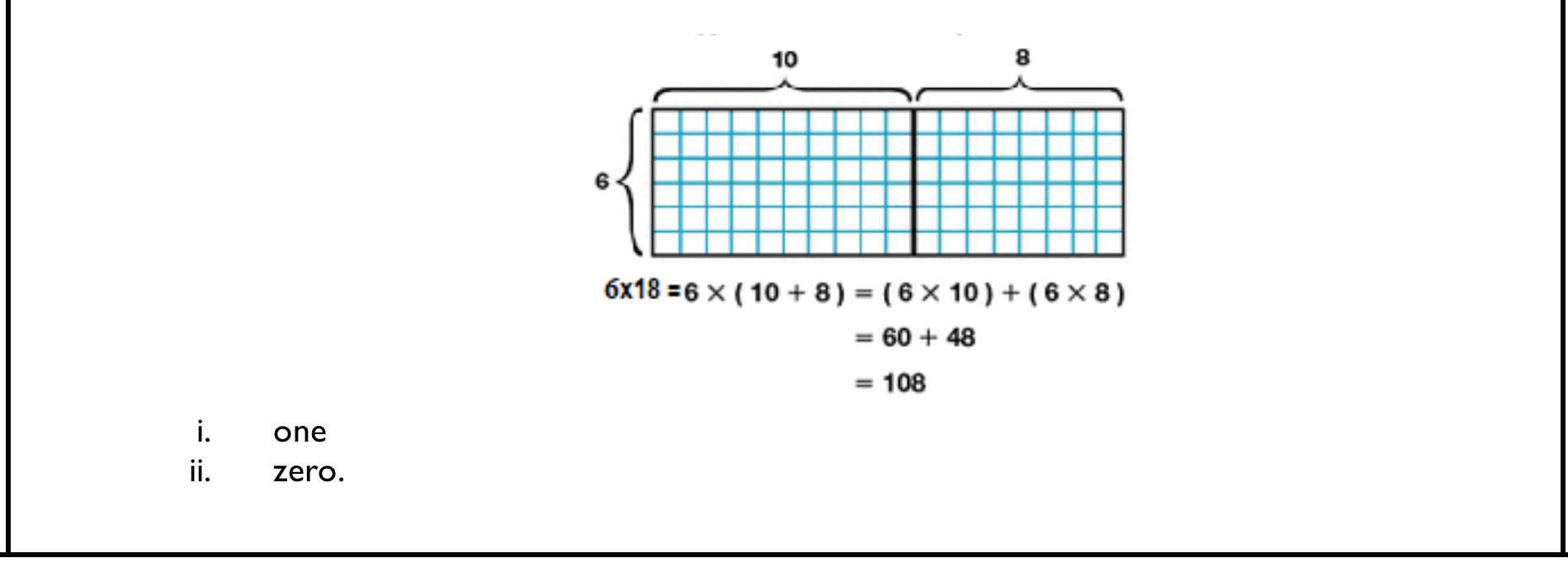
- Use the distributive property to multiply by splitting one factor into parts (e.g., 6 × 18 = (6 × 10) + (6 × 8) = 108)
- Use the distributive property with subtraction for factors close to multiples of 10 (e.g., 29 × 7 = (30 × 7) - (1 × 7) = 203)
- State and apply the properties of multiplying by one and by zero
Sign in with your phone number to read the full note and download the GES plan - free.
Sign in with phone numberCurriculum details
- Strand
- Number (Strand 1)
- Sub-strand
- Number Operations (1.2)
- Content standard
- B5.1.2.1 - Describe and apply mental mathematics strategies and number properties to determine answers for basic multiplication facts to 81 and related division facts
- Indicator
- B5.1.2.1.2 - Apply mental mathematics strategies for multiplication, such as annexing then adding zero halving and doubling using the distributive property
- Suggested placement
-
Term 1, Week 8
(Week 8 of the year)
Our suggestion, laid out in curriculum order across three terms of twelve weeks. NaCCA does not fix the week, so follow your school's scheme of learning.
- Curriculum reference
-
Mathematics Curriculum for Primary Schools (Basic 4-6), 2019, p. 66
Transcribed from the official NaCCA publication. Check this page against the source.
Exemplars (from the NaCCA curriculum)
E.g. 1 Determine the products when one factor is a multiple of 10, 100, or 1000 by annexing zero or adding zeros (e.g., for 3×200 think of 3×2 and then add two zeros)
E.g. 2 Apply halving and doubling when determining a given product (e.g., 32×5 is the same as 16×10)
E.g. 3 Apply the distributive property to determine a given product involving multiplying factors that can be written in the expanded form (e.g., 6×18 = (6×10) + (6×8) = 60+48 = 108. Or apply distributive property to determine a given product involving multiplying factors that are close to multiples of 10 (e.g., 29×7 = (30×7) - (1×7) = 203.
E.g. 4 Explain the property for determining the answer when multiplying numbers by i. one ii. zero.