B4 Mathematics · Term 1, Week 10
Number Operations
Lesson notes
Learning Objectives
Indicator: B4.1.2.3.1 - Multiply multi-digit numbers efficiently
By the end of the lesson, learners can:
- Expand a 2-digit or 3-digit number into hundreds, tens, and ones (for example, 448 = 400 + 40 + 8).
- Use the “expand and box” (partial decomposition) method to multiply a 2-digit or 3-digit number by a 1-digit number accurately.
- Use the lattice method to multiply a 2-digit number by a 1-digit number accurately.
- Solve word problems involving multiplication of multi-digit numbers by 1-digit numbers in everyday situations.
- Justify their choice of multiplication method by comparing answers obtained from two different methods.
Sign in with your phone number to read the full note and download the GES plan - free.
Sign in with phone numberCurriculum details
- Strand
- Number (Strand 1)
- Sub-strand
- Number Operations (1.2)
- Content standard
- B4.1.2.3 - Demonstrate an understanding of multiplication (2 or 3- digit by 1-digit )
- Indicator
- B4.1.2.3.1 - Multiply multi-digit numbers efficiently
- Suggested placement
-
Term 1, Week 10
(Week 10 of the year)
Our suggestion, laid out in curriculum order across three terms of twelve weeks. NaCCA does not fix the week, so follow your school's scheme of learning.
- Source document note
-
The official curriculum document has a fault in this entry, so the curriculum text above is transcribed exactly as printed:
- exemplars - p.16
- Curriculum reference
-
Mathematics Curriculum for Primary Schools (Basic 4-6), 2019, p. 16
Transcribed from the official NaCCA publication. Check this page against the source.
Exemplars (from the NaCCA curriculum)
E.g. 1. Multiplication of whole numbers using the "expand and box" method (partial decomposition method). Lead learners to multiply a 3-digit number by a 1-digit number as shown below, for example 448 × 2 =?
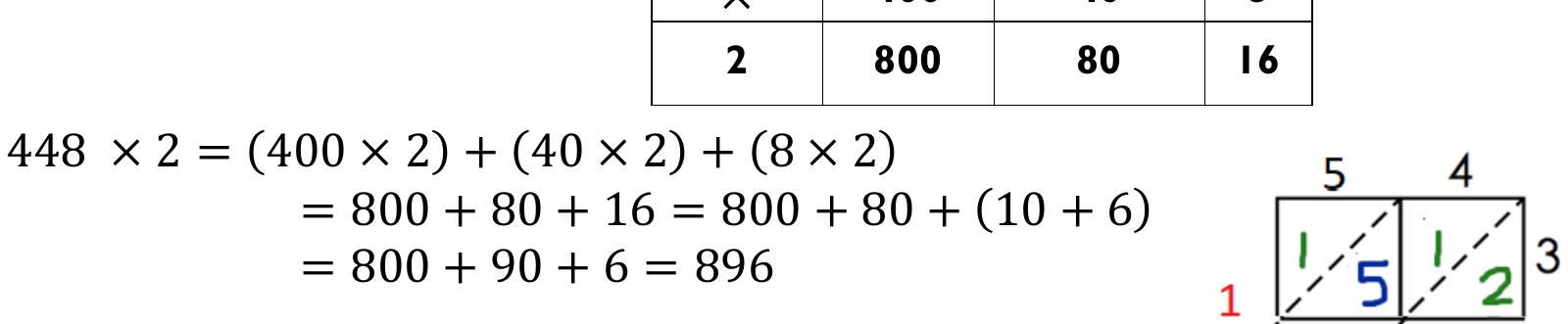
448 × 2 = (400 × 2) + (40 × 2) + (8 × 2) = 800 + 80 + 16 = 800 + 80 + (10 + 6) = 800 + 90 + 6 = 896
E.g. 2. Multiplication of whole numbers using the lattice method. Have learners draw a 2 by 1 rectangular box for solving 54 × 3.
E.g. 3. Have learners draw a 2 by 2 rectangular box for solving 34 × 17.

The "expand and box" table (× / 400 / 40 / 8 over 2 / 800 / 80 / 16) is drawn beside E.g. 1; its cells interleave with the exemplar in the text layer and are shown in the figure instead.