B4 Mathematics · Term 1, Week 11
Number Operations
Lesson notes
Learning Objectives
Indicator: B4.1.2.5.1 - Divide 2-digit numbers by 1-digit number efficiently
By the end of the lesson, learners can:
- Use repeated subtraction to divide 2-digit numbers by 1-digit numbers and state the quotient correctly.
- Use the “Big 7” estimation method to divide 2-digit numbers by 1-digit numbers.
- Apply multiplication facts up to 12 × 12 to check division results.
- Justify their choice of estimation when dividing, explaining why a particular multiple was chosen.
- Work collaboratively in pairs or small groups to solve division problems and share their reasoning.
Sign in with your phone number to read the full note and download the GES plan - free.
Sign in with phone numberCurriculum details
- Strand
- Number (Strand 1)
- Sub-strand
- Number Operations (1.2)
- Content standard
- B4.1.2.5 - Demonstrate an understanding of division (2- or 3-digit by one digit number)
- Indicator
- B4.1.2.5.1 - Divide 2-digit numbers by 1-digit number efficiently
- Suggested placement
-
Term 1, Week 11
(Week 11 of the year)
Our suggestion, laid out in curriculum order across three terms of twelve weeks. NaCCA does not fix the week, so follow your school's scheme of learning.
- Curriculum reference
-
Mathematics Curriculum for Primary Schools (Basic 4-6), 2019, p. 17
Transcribed from the official NaCCA publication. Check this page against the source.
Exemplars (from the NaCCA curriculum)
E.g. 1. Division as repeated subtraction (using the long division method). Explain division as a way of repeatedly subtracting a divisor number from a given dividend until there is none left and then determining the number of times the divisor is taken from the dividend. For example, 25 ÷ 5 = ? Learners count the number of times 5 was subtracted from 25, which is 5 times. Hence, 25 ÷ 5 = 5

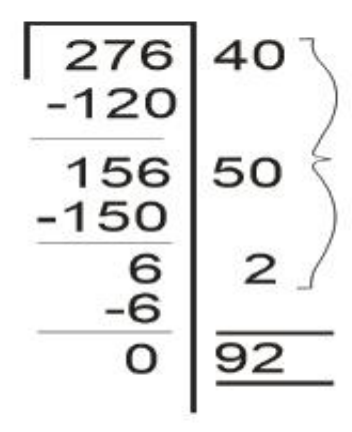
E.g. 2. Division using the estimation of multiples of 10, 100 and others of the divisor. For Example to solve 276 ÷ 3 = ? Learners use estimations: (they may have to use multiples of divisor to select a convenient estimate) "About how many groups of 3 can fit into 276?" The estimation used here is 40. So 3 × 40 = 120. Subtracting 120 from 276 to get 156. The next estimation used is 50. So 3 × 50 = 150. Subtracting 150 from 156 to get 6. The next estimation used is 2. And 2 × 3 = 6. Subtracting 6 from 6 to get 0. There is nothing more to share. To find the final answer add the estimations: 40 + 50 + 2 = 92 . Therefore 276 ÷ 3 = 92 Note: This strategy is nicknamed the "Big 7" because the division box looks like a 7.