B3 Mathematics · Term 1, Week 10
Number Operations (Addition, Subtraction, Multiplication and Division)
Lesson notes
Learning Objectives
Indicator: B3.1.2.4.1
By the end of the lesson, learners can:
- Model addition of 2-digit and 3-digit numbers within 1000 using base-ten objects (bundles of 100s, 10s and ones) or drawings on an addition frame.
- Apply at least two different personal strategies (e.g. counting on, splitting into hundreds/tens/ones, adding from the left, or using a number line) to solve addition problems within 1000.
- Record addition processes symbolically, both with and without an addition frame, showing clear steps.
- Explain and justify their chosen strategy to a partner, describing why their method works.
- Solve addition word problems set in everyday situations, selecting the strategy that suits the numbers involved.
Sign in with your phone number to read the full note and download the GES plan - free.
Sign in with phone numberCurriculum details
- Strand
- Number (Strand 1)
- Sub-strand
- Number Operations (Addition, Subtraction, Multiplication and Division) (1.2)
- Content standard
- B3.1.2.4 - Develop and apply personal and standard strategies for adding and subtracting within 1000
- Indicator
- B3.1.2.4.1 - Use a variety of personal strategies for adding within 1000
- Suggested placement
-
Term 1, Week 10
(Week 10 of the year)
Our suggestion, laid out in curriculum order across three terms of twelve weeks. NaCCA does not fix the week, so follow your school's scheme of learning.
- Source document note
-
The official curriculum document has a fault in this entry, so the curriculum text above is transcribed exactly as printed:
- exemplars - p.50
- Curriculum reference
-
Mathematics Curriculum for Primary Schools (Basic 1-3), 2019, p. 50
Transcribed from the official NaCCA publication. Check this page against the source.
Exemplars (from the NaCCA curriculum)
E.g. 1 Use objects (groups of 100s, 10s and ones) or drawings to model addition and subtraction of 1 to 3 digit numbers (with answers to 1000) and record the process symbolically, with and without a 100s frame.
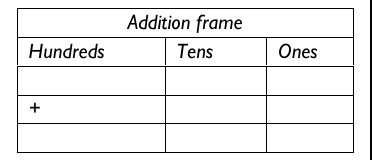
The "Addition frame" table (Hundreds / Tens / Ones, with a + in the second row) is set beside E.g. 1 and its words interleave with the exemplar's in the text layer; the figure shows it.