B2 Mathematics · Term 1, Week 9
Number Operations (Addition, Subtraction, Multiplication and Division)
Lesson notes
Learning Objectives
Indicator: B2.1.2.2.1 - Use the concept of “equal to” and “not equal to” to solve addition and subtraction problems with sums up to 100
By the end of the lesson, learners can:
- Explain in their own words that “not equal to” means two quantities or expressions are not the same.
- Compare two sets of objects and use the correct symbol (= or ≠) to record whether the sets are equal or not equal.
- Determine whether two sides of a given number sentence are equal or not, and record the relationship using the correct symbol.
- Use a symbol (such as a box or a question mark) to represent an unknown number in addition and subtraction sentences up to 100, and find its value.
- Show the relationship between addition and subtraction by rewriting a subtraction fact as a missing-addend addition fact (for example, 40 - 28 = ? means 28 + ? = 40).
Sign in with your phone number to read the full note and download the GES plan - free.
Sign in with phone numberCurriculum details
- Strand
- Number (Strand 1)
- Sub-strand
- Number Operations (Addition, Subtraction, Multiplication and Division) (1.2)
- Content standard
- B2.1.2.2 - Demonstrate an understanding of the concept of "not equal to" to solve addition and subtraction problems with sums up to 100
- Indicator
- B2.1.2.2.1 - Use the concept of "equal to" and "not equal to" to solve addition and subtraction problems with sums up 100
- Suggested placement
-
Term 1, Week 9
(Week 9 of the year)
Our suggestion, laid out in curriculum order across three terms of twelve weeks. NaCCA does not fix the week, so follow your school's scheme of learning.
- Source document note
-
The official curriculum document has a fault in this entry, so the curriculum text above is transcribed exactly as printed:
- exemplars - p.24
- Curriculum reference
-
Mathematics Curriculum for Primary Schools (Basic 1-3), 2019, p. 24
Transcribed from the official NaCCA publication. Check this page against the source.
Exemplars (from the NaCCA curriculum)
E.g. 1. Explaining that that' "not equal to" means "not the same as" or "not equal to"
- Constructing and drawing two sets that are not equal, explaining why they are not equal and recording the relationship using the symbol (not equal to) (e.g., [] [] [] (not equal to) [] [] []); Changing two given sets, equal in size, to create sets that are not equal (e.g., change [] [] [] = [] [] [] to [] [] [] [] [] (not equal to) [] []), explain the changes made and why
- Determining whether two sides of a given number sentence are equal or not and using the appropriate symbol to represent the relationship (e.g., 16 (not equal to) 8 + 5)
E.g. 2. Using a symbol () to represent an unknown in addition/subtraction statements to 100.
E.g. 3. Demonstrate an understanding of the relationship between addition and subtraction by describing a subtraction as an equivalent addition and vice versa; i.e. finding the missing addend. (For example, that subtract 40 - 28 is the same as finding the number that must be added to 28 to make 40).
40 - 28 = What? Means 28 + What? = 40
Or if given 40 - 28 = ___ change question to 28 +__ = 40. The answer is 12, so 40 - 28 = 12).
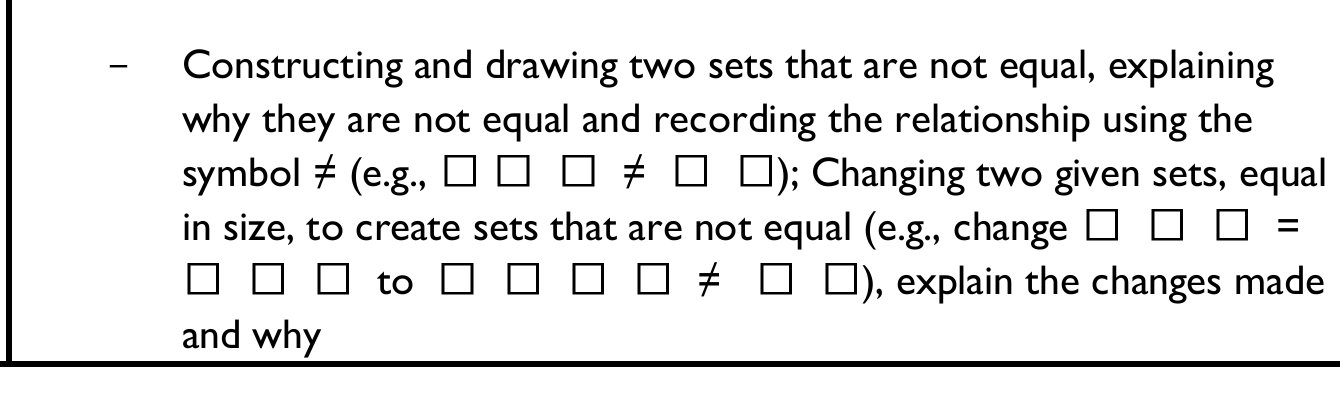
The page prints the not-equal sign as a glyph and the two sets as rows of small square pictures; the text layer carries neither. The squares are written here as [] and the sign is spelled out; the figure shows the page as printed, and the exact number of squares in each set must be read off it.