B5 Mathematics · Term 1, Week 11
Number: Fractions
Lesson notes
Learning Objectives
Indicator: B5.1.3.1.1 - Determine equivalent fractions of given fractions
By the end of the lesson, learners can:
- identify the multiplier that converts one denominator to another within a pair of equivalent fractions.
- generate equivalent fractions for a given fraction by multiplying both numerator and denominator by the same whole number.
- determine the Lowest Common Denominator (LCD) of two or more denominators using the prime factorisation strategy.
- rewrite given fractions as equivalent fractions using the LCD as the new common denominator.
- justify why the value of a fraction does not change when both numerator and denominator are multiplied by the same number.
Sign in with your phone number to read the full note and download the GES plan - free.
Sign in with phone numberCurriculum details
- Strand
- Number (Strand 1)
- Sub-strand
- Number: Fractions (1.3)
- Content standard
- B5.1.3.1 - Demonstrate understanding of strategies for comparing, adding, subtracting and multiplying fractions
- Indicator
- B5.1.3.1.1 - Determine equivalent fractions of given fractions
- Suggested placement
-
Term 1, Week 11
(Week 11 of the year)
Our suggestion, laid out in curriculum order across three terms of twelve weeks. NaCCA does not fix the week, so follow your school's scheme of learning.
- Source document note
-
The official curriculum document has a fault in this entry, so the curriculum text above is transcribed exactly as printed:
- exemplars - p.72
- Curriculum reference
-
Mathematics Curriculum for Primary Schools (Basic 4-6), 2019, p. 72
Transcribed from the official NaCCA publication. Check this page against the source.
Exemplars (from the NaCCA curriculum)
E.g. 1 To compare, add or subtract the fractions, 3/4, 5/6 and 7/10, we need find the Lowest Common Denominator (LCD) and use this to express the equivalent fractions. Use the prime factorising strategy to determine the LCD of 4, 6, and 20. Use the LCD work out the equivalent fractions. 3/4 = ?/36; 5/6 = ??/36; and 7/10 = ???/36.
[To obtain the numerators, determine how many times the denominator goes into the LCD and multiply this by the numerator to obtain a new numerator.]
24 = 2 x 2 x 2 x 3 so 2 and 3 are prime factors of 24
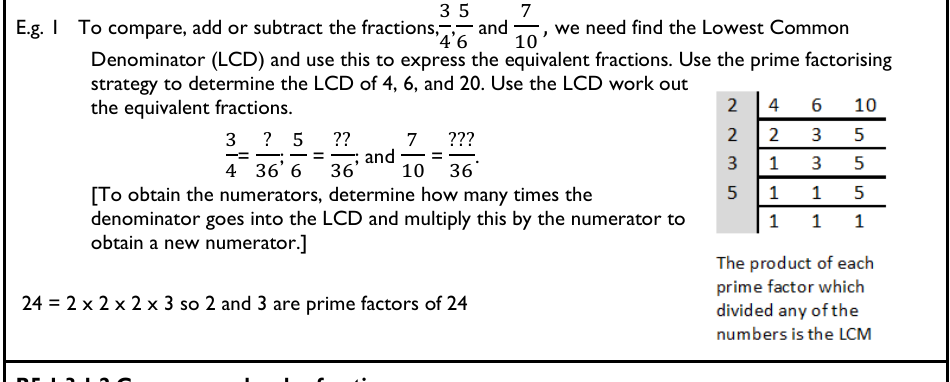
The prime-factorisation table is set beside the exemplar and its cells interleave with it in the text layer; the figure shows it. The fractions are stacked and are written inline. The exemplar names the fractions 3/4, 5/6 and 7/10 but then asks for the LCD of 4, 6 and 20; both are as printed.