JHS3 Mathematics · Term 1, Week 1
Number and Numeration System
Lesson notes
Learning Objectives
Indicator: B9.1.1.1.2 - Use knowledge and understanding of place value to solve real life problems
By the end of the lesson, learners can:
- Read and interpret multi-digit numbers (up to 7 digits) in real-life contexts such as population figures, mobile money balances, and market sales.
- Decode number puzzles by applying place value concepts, multiples, quotients, and relationships between digits.
- Create original real-life story problems involving large numbers and solve them correctly, writing answers in standard form.
- Express numbers in standard form (scientific notation) and convert standard form back to ordinary numbers in real-life contexts.
- Work collaboratively to present and justify solutions to digit puzzles and story problems with clear reasoning.
Sign in with your phone number to read the full note and download the GES plan - free.
Sign in with phone numberCurriculum details
- Strand
- Number (Strand 1)
- Sub-strand
- Number and Numeration System (1.1)
- Content standard
- B9.1.1.1 - Apply the understanding of place value in solving real life problems involving integers of any size, rounding this to given decimal places and significant figures
- Indicator
- B9.1.1.1.2 - Use knowledge and understanding of place value to solve real life problems
- Suggested placement
-
Term 1, Week 1
(Week 1 of the year)
Our suggestion, laid out in curriculum order across three terms of twelve weeks. NaCCA does not fix the week, so follow your school's scheme of learning.
- Curriculum reference
-
Mathematics, Common Core Programme (JHS1-JHS3), 2023, p. 165
Transcribed from the official NaCCA publication. Check this page against the source.
Exemplars (from the NaCCA curriculum)
E.g.1. Create and solve a real-life problem or a story problem and write the answer in standard form. (I) I am a 6-digit number. My first digit is 5 more than the last digit, but 2 less than my second digit. My second digit is the third multiple of 3, while my fourth digit is the second multiple of 3. My third digit is the quotient when the fourth digit is divided by my last digit. However, my fourth and fifth digits are consecutive numbers. What number am I?
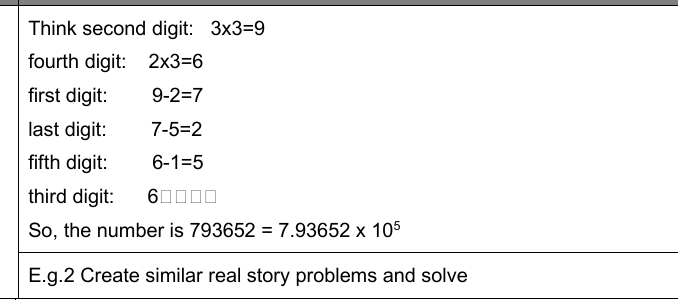
Think second digit: 3x3=9 fourth digit: 2x3=6 first digit: 9-2=7 last digit: 7-5=2 fifth digit: 6-1=5 third digit: 6-'=' So, the number is 793652 = 7.93652 x 10 5
E.g.2 Create similar real story problems and solve