B3 Mathematics · Term 2, Week 9
Money
Lesson notes
Learning Objectives
Indicator: B3.1.4.1.1 - Use different denominations of money (1, 2, 5, 10, 20, 50 cedis notes and pesewas coins) to buy and give change
By the end of the lesson, learners can:
- Identify and state the value of Ghanaian currency notes (GHS 1, GHS 2, GHS 5, GHS 10, GHS 20, GHS 50) and pesewa coins (1p, 5p, 10p, 20p, 50p, GHS 1 and GHS 2 coins).
- Calculate the total cost of two or more items and determine the change to be received from a given amount of money.
- Solve word problems involving buying items and giving change using notes and coins up to GHS 50.
- Find different combinations of notes that make up a given total amount (e.g., ways to make GHS 30 using GHS 1, GHS 2, GHS 5, GHS 10 and GHS 20 notes).
- Justify their answers by explaining the steps they used to calculate costs and change.
Sign in with your phone number to read the full note and download the GES plan - free.
Sign in with phone numberCurriculum details
- Strand
- Number (Strand 1)
- Sub-strand
- Money (1.4)
- Content standard
- B3.1.4.1 - Determine the value of coins and notes in order to solve monetary transactions
- Indicator
- B3.1.4.1.1 - Use different denominations of money (1,2, 5, 10, 20, 50 cedis notes an pesewas coins) to buy and give change
- Suggested placement
-
Term 2, Week 9
(Week 21 of the year)
Our suggestion, laid out in curriculum order across three terms of twelve weeks. NaCCA does not fix the week, so follow your school's scheme of learning.
- Source document note
-
The official curriculum document has a fault in this entry, so the curriculum text above is transcribed exactly as printed:
- exemplars - p.61
- Curriculum reference
-
Mathematics Curriculum for Primary Schools (Basic 1-3), 2019, p. 61
Transcribed from the official NaCCA publication. Check this page against the source.
Exemplars (from the NaCCA curriculum)
E.g. 1. Solve word problems involving money including 1,2, 5, 10 and 20 cedi denominations and giving change
Display a chart with items and their prices as in the example below
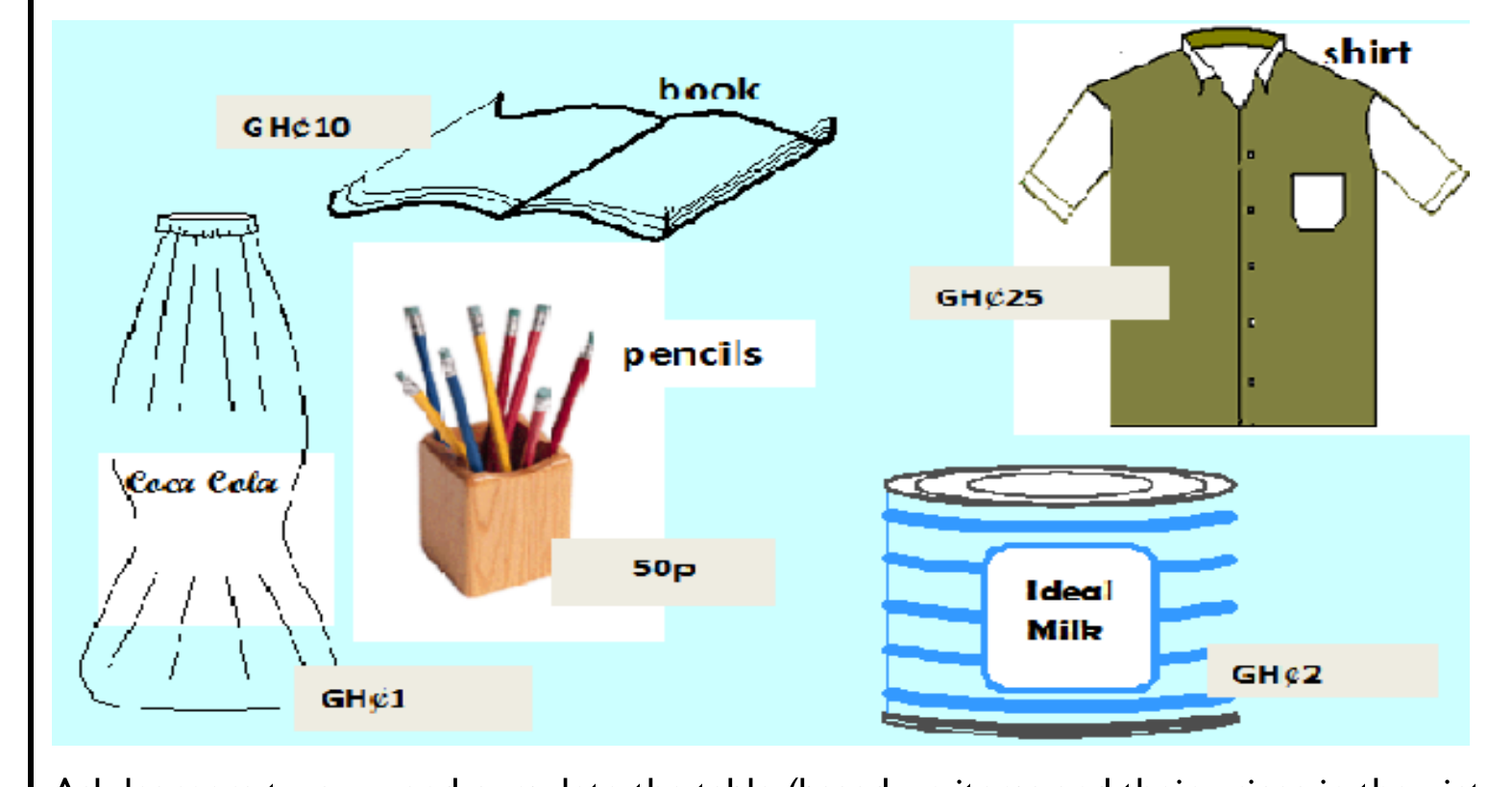
Ask learners to copy and complete the table (based on items and their prices in the picture and find the change to receive in each case
Shopping money Items to buy Change to receive
1. GH¢100 3 shirts
2. GH¢50 4 books
3. GH¢5 8 pencils
4. GH¢10 4 bottles coca cola
E.g. 1. Find how many different ways the notes ¢1, ¢ 2 ¢5, ¢10 and ¢20 can be used to make ¢30
E.g. 2. Solve word problems involving money including 1,2, 5, 10, 20, 50 cedi denominations
E.g. 3. Find how many different ways the notes ¢5, ¢10 and ¢20 can be used to make ¢50 The document restarts this indicator's exemplar numbering at E.g. 1 when it continues on printed p.62, and prints the "Sub-Strand 4: Money" heading above p.62 although the sub-strand starts on p.61.