SHS1 Mathematics · Semester 2, Week 3
Measurement
Lesson notes
Learning Objectives
Indicator: 1.3.2.LI.1 - Recognise a vector as a quantity with both magnitude and direction, and identify, gather, and interpret information about real-world applications of vectors.
By the end of the lesson, learners can:
- Define a vector as a quantity that has both magnitude and direction, and distinguish it from a scalar quantity.
- Explain the meaning of magnitude and direction using everyday examples such as movement, force, and displacement.
- Identify at least five real-world applications of vectors from fields such as physics, engineering, navigation, and sports.
- Gather and interpret information about how vectors are used in real life, presenting findings clearly to peers.
- Recognise that vectors with the same magnitude and direction are equal even when they start from different positions.
Sign in with your phone number to read the full note and download the GES plan - free.
Sign in with phone numberCurriculum details
- Strand
- Geometry Around Us (Strand 3)
- Sub-strand
- Measurement (3.2)
- Content standard
- 1.3.2.CS.1 - Demonstrate knowledge and understanding of the concept of measurement with respect to bearings and vectors. 1.3.2.LO.1 Interpret information about realworld applications of vectors and recognise vectors with the same magnitude and direction but different positions as equal vectors.
- Indicator
- 1.3.2.LI.1 - Recognise a vector as a quantity with both magnitude and direction, and identify, gather, and interpret information about real-world applications of vectors.
- Suggested placement
-
Semester 2, Week 3
(Week 23 of the year)
Our suggestion, laid out in curriculum order across three terms of twelve weeks. NaCCA does not fix the week, so follow your school's scheme of learning.
- Curriculum reference
- NaCCA curriculum document, p. 110
Exemplars (from the NaCCA curriculum)
Using Talk for Learning strategy, lead the class to discuss (dwelling on their experiences from JHS) the concept of vectors.
Example: Vectors define the movement of objects from one point to another. Vectors carry a point A to point B. The length of the line between the two points A and B is called the magnitude of the vector, and the direction of the displacement of point A to point B is called the direction of the vector AB.
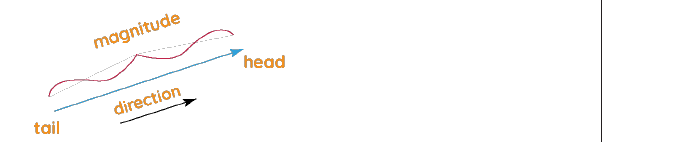
Using Talk for Learning strategy, engage learners in a class discussion on some real-life examples of vectors.
Examples: Vectors play an important role in physics. For instance, velocity, displacement, acceleration, and force are all vector quantities that have a magnitude as well as a direction.
Real-life uses of vectors
- Vectors can be used to find the direction in which the force is applied to move an object.
- The concept of vectors aids in understanding how gravity uses a force of attraction on an object to work.
- Vectors can be used to obtain the motion of a body which is confined to a plane.
- Vectors help in defining the force applied on a body simultaneously in the three dimensions.
- In the field of Engineering, for a structure not to collapse, vectors are used where the force is much stronger than the structure will sustain.
- Vectors are used in various oscillators.
Using Talk for Learning approaches, discuss the representation of and types of vectors with examples.
Example Zero Vectors Negative Vector Unit Vectors Parallel Vectors Position Orthogonal Vectors Vectors Equal Vectors Co-initial Vectors
Teaching and Learning Resources:
- Mathematical sets.
- Technology tools such as computers, mobile phones, etc.
- Computer software applications like GeoGebra.
Assessment (1.3.2.AS.1). The document marks these depth-of-knowledge levels for this indicator: Level 1 Recall; Level 2 Skills of conceptual understanding.