SHS1 Mathematics · Semester 2, Week 6
Measurement
Lesson notes
Learning Objectives
Indicator: 1.3.2.LI.3 - Solve problems using the three primary trigonometric ratios for angles from 0° to 360° in standard position.
By the end of the lesson, learners can:
- Define standard position of an angle and identify the quadrant in which any angle from 0° to 360° lies.
- Determine the sign (positive or negative) of sine, cosine, and tangent for angles in each of the four quadrants using the CAST rule.
- Solve for unknown sides and angles in right-angled triangles using the three primary trigonometric ratios (sine, cosine, tangent).
- Apply trigonometric ratios to solve real-life problems involving angles of elevation and depression in Ghanaian contexts.
- Verify solutions to trigonometric problems using a scientific calculator and justify the reasonableness of answers.
Sign in with your phone number to read the full note and download the GES plan - free.
Sign in with phone numberCurriculum details
- Strand
- Geometry Around Us (Strand 3)
- Sub-strand
- Measurement (3.2)
- Content standard
- 1.3.2.CS.2 - Demonstrate a conceptual understanding of the primary trigonometric ratios and apply it to solve problems that involve right triangles. 1.3.2.LO.2 Investigate and determine the trigonometric functions of special angles and solve problems using the three primary trigonometric ratios.
- Indicator
- 1.3.2.LI.3 - Solve problems using the three primary trigonometric ratios for angles from 0° to 360° in standard position.
- Suggested placement
-
Semester 2, Week 6
(Week 26 of the year)
Our suggestion, laid out in curriculum order across three terms of twelve weeks. NaCCA does not fix the week, so follow your school's scheme of learning.
- Curriculum reference
- NaCCA curriculum document, p. 117
Exemplars (from the NaCCA curriculum)
Using Think-Pair-Share activities: Task learners to investigate and create real-life problems and solve them.
Example: A boy is standing near a tree. He looks up at the tree and wonders, "How tall is the tree?"
Solution: The height of the tree can be found without actually measuring it. What we have here is a right-angled triangle, i.e., a triangle with one of the angles equal to 90 degrees.
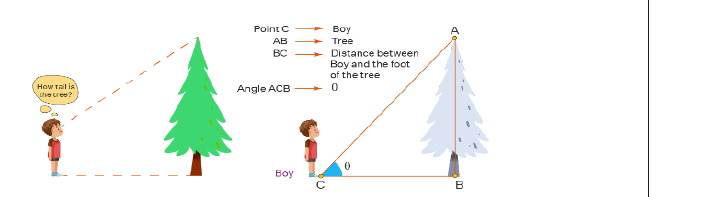
It is determined using the tangent function, such as the tan of angle is equal to the ratio of the height of the tree and the distance. Let us say the angle is θ, then tan θ = Height/Distance between object and tree Distance = Height/tan θ
Let us assume that the distance is 30m and the angle formed is 45 degrees, then. Height = 30/tan 45° Since, tan 45° = 1 So, Height = 30 m
The height of the tree can be found out by using basic trigonometry formulas.
Teaching and Learning Resources:
- * Mathematical sets.
- Technology tools such as computers, mobile phones, etc.
- * Computer software applications like GeoGebra
Assessment (1.3.2.AS.3). The document marks these depth-of-knowledge levels for this indicator: Level 3 Strategic reasoning.