SHS1 Mathematics · Semester 2, Week 8
Measurement
Lesson notes
Learning Objectives
Indicator: 1.3.2.LI.2 - Estimate the perimeter and area of a given regular, composite or irregular 2D shape [kites, parallelogram, rhombus and trapezoids].
By the end of the lesson, learners can:
- Estimate the perimeter of regular, composite and irregular 2D shapes by comparing side lengths and using referents (e.g., a stride, a hand span, or a known length such as a exercise book edge).
- Estimate the area of a parallelogram, rhombus, kite, and trapezoid using the formula for each shape, and verify the estimate using a grid or graph paper.
- Decompose a composite or irregular shape into simpler familiar shapes (rectangles, triangles, parallelograms) to estimate its total area.
- Use the half-square rule to estimate the area of irregular shapes on a grid where parts of squares are occupied.
- Justify their estimation strategy in writing or orally, comparing estimates from different methods and explaining which is more accurate and why.
Sign in with your phone number to read the full note and download the GES plan - free.
Sign in with phone numberCurriculum details
- Strand
- Geometry Around Us (Strand 3)
- Sub-strand
- Measurement (3.2)
- Content standard
- 1.3.2.CS.3 - Demonstrate conceptual understanding of the measurement of perimeter and area of circles and quadrilaterals. 1.3.2.LO.3 Identify and compare referents for SI and imperial area measurements, estimate the perimeter and area of 2D shapes [kites, parallelogram, rhombus and trapezoids], and volume of prisms, and solve problems that involve a given regular, composite or irregular 2D shapes.
- Indicator
- 1.3.2.LI.2 - Estimate the perimeter and area of a given regular, composite or irregular 2D shape [kites, parallelogram, rhombus and trapezoids].
- Suggested placement
-
Semester 2, Week 8
(Week 28 of the year)
Our suggestion, laid out in curriculum order across three terms of twelve weeks. NaCCA does not fix the week, so follow your school's scheme of learning.
- Curriculum reference
- NaCCA curriculum document, p. 121
Exemplars (from the NaCCA curriculum)
Experiential Learning: In small groups, engage learners to investigate the area of 2-D shapes (both regular and irregular) and estimate the perimeter using geodot.
Example 1: Find the area of the shape on the grid:
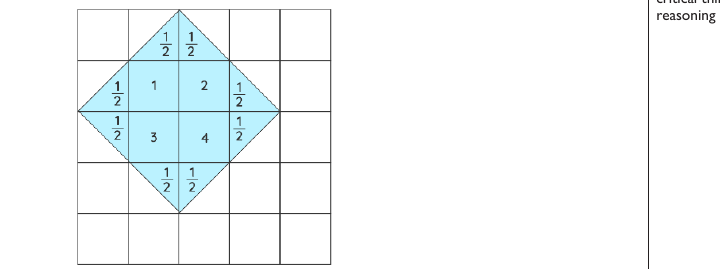
Solution: For this problem, some part of the shape does not occupy complete squares. Because of that, we need to approximate its perimeter. If it occupies about 1/2 of the unit square, we can combine two such halves to form an area of 1 square unit.
Example 2: Find the area of the shape:
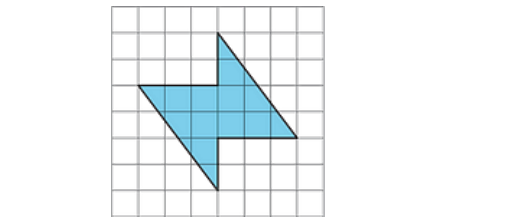
Solution: Think! We will first have to decompose it and rearrange the pieces into a shape that will make it easy to
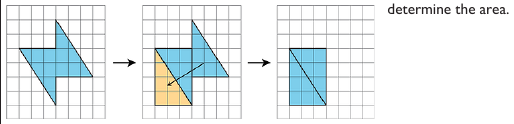
 determine the area.
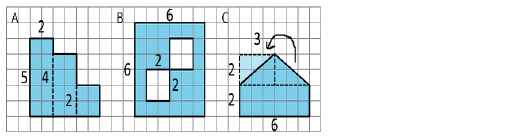
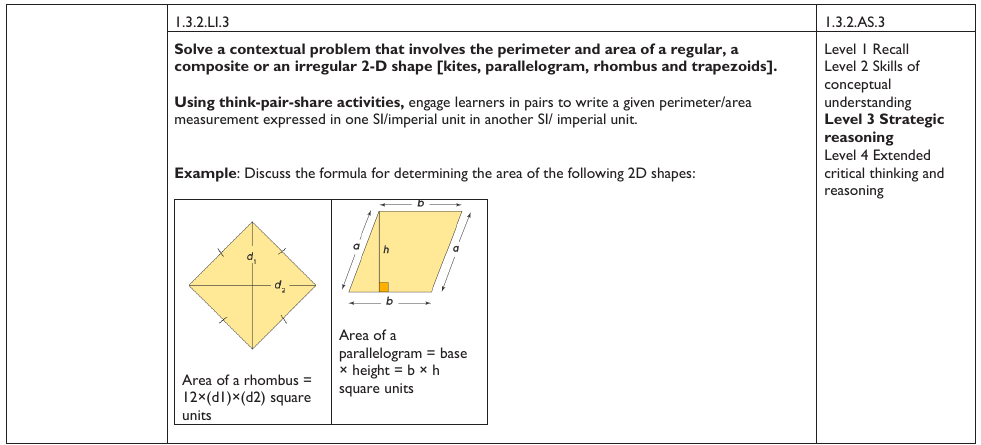
Example 3: Investigate the perimeter and area of the following shapes.
Teaching and Learning Resources:
- Mathematical sets.
- Technology tools such as computers, mobile phones, etc.
- Computer software applications like GeoGebra.
Assessment (1.3.2.AS.2). The document marks these depth-of-knowledge levels for this indicator: Level 3 Strategic reasoning.