SHS1 Mathematics · Semester 2, Week 10
Measurement
Lesson notes
Learning Objectives
Indicator: 1.3.2.LI.4 - Determine the volume of prisms and solve everyday life problems on them.
By the end of the lesson, learners can:
- Define a prism and identify the base, height, and cross-section of a given prism.
- State and apply the formula V = Bh (where B is the area of the base and h is the height) to calculate the volume of rectangular, triangular, and trapezoidal prisms.
- Solve problems that require finding a missing dimension (height or base area) of a prism when the volume is known.
- Solve everyday life problems involving volumes of prism-shaped objects such as boxes, water tanks, and containers, using appropriate units (cm³, m³).
- Justify the reasonableness of their solutions through estimation and strategic reasoning (Level 3 depth of knowledge).
Sign in with your phone number to read the full note and download the GES plan - free.
Sign in with phone numberCurriculum details
- Strand
- Geometry Around Us (Strand 3)
- Sub-strand
- Measurement (3.2)
- Content standard
- 1.3.2.CS.3 - Demonstrate conceptual understanding of the measurement of perimeter and area of circles and quadrilaterals. 1.3.2.LO.3 Identify and compare referents for SI and imperial area measurements, estimate the perimeter and area of 2D shapes [kites, parallelogram, rhombus and trapezoids], and volume of prisms, and solve problems that involve a given regular, composite or irregular 2D shapes.
- Indicator
- 1.3.2.LI.4 - Determine the volume of prisms and solve everyday life problems on them.
- Suggested placement
-
Semester 2, Week 10
(Week 30 of the year)
Our suggestion, laid out in curriculum order across three terms of twelve weeks. NaCCA does not fix the week, so follow your school's scheme of learning.
- Curriculum reference
- NaCCA curriculum document, p. 124
Exemplars (from the NaCCA curriculum)
Using think-square-share activities, task learners to solve problems using formulas for determining the volume of prisms. Examples of prisms include;
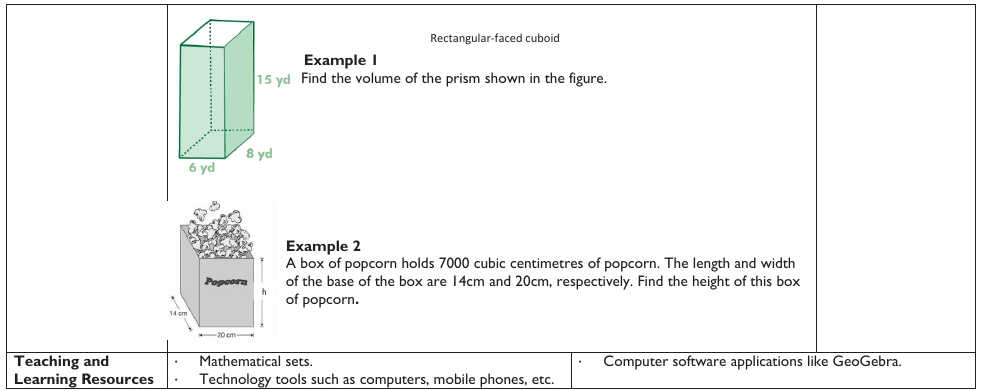
Example 1 Find the volume of the prism shown in the figure.
Example 2 A box of popcorn holds 7000 cubic centimetres of popcorn. The length and width of the base of the box are 14cm and 20cm, respectively. Find the height of this box of popcorn.
Teaching and Learning Resources:
- Mathematical sets.
- Technology tools such as computers, mobile phones, etc.
- Computer software applications like GeoGebra.
Assessment (1.3.2.AS.4). The document marks these depth-of-knowledge levels for this indicator: Level 3 Strategic reasoning.