SHS1 Mathematics · Semester 2, Week 9
Measurement
Lesson notes
Learning Objectives
Indicator: 1.3.2.LI.3 - Solve a contextual problem that involves the perimeter and area of a regular, a composite or an irregular 2-D shape [kites, parallelogram, rhombus and trapezoids].
By the end of the lesson, learners can:
- Solve contextual word problems requiring the perimeter of kites, parallelograms, rhombuses and trapezoids, showing all working and stating the correct units.
- Solve contextual word problems requiring the area of kites, parallelograms, rhombuses and trapezoids, applying the correct formula for each shape.
- Break composite shapes into familiar 2D shapes, solve for their perimeters and areas, and combine the results to answer the problem.
- Estimate the area of an irregular 2D shape from a real-world setting and justify the estimation method used.
- Verify solutions to perimeter and area problems by checking reasonableness of results and unit consistency.
Sign in with your phone number to read the full note and download the GES plan - free.
Sign in with phone numberCurriculum details
- Strand
- Geometry Around Us (Strand 3)
- Sub-strand
- Measurement (3.2)
- Content standard
- 1.3.2.CS.3 - Demonstrate conceptual understanding of the measurement of perimeter and area of circles and quadrilaterals. 1.3.2.LO.3 Identify and compare referents for SI and imperial area measurements, estimate the perimeter and area of 2D shapes [kites, parallelogram, rhombus and trapezoids], and volume of prisms, and solve problems that involve a given regular, composite or irregular 2D shapes.
- Indicator
- 1.3.2.LI.3 - Solve a contextual problem that involves the perimeter and area of a regular, a composite or an irregular 2-D shape [kites, parallelogram, rhombus and trapezoids].
- Suggested placement
-
Semester 2, Week 9
(Week 29 of the year)
Our suggestion, laid out in curriculum order across three terms of twelve weeks. NaCCA does not fix the week, so follow your school's scheme of learning.
- Curriculum reference
- NaCCA curriculum document, p. 123
Exemplars (from the NaCCA curriculum)
Using think-pair-share activities, engage learners in pairs to write a given perimeter/area measurement expressed in one SI/imperial unit in another SI/ imperial unit.
Example: Discuss the formula for determining the area of the following 2D shapes:
Area of a parallelogram = base × height = b × h Area of a rhombus = square units 12×(d1)×(d2) square units
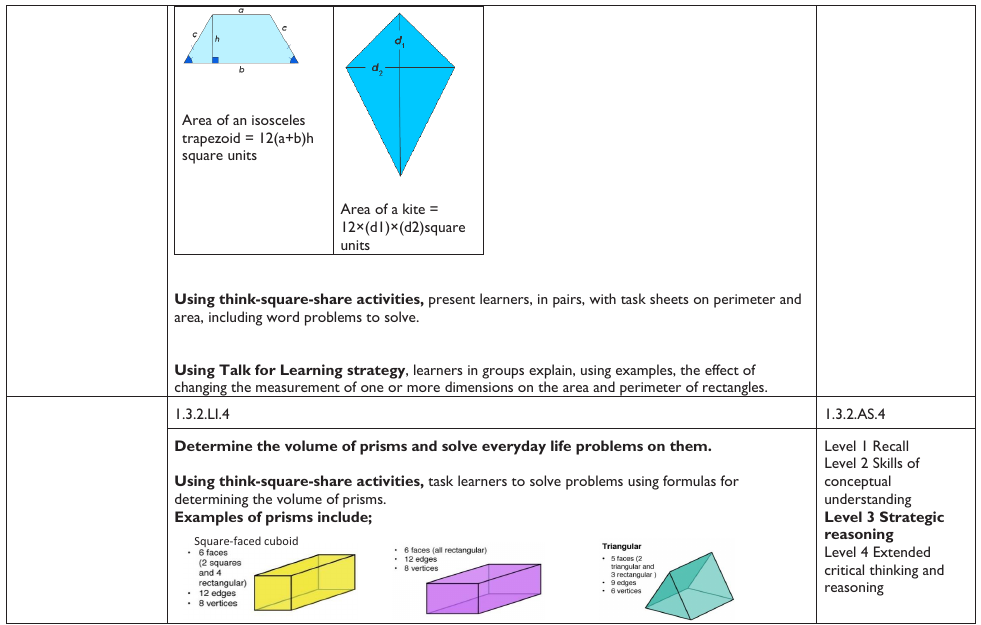
Area of an isosceles trapezoid = 12(a+b)h square units
Area of a kite = 12×(d1)×(d2)square units
Using think-square-share activities, present learners, in pairs, with task sheets on perimeter and area, including word problems to solve.
Using Talk for Learning strategy, learners in groups explain, using examples, the effect of changing the measurement of one or more dimensions on the area and perimeter of rectangles.
Teaching and Learning Resources:
- Mathematical sets.
- Technology tools such as computers, mobile phones, etc.
- Computer software applications like GeoGebra.
Assessment (1.3.2.AS.3). The document marks these depth-of-knowledge levels for this indicator: Level 3 Strategic reasoning.