B4 Mathematics · Term 3, Week 7
Measurement- (Perimeter and Area)
Lesson notes
Learning Objectives
Indicator: B4.3.3.2.4 - Develop and apply a formula for determining area of a rectangle and square
By the end of the lesson, learners can:
- Explain that the area of a rectangle is found by multiplying its length by its breadth (L × B).
- Explain that the area of a square is found by multiplying the length of one side by itself (L × L).
- Apply the formulas to calculate the area of given rectangles and squares in square centimetres (cm²) and square metres (m²).
- Distinguish between perimeter (distance around) and area (space inside) for rectangles and squares.
- Justify their choice of formula and show their working clearly when solving area problems.
Sign in with your phone number to read the full note and download the GES plan - free.
Sign in with phone numberCurriculum details
- Strand
- Geometry and Measurement (Strand 3)
- Sub-strand
- Measurement- (Perimeter and Area) (3.3)
- Content standard
- B4.3.3.2 - Demonstrate an understanding of area of regular and irregular 2-D shapes
- Indicator
- B4.3.3.2.4 - Develop and apply a formula for determining area of a rectangle and square
- Suggested placement
-
Term 3, Week 7
(Week 31 of the year)
Our suggestion, laid out in curriculum order across three terms of twelve weeks. NaCCA does not fix the week, so follow your school's scheme of learning.
- Curriculum reference
-
Mathematics Curriculum for Primary Schools (Basic 4-6), 2019, p. 42
Transcribed from the official NaCCA publication. Check this page against the source.
Exemplars (from the NaCCA curriculum)
E.g. 1 Give pupils a standard graph sheet with 1 cm squares and ask them to draw a square of given length on the graph sheet. The area can be measured by counting the number of square units. So, we can count the number of unit units to find the area. In the diagram the area is 16cm 2 since there are 36 squares in the shape
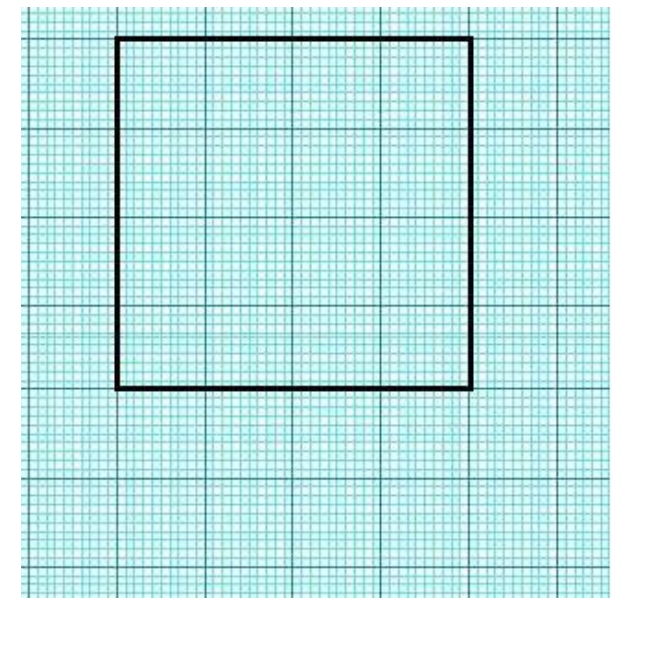
E.g. 2 Ask pupils to count the number of cubic squares on the vertical section of the shape and multiply it by the number on the horizontal section Ask pupils to compare their answer with the first strategy and draw their own conclusions. The area of a square can be given as L × L and that of a rectangle is L × B.