JHS3 Mathematics · Term 3, Week 3
Measurement
Lesson notes
Learning Objectives
Indicator: B9.3.2.1.4 - Express points in the Cartesian plane as position vectors
By the end of the lesson, learners can:
- Identify the origin and axes of the Cartesian plane and state the coordinates of a given point.
- Define a position vector as a vector that starts at the origin and ends at a given point.
- Draw the position vector of a given point on the Cartesian plane.
- Write the position vector of a given point in column form (e.g., point M(2,3) has position vector (2 above, 3 below)).
- Interpret the components of a position vector as the horizontal and vertical displacements from the origin.
Sign in with your phone number to read the full note and download the GES plan - free.
Sign in with phone numberCurriculum details
- Strand
- Geometry and Measurement (Strand 3)
- Sub-strand
- Measurement (3.2)
- Content standard
- B9.3.2.1 - Derive the formulas for determining the surface area of prisms (i.e. cuboid and triangular prism) and use to solve problems.
- Indicator
- B9.3.2.1.4 - Express points in the Cartesian plane as position vectors
- Suggested placement
-
Term 3, Week 3
(Week 27 of the year)
Our suggestion, laid out in curriculum order across three terms of twelve weeks. NaCCA does not fix the week, so follow your school's scheme of learning.
- Curriculum reference
-
Mathematics, Common Core Programme (JHS1-JHS3), 2023, p. 207
Transcribed from the official NaCCA publication. Check this page against the source.
Exemplars (from the NaCCA curriculum)
E.g.1 Identity the following using the diagram below:
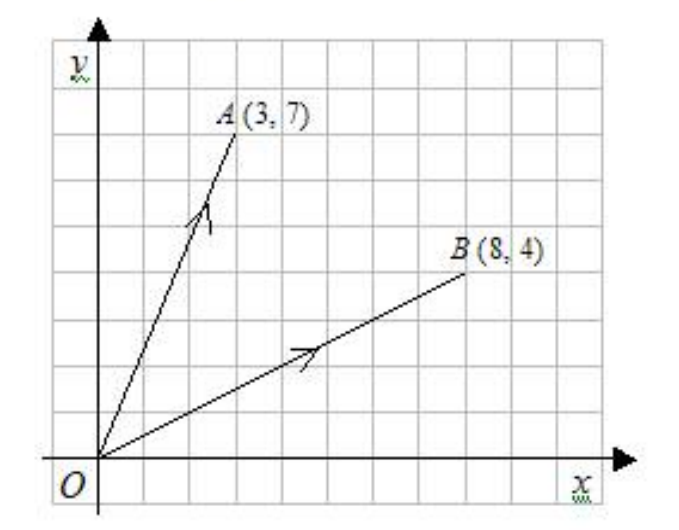
(i) the origin
(ii) the position vector
E.g.2 Draw and write the
position vectors of the following with 0 as the origin:
(i) M(2,3) (ii) N(-1,2)