JHS2 Mathematics · Term 3, Week 2
Measurement
Lesson notes
Learning Objectives
Indicator: B8.3.2.1.1 - Use the relationship between the diameter and circumference of a circle to deduce the formula for finding its area, and use this to solve problems.
By the end of the lesson, learners can:
- Explain how the circumference of a circle relates to its diameter using the constant π (pi) as approximately 22/7 or 3.14.
- Divide a circle into sectors and rearrange them to form a rectangle, and use this to deduce that the area of a circle is given by A = πr².
- Calculate the area of a circle when given the radius or the diameter, using π = 22/7.
- Calculate the area of a semi-circle and of a ring (annulus) formed by two concentric circles.
- Apply the area of a circle formula to solve real-life problems involving circular objects such as tablecloths, fish ponds and compound gardens.
Sign in with your phone number to read the full note and download the GES plan - free.
Sign in with phone numberCurriculum details
- Strand
- Geometry and Measurement (Strand 3)
- Sub-strand
- Measurement (3.2)
- Content standard
- B8.3.2.1 - Apply the Pythagoras theorem, the primary trigonometric ratios and the formulas for determining the area of a circle to solve real problems.
- Indicator
- B8.3.2.1.1 - Use the relationship between the diameter and circumference of a circle to deduce the formula for finding its area, and use this to solve problems.
- Suggested placement
-
Term 3, Week 2
(Week 26 of the year)
Our suggestion, laid out in curriculum order across three terms of twelve weeks. NaCCA does not fix the week, so follow your school's scheme of learning.
- Curriculum reference
-
Mathematics, Common Core Programme (JHS1-JHS3), 2023, p. 142
Transcribed from the official NaCCA publication. Check this page against the source.
Exemplars (from the NaCCA curriculum)
E.g.1: Divide a circle into sectors (minimum of 16) then cut the sectors and arrange to form a rectangle to deduce the area of the circle.
Thus, length of the rectangle = πr width = r
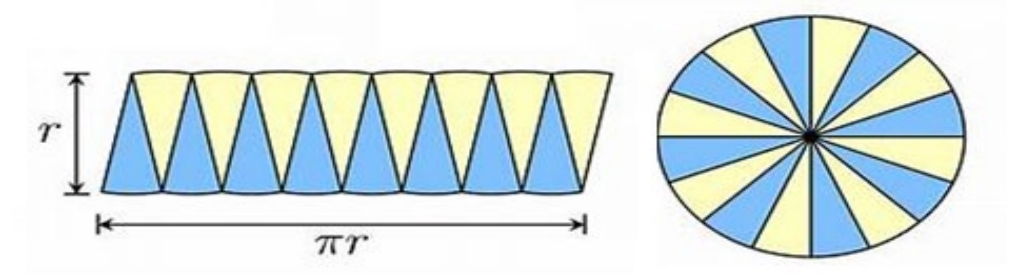
∴ A = πr × r = πr 2
E.g. 2 Solve problems on area of a circle.
(i) Find the area of a circle whose radius is 14cm (Take π = 22/7).
(ii) Find the area of a semi-circle whose radius is 7cm (Take π = 22/7)
(iii) Two circles have a common centre; the small circle has radius 7cm, the big circle has radius 14cm.Find the shaded area. (Take π = 22/7).