JHS2 Mathematics · Term 3, Week 3
Measurement
Lesson notes
Learning Objectives
Indicator: B8.3.2.1.2 - Establish the relationship between the hypotenuse ‘c’ and the two other sides ‘a’ and ‘b’ of a right-angled triangle (i.e. a² + b² = c²) and use it to solve problems.
By the end of the lesson, learners can:
- Construct squares on the three sides of a right-angled triangle on a square grid and compare their areas to state the relationship between the sides.
- State the Pythagoras theorem in their own words, identifying the hypotenuse as the side opposite the right angle.
- Use a pair of compasses and ruler to construct squares on the sides of a right-angled triangle and verify that a² + b² = c².
- Apply the theorem to calculate the missing side length of a right-angled triangle when the other two sides are given.
- Solve at least one practical problem involving the Pythagoras theorem in a real-life situation.
Sign in with your phone number to read the full note and download the GES plan - free.
Sign in with phone numberCurriculum details
- Strand
- Geometry and Measurement (Strand 3)
- Sub-strand
- Measurement (3.2)
- Content standard
- B8.3.2.1 - Apply the Pythagoras theorem, the primary trigonometric ratios and the formulas for determining the area of a circle to solve real problems.
- Indicator
- B8.3.2.1.2 - Establish the relationship between the hypotenuse 'c' and the two other sides 'a' and 'b' of a right-angled triangle (i.e. a 2 + b 2 = c 2 ) and use it to solve problems.
- Suggested placement
-
Term 3, Week 3
(Week 27 of the year)
Our suggestion, laid out in curriculum order across three terms of twelve weeks. NaCCA does not fix the week, so follow your school's scheme of learning.
- Source document note
-
The official curriculum document has a fault in this entry, so the curriculum text above is transcribed exactly as printed:
- indicator text - p.143: the squares are set as superscripts, which the text layer renders as separate digits; read 'a squared + b squared = c squared'
- Curriculum reference
-
Mathematics, Common Core Programme (JHS1-JHS3), 2023, p. 143
Transcribed from the official NaCCA publication. Check this page against the source.
Exemplars (from the NaCCA curriculum)
E.g.1Construct squares on the three sides
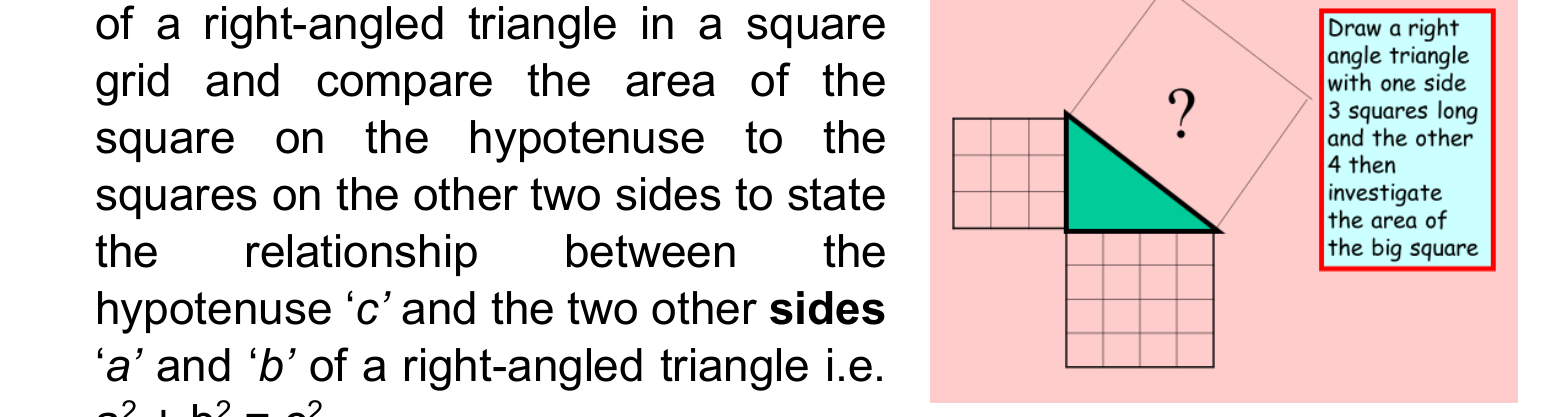
of a right-angled triangle in a square grid and compare the area of the square on the hypotenuse to the squares on the other two sides to state the relationship between the hypotenuse 'c' and the two other sides 'a' and 'b' of a right-angled triangle i.e. a 2 + b 2 = c 2
E.g. 2 Using a pair of compasses and ruler,
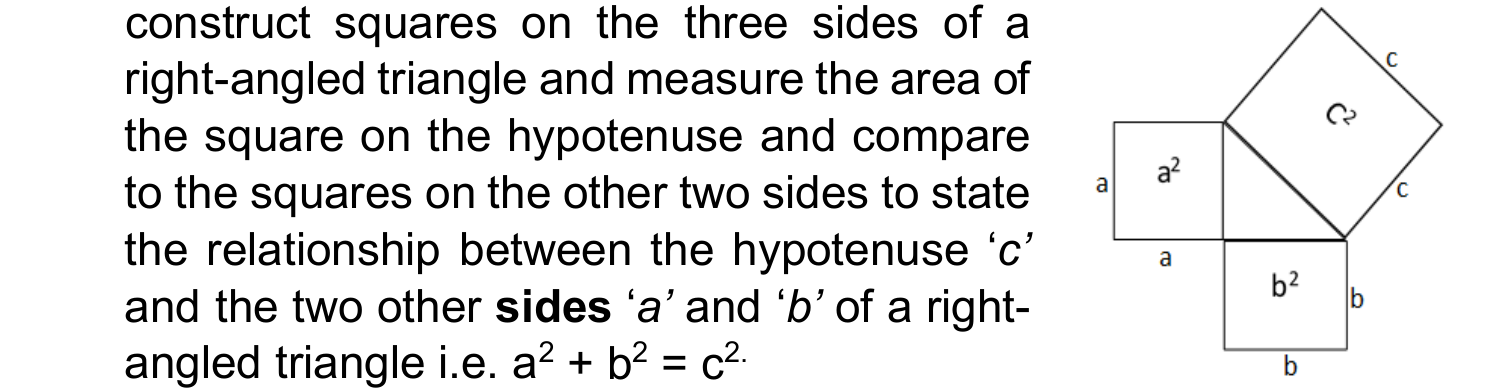
construct squares on the three sides of a right-angled triangle and measure the area of the square on the hypotenuse and compare to the squares on the other two sides to state the relationship between the hypotenuse 'c' and the two other sides 'a' and 'b' of a right- angled triangle i.e. a 2 + b 2 = c 2.
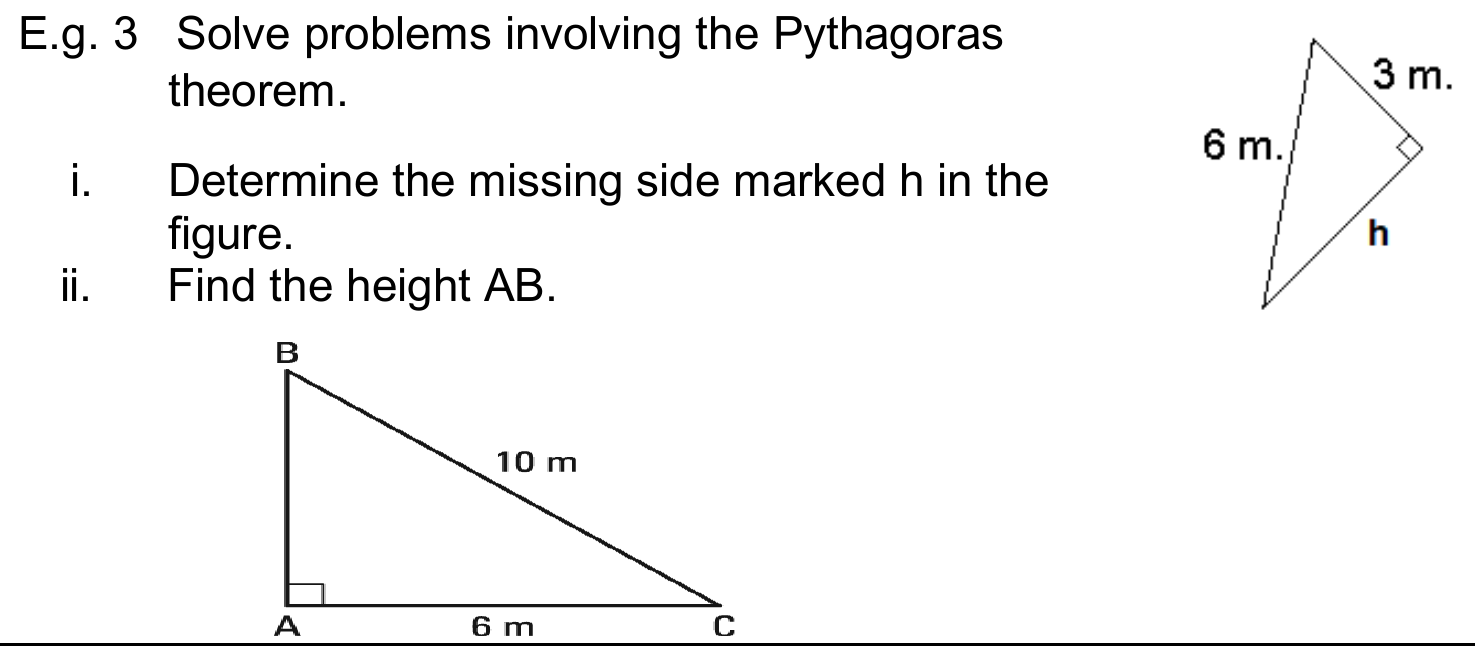
E.g. 3 Solve problems involving the Pythagoras theorem.
i. Determine the missing side marked h in the figure.
ii. Find the height AB.