JHS1 Mathematics · Term 3, Week 4
Measurement
Lesson notes
Learning Objectives
Indicator: B7.3.2.2.2 - Determine the area of a triangle.
By the end of the lesson, learners can:
- State the formula for finding the area of a triangle as half the product of its base and height (Area = 1/2 × base × height).
- Identify the base and corresponding height of a triangle, including when the triangle is drawn in different orientations.
- Calculate the area of a triangle when the base and height are given in the same unit (cm, m, or mm).
- Solve word problems involving the area of triangles in practical situations.
- Work collaboratively to measure, record, and calculate areas of triangular shapes found in their surroundings.
Sign in with your phone number to read the full note and download the GES plan - free.
Sign in with phone numberCurriculum details
- Strand
- Geometry and Measurement (Strand 3)
- Sub-strand
- Measurement (3.2)
- Content standard
- B7.3.2.2 - Derive the formula for determining the area of a triangle and use it to solve problems.
- Indicator
- B7.3.2.2.2 - Determine the area of a triangle.
- Suggested placement
-
Term 3, Week 4
(Week 28 of the year)
Our suggestion, laid out in curriculum order across three terms of twelve weeks. NaCCA does not fix the week, so follow your school's scheme of learning.
- Curriculum reference
-
Mathematics, Common Core Programme (JHS1-JHS3), 2023, p. 66
Transcribed from the official NaCCA publication. Check this page against the source.
Exemplars (from the NaCCA curriculum)
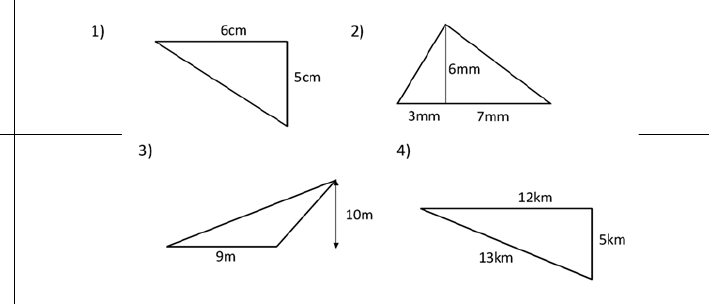
E.g. 1. Calculate the area of the triangles: