B5 Mathematics · Term 3, Week 5
Measurement
Lesson notes
Learning Objectives
Indicator: B5.3.2.2.2 - Determine the volume of boxes by finding how many cubes of sizes 1cm³ each contains
By the end of the lesson, learners can:
- Fill a given box with 1cm³ cubes and count the total number of cubes to determine its volume in cubic centimetres (cm³).
- Describe volume as the total number of 1cm³ cubes that fill a box completely.
- Calculate the volume of a box by counting the number of cubes in one layer (length × width) and multiplying by the number of layers (height).
- State and apply the formula Volume = length × width × height for rectangular boxes.
- Justify their answers by explaining why counting cubes in layers gives the same result as multiplying length, width and height.
Sign in with your phone number to read the full note and download the GES plan - free.
Sign in with phone numberCurriculum details
- Strand
- Geometry and Measurement (Strand 3)
- Sub-strand
- Measurement (3.2)
- Content standard
- B5.3.2.2 - Demonstrate an understanding of volume of common 3D shapes
- Indicator
- B5.3.2.2.2 - Determine the volume of boxes by finding how many cubes of sizes 1cm 3 each contains
- Suggested placement
-
Term 3, Week 5
(Week 29 of the year)
Our suggestion, laid out in curriculum order across three terms of twelve weeks. NaCCA does not fix the week, so follow your school's scheme of learning.
- Source document note
-
The official curriculum document has a fault in this entry, so the curriculum text above is transcribed exactly as printed:
- indicator text - filed as B5.3.2.2.2; the source prints the indicator code as B5.3.3.2.2. The printed content standard beside it is B5.3.2.2, the section heading is 'Sub-Strand 2: Measurement', all four rows carry the identical standard text 'Demonstrate an understanding of volume of common 3D shapes', and the indicator numbers only run 1,2,3,4 under one standard. The printed sub-strand digit is a typo, the same stuck-digit shape SHS Geography printed in 1.1.1.3LI3. Sub-strand 3.3 (Measurement - Angles) holds only B5.3.3.3
- Curriculum reference
-
Mathematics Curriculum for Primary Schools (Basic 4-6), 2019, p. 101
Transcribed from the official NaCCA publication. Check this page against the source.
Exemplars (from the NaCCA curriculum)
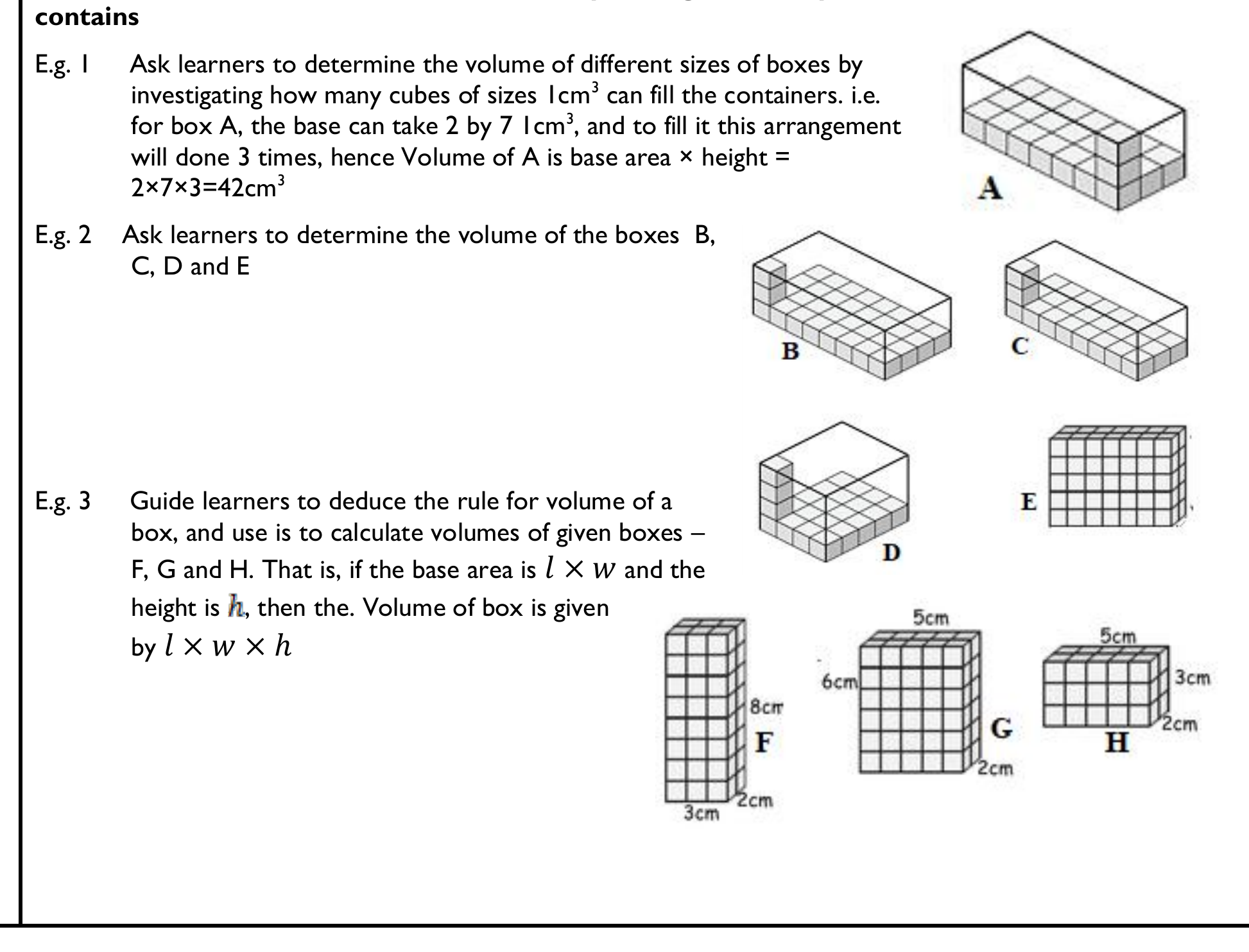
E.g. 1 Ask learners to determine the volume of different sizes of boxes by investigating how many cubes of sizes 1cm 3 can fill the containers. i.e. for box A, the base can take 2 by 7 1cm 3 , and to fill it this arrangement will done 3 times, hence Volume of A is base area × height = 2×7×3=42cm 3
E.g. 2 Ask learners to determine the volume of the boxes B, C, D and E
E.g. 3 Guide learners to deduce the rule for volume of a box, and use is to calculate volumes of given boxes - F, G and H. That is, if the base area is l × w and the height is , then the. Volume of box is given by l × w × h
The indicator is printed B5.3.3.2.2 but the content standard cell beside it prints B5.3.2.2 ("Demonstrate an understanding of volume of common 3D shapes CONT'D"). The standard code here follows the indicator's own code; the text is the one printed in the cell.