B5 Mathematics · Term 3, Week 6
Measurement
Lesson notes
Learning Objectives
Indicator: B5.3.2.2.4. Demonstrate an understanding of capacity by describing the relationship between capacity and volume as well as litre and 10cm 3.
By the end of the lesson, learners can:
- Differentiate between volume (the space an object covers) and capacity (the amount a container can hold), using examples from the classroom and home.
- Demonstrate that a cube measuring 10 cm × 10 cm × 10 cm has a volume of 1000 cm³, which equals 1 litre.
- State and apply the relationship that 1 litre = 1000 cm³, and convert between litres and cubic centimetres for simple values.
- Explain the connection between the litre, the millilitre, and cubic centimetres (1 mL = 1 cm³).
- Solve practical problems involving filling, emptying, and comparing containers using the relationship between capacity and volume.
Sign in with your phone number to read the full note and download the GES plan - free.
Sign in with phone numberCurriculum details
- Strand
- Geometry and Measurement (Strand 3)
- Sub-strand
- Measurement (3.2)
- Content standard
- B5.3.2.2 - Demonstrate an understanding of volume of common 3D shapes
- Indicator
- B5.3.2.2.4 - Demonstrate an understanding of capacity by describing the relationship between capacity and volume as well as litre and 10cm 3
- Suggested placement
-
Term 3, Week 6
(Week 30 of the year)
Our suggestion, laid out in curriculum order across three terms of twelve weeks. NaCCA does not fix the week, so follow your school's scheme of learning.
- Source document note
-
The official curriculum document has a fault in this entry, so the curriculum text above is transcribed exactly as printed:
- indicator text - filed as B5.3.2.2.4; the source prints the indicator code as B5.3.3.2.4. The printed content standard beside it is B5.3.2.2, the section heading is 'Sub-Strand 2: Measurement', all four rows carry the identical standard text 'Demonstrate an understanding of volume of common 3D shapes', and the indicator numbers only run 1,2,3,4 under one standard. The printed sub-strand digit is a typo, the same stuck-digit shape SHS Geography printed in 1.1.1.3LI3. Sub-strand 3.3 (Measurement - Angles) holds only B5.3.3.3
- Curriculum reference
-
Mathematics Curriculum for Primary Schools (Basic 4-6), 2019, p. 102
Transcribed from the official NaCCA publication. Check this page against the source.
Exemplars (from the NaCCA curriculum)
E.g. 1 Give learners a litre container and a 10cm x 10cm x 10cm container (i.e. a 1000cm 3 container. Ask them to fill one with water and empty it into the other; and ask them to explore and state the relationship between 1cm 3 and 1m 3 i.e. 10cm x 10cm x 10cm = 1000cm 3 = 1litre. [see B5.3.2.2.1 i.e. 1000litres is 1m 3 ]
Note: the volume is the actual amount of something which covers a definite space. Capacity is the potential amount of a substance which an object is able to hold (units are litres and millilitres, gallons, etc).
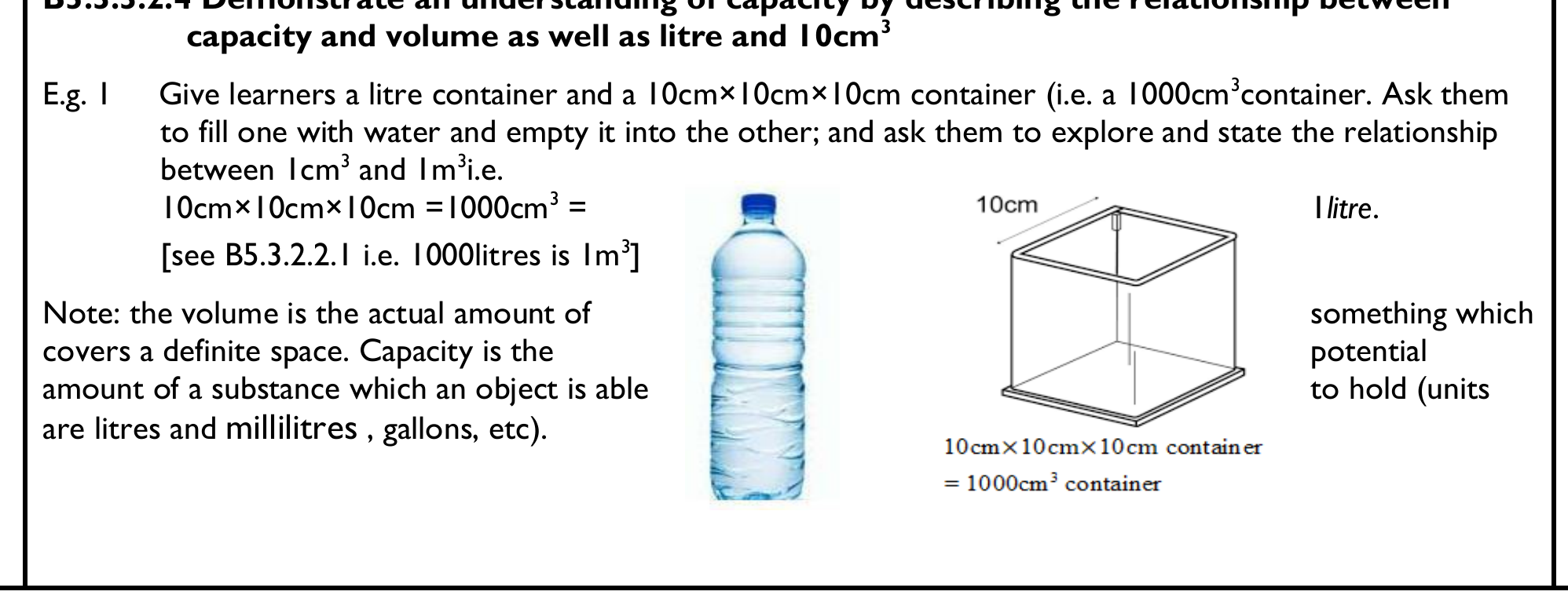
The bottle and cube pictures sit inside the exemplar and their captions interleave with the sentence in the text layer; the figure shows them.