B5 Mathematics · Term 3, Week 7
Measurement - Angles
Lesson notes
Learning Objectives
Indicator: B5.3.3.3.1 - Identify examples of angles in the environment that are equal to, less than or larger than, a right angle
By the end of the lesson, learners can:
- Define an angle as the region formed when two lines meet or cross at a point.
- Identify and describe a right angle as a square corner, equal to 90 degrees.
- Recognise and name angles in the classroom and school compound that are equal to a right angle.
- Identify and classify angles found in the environment as less than a right angle or larger than a right angle.
- Justify their classification of an angle by comparing it with a paper right-angle checker.
Sign in with your phone number to read the full note and download the GES plan - free.
Sign in with phone numberCurriculum details
- Strand
- Geometry and Measurement (Strand 3)
- Sub-strand
- Measurement - Angles (3.3)
- Content standard
- B5.3.3.3 - Demonstrate an understanding of angles
- Indicator
- B5.3.3.3.1 - Identify examples of angles in the environment that are equal to, less than or larger than, a right angle
- Suggested placement
-
Term 3, Week 7
(Week 31 of the year)
Our suggestion, laid out in curriculum order across three terms of twelve weeks. NaCCA does not fix the week, so follow your school's scheme of learning.
- Curriculum reference
-
Mathematics Curriculum for Primary Schools (Basic 4-6), 2019, p. 103
Transcribed from the official NaCCA publication. Check this page against the source.
Exemplars (from the NaCCA curriculum)
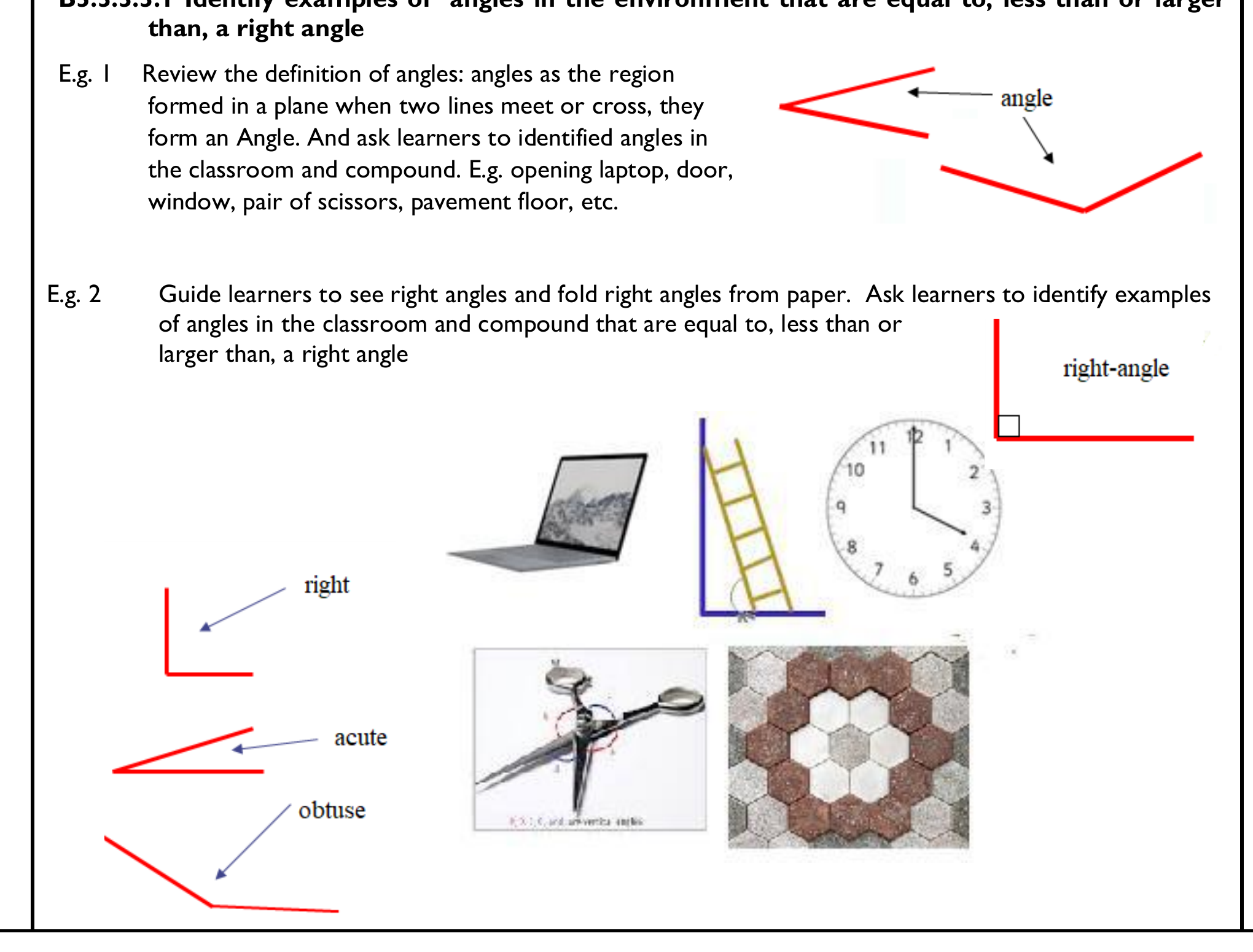
E.g. 1 Review the definition of angles: angles as the region formed in a plane when two lines meet or cross, they form an Angle. And ask learners to identified angles in the classroom and compound. E.g. opening laptop, door, window, pair of scissors, pavement floor, etc.
E.g. 2 Guide learners to see right angles and fold right angles from paper. Ask learners to identify examples of angles in the classroom and compound that are equal to, less than or larger than, a right angle