B5 Mathematics · Term 3, Week 1
Lines and Shapes
Lesson notes
Learning Objectives
Indicator: B5.3.1.1.1
By the end of the lesson, learners can:
- Identify squares and rectangles from a collection of shapes, giving reasons based on their properties.
- State and describe the properties of squares and rectangles, including sides, angles, and diagonals.
- Compare and contrast squares and rectangles, explaining what is the same and what is different.
- Use the properties of squares and rectangles to solve simple problems and justify their answers.
- Sort shapes into groups labelled “Square”, “Rectangle”, or “Neither”, explaining their reasoning.
Sign in with your phone number to read the full note and download the GES plan - free.
Sign in with phone numberCurriculum details
- Strand
- Geometry and Measurement (Strand 3)
- Sub-strand
- Lines and Shapes (3.1)
- Content standard
- B5.3.1.1 - Identify and sort quadrilaterals, including rectangles, squares, trapezoids, parallelograms, and rhombuses, according to their attributes
- Indicator
- B5.3.1.1.1 - Demonstrate an understanding of the properties (e.g. sides, angles, and diagonals) of squares and rectangles
- Suggested placement
-
Term 3, Week 1
(Week 25 of the year)
Our suggestion, laid out in curriculum order across three terms of twelve weeks. NaCCA does not fix the week, so follow your school's scheme of learning.
- Curriculum reference
-
Mathematics Curriculum for Primary Schools (Basic 4-6), 2019, p. 94
Transcribed from the official NaCCA publication. Check this page against the source.
Exemplars (from the NaCCA curriculum)
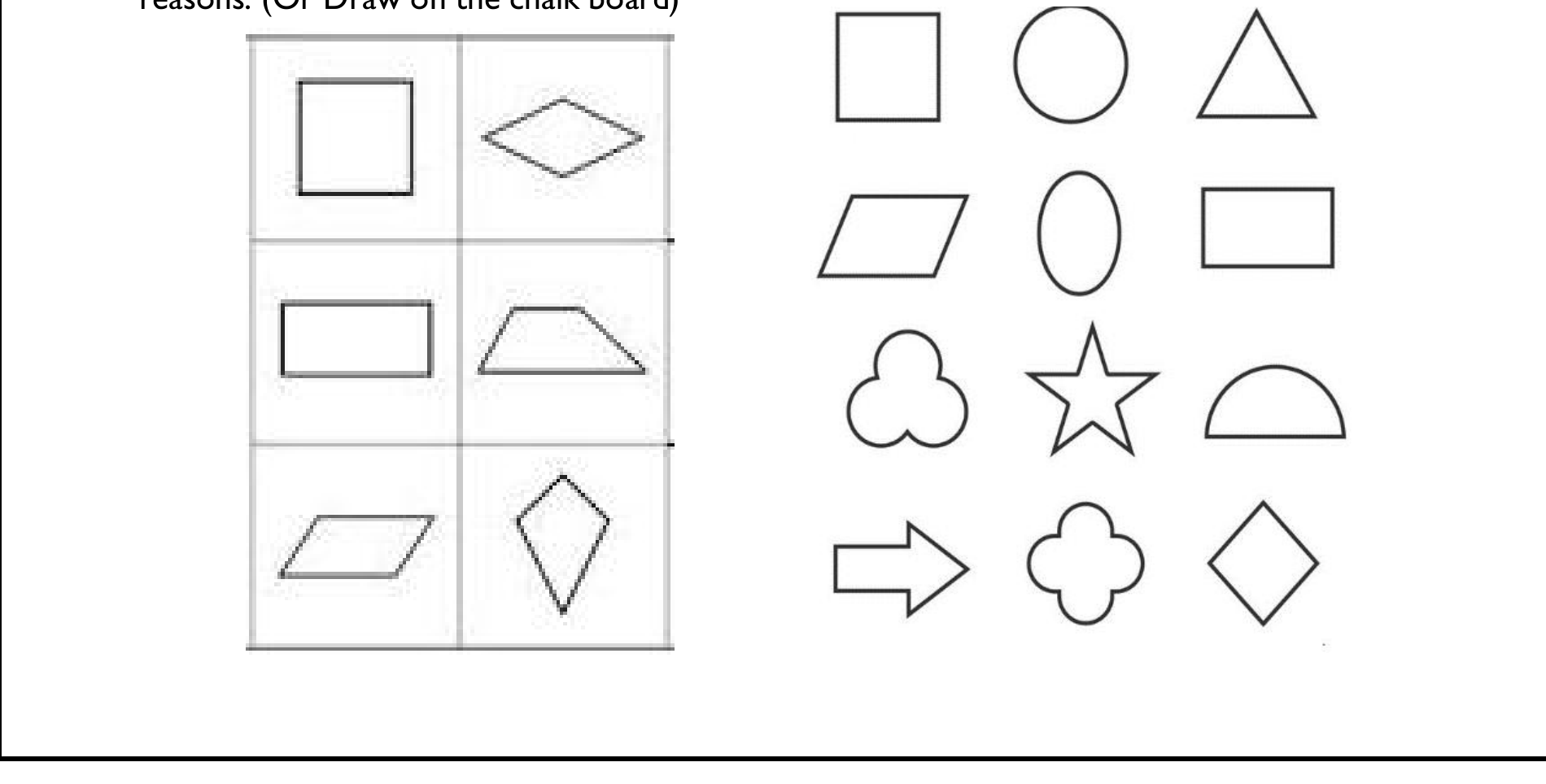
E.g. 1 Give learners photocopied worksheets with shapes to identify squares and rectangles and give reasons. (Or Draw on the chalk board)