B4 Mathematics · Term 2, Week 2
Fractions
Lesson notes
Learning Objectives
Indicator: B4.1.3.1.4 - Recognise fractions that are greater than one (i.e. improper fractions), draw and label such fractions with their symbols
By the end of the lesson, learners can:
- Identify improper fractions as fractions where the numerator is larger than the denominator (e.g. 9/4, 7/6).
- Recognise improper fractions in pictorial representations, including shaded diagrams and number lines.
- Draw and shade pictorial representations to match a given improper fraction symbol (e.g. shade 7/4 of a set of shapes).
- Write the correct fraction symbol (numerator over denominator) for a given shaded or coloured diagram.
- Convert given improper fractions to mixed fractions (e.g. 9/4 = 2 1/4) and express mixed fractions as improper fractions, using drawings to support their reasoning.
Sign in with your phone number to read the full note and download the GES plan - free.
Sign in with phone numberCurriculum details
- Strand
- Number (Strand 1)
- Sub-strand
- Fractions (1.3)
- Content standard
- B4.1.3.1 - Develop an understanding of equivalent and improper fractions
- Indicator
- B4.1.3.1.4 - Recognise fractions that are greater than one (i.e. improper fractions), draw and label such fractions with their symbols
- Suggested placement
-
Term 2, Week 2
(Week 14 of the year)
Our suggestion, laid out in curriculum order across three terms of twelve weeks. NaCCA does not fix the week, so follow your school's scheme of learning.
- Source document note
-
The official curriculum document has a fault in this entry, so the curriculum text above is transcribed exactly as printed:
- exemplars - p.22
- Curriculum reference
-
Mathematics Curriculum for Primary Schools (Basic 4-6), 2019, p. 22
Transcribed from the official NaCCA publication. Check this page against the source.
Exemplars (from the NaCCA curriculum)
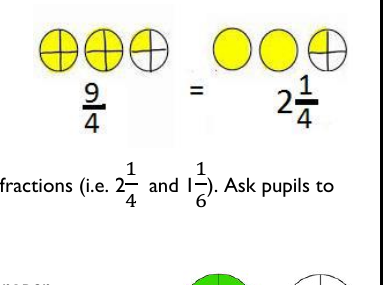
E.g. 1. Use several pictorial representations (or card cut outs) to introduce improper fractions (i.e. where the fraction is bigger than 1 or the numerator in larger than the denominator). Examples are 9/4 and 7/6 (i.e. nine-fourths and seven-sixths) and show how they are expressed as mixed fractions (i.e. 2 1/4 and 1 1/6). Ask pupils to change given improper fractions to mixed fractions
E.g. 2. Ask pupils to express given coloured mixed fractions as improper fractions or draw and colour given improper fraction (e.g. seven-fourths, eleven-eights, etc.)

E.g. 3. Use number line to present more mixed fractions for pupils to identify and state their improper fractions

The fractions are set as stacked numerator over denominator and are written inline.