B4 Mathematics · Term 2, Week 1
Fractions
Lesson notes
Learning Objectives
Indicator: B4.1.3.1.2 - Recognise and name equivalent fractions using pictorial representations and number line to determine the Lowest Common Denominator (LCD).
By the end of the lesson, learners can:
- Identify equivalent fractions from pictorial representations such as fraction charts and shaded diagrams.
- Name at least three equivalent fractions for a given fraction (e.g., name 2/4, 3/6, and 4/8 as equivalent to 1/2).
- Locate and mark equivalent fractions on a number line from 0 to 1.
- Determine the Lowest Common Denominator (LCD) of two given fractions by listing multiples.
- Use the LCD to write equivalent fractions for two given fractions so they share the same denominator.
Sign in with your phone number to read the full note and download the GES plan - free.
Sign in with phone numberCurriculum details
- Strand
- Number (Strand 1)
- Sub-strand
- Fractions (1.3)
- Content standard
- B4.1.3.1 - Develop an understanding of equivalent and improper fractions
- Indicator
- B4.1.3.1.2 - Recognise and name equivalent fractions using pictorial representations and number line to determine the Lowest Common Denominator (LCD).
- Suggested placement
-
Term 2, Week 1
(Week 13 of the year)
Our suggestion, laid out in curriculum order across three terms of twelve weeks. NaCCA does not fix the week, so follow your school's scheme of learning.
- Curriculum reference
-
Mathematics Curriculum for Primary Schools (Basic 4-6), 2019, p. 20
Transcribed from the official NaCCA publication. Check this page against the source.
Exemplars (from the NaCCA curriculum)
E.g. 1. Use fraction chart to illustrate the concept of equivalent fractions (i.e. equal fractions that have different fractional units or denominators) i.e. one-half is 2-fourths, 3-sixth or 4-eighths.
E.g. 2. Illustrate the relationship between fractions and their equivalences by observing the different fractional units or denominators (i.e. the numerator is multiplied by the number of units the denominator is further broken into)
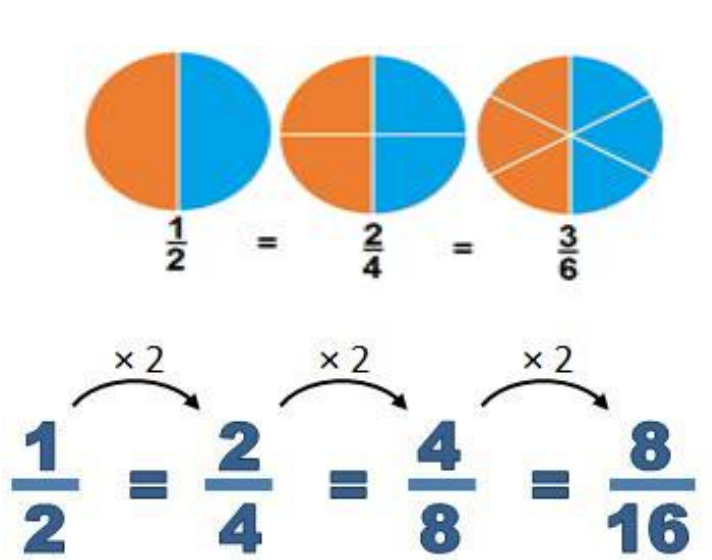
E.g. 3. Ask pupils to colour fractions that are equivalent to given fractions or write more equivalent fractions for give n fractions

E.g. 4. To determine the equivalent fractions of given fractions, find the Lowest Common Denominator (LCD) and use this to express the equivalent fractions that are comparable