B3 Mathematics · Term 2, Week 8
Fractions
Lesson notes
Learning Objectives
Indicator: B3.1.3.1.3 - Compare and order unit fractions and fractions with like denominators by using concrete models, pictorial representations and number line.
By the end of the lesson, learners can:
- Compare two unit fractions using fraction strips or pictorial representations and state which is larger or smaller.
- Compare two fractions with like denominators using fraction models and explain their reasoning.
- Use a number line to position unit fractions and fractions with like denominators in the correct order.
- Arrange a set of three unit fractions or fractions with like denominators from smallest to largest.
- Justify their comparison by referring to the size of the parts in the fraction model.
Sign in with your phone number to read the full note and download the GES plan - free.
Sign in with phone numberCurriculum details
- Strand
- Number (Strand 1)
- Sub-strand
- Fractions (1.3)
- Content standard
- B3.1.3.1 - Develop an understanding of fractions using concrete and pictorial representations and write fractions in words and symbols
- Indicator
- B3.1.3.1.3 - Compare and order unit fractions and fractions with like denominators by using concrete models, pictorial representations and number line.
- Suggested placement
-
Term 2, Week 8
(Week 20 of the year)
Our suggestion, laid out in curriculum order across three terms of twelve weeks. NaCCA does not fix the week, so follow your school's scheme of learning.
- Source document note
-
The official curriculum document has a fault in this entry, so the curriculum text above is transcribed exactly as printed:
- exemplars - p.60
- Curriculum reference
-
Mathematics Curriculum for Primary Schools (Basic 1-3), 2019, p. 60
Transcribed from the official NaCCA publication. Check this page against the source.
Exemplars (from the NaCCA curriculum)
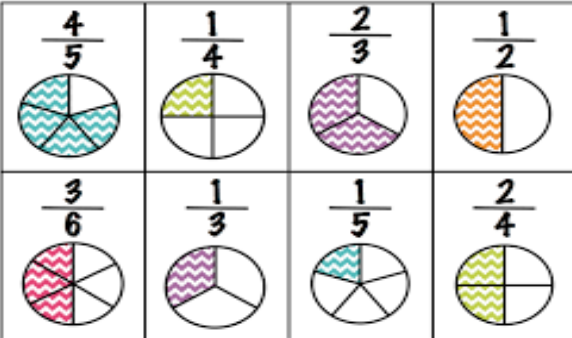
E.g. 1. Use pictorial representations to compare pairs of fractions. Which is larger, 3/8 and 1/4 ? Arrange from smallest to largest 3/6, 2/3 and 5/6
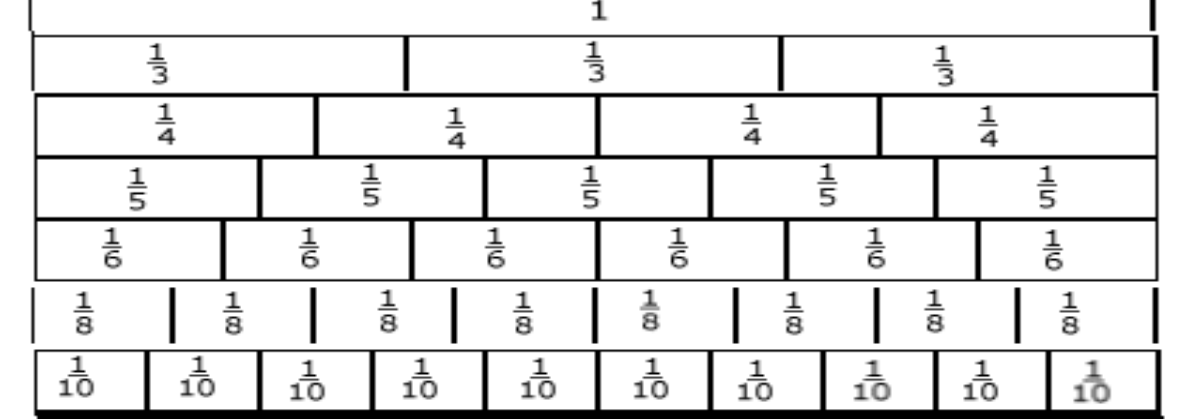
E.g. 2. Use fraction charts to compare pairs of fractions. Which is larger, 3/8 and 1/4 ? Arrange from smallest to largest 3/6, 2/3 and 5/6
The fractions are set as stacked numerator over denominator; they are written here inline as 3/8, 1/4, 3/6, 2/3 and 5/6.