B6 Mathematics · Term 1, Week 1
Counting, Representation, Cardinality & Ordinality
Lesson notes
Learning Objectives
Indicator: B6.1.1.1.1 - Model number quantities up to 1,000,000 using graph sheets and multi-base block
By the end of the lesson, learners can:
- Identify the value of each multi-base block piece (cube = 1,000, rod = 10,000, flat = 100,000, block = 1,000,000) and state the relationship between them.
- Model given numbers up to 1,000,000 using multi-base blocks or graph sheets, correctly selecting the number of each piece needed.
- Shade graph sheet squares to represent quantities up to 1,000,000, using place value to determine how many squares of each size to shade.
- Use teacher-made token currency notes to model amounts up to GHS 1,000,000 and justify the combinations chosen.
- Work collaboratively in groups to build and verify models of multi-digit numbers, checking for accuracy and precision.
Sign in with your phone number to read the full note and download the GES plan - free.
Sign in with phone numberCurriculum details
- Strand
- Number (Strand 1)
- Sub-strand
- Counting, Representation, Cardinality & Ordinality (1.1)
- Content standard
- B6.1.1.1 - Demonstrate an understanding of quantities and place value for multi-digit numerals up to 1,000, 000,000 or 1 billion
- Indicator
- B6.1.1.1.1 - Model number quantities up to 1,000,000 using graph sheets and multi-base block
- Suggested placement
-
Term 1, Week 1
(Week 1 of the year)
Our suggestion, laid out in curriculum order across three terms of twelve weeks. NaCCA does not fix the week, so follow your school's scheme of learning.
- Curriculum reference
-
Mathematics Curriculum for Primary Schools (Basic 4-6), 2019, p. 114
Transcribed from the official NaCCA publication. Check this page against the source.
Exemplars (from the NaCCA curriculum)
E.g.1. Ask pupils to model number quantities up to 1000,000 using graph sheets or multi-base materials. For instance, with multi-base block, a cube = 1000 unit; a rod = 10,000; a flat = 100,000 and a block = 1,000,000; learners model 436,000 with the appropriate materials
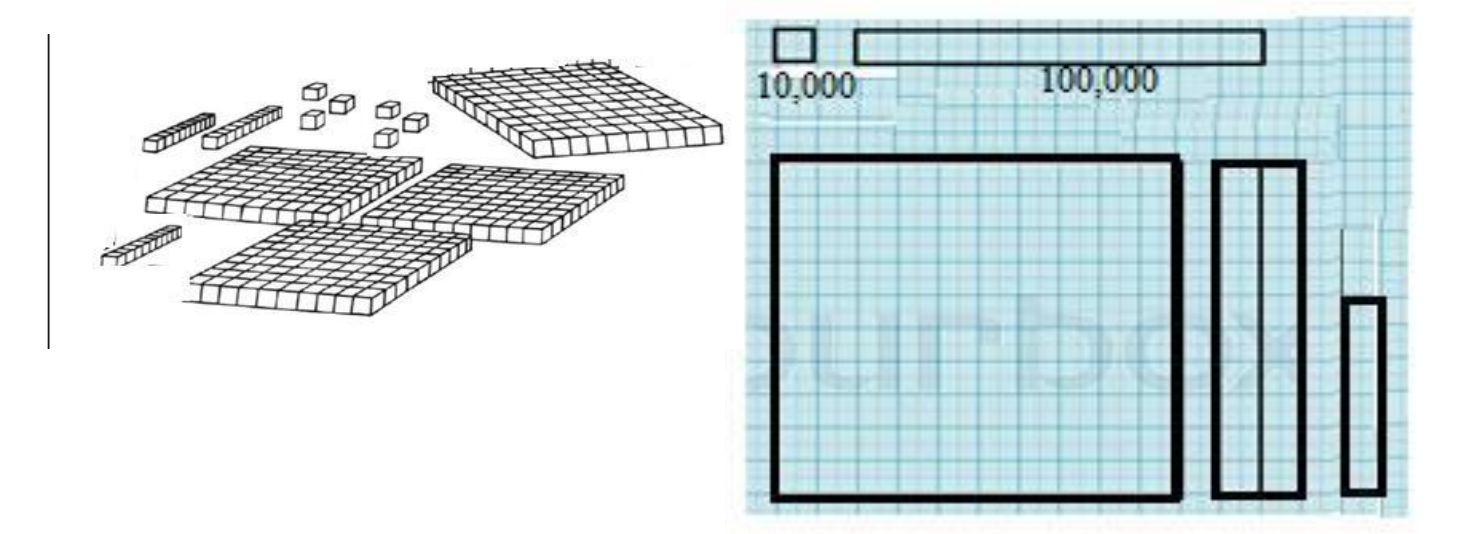
E.g.2 Ask pupils to model the number 137,000 shading graph sheet square as shown below
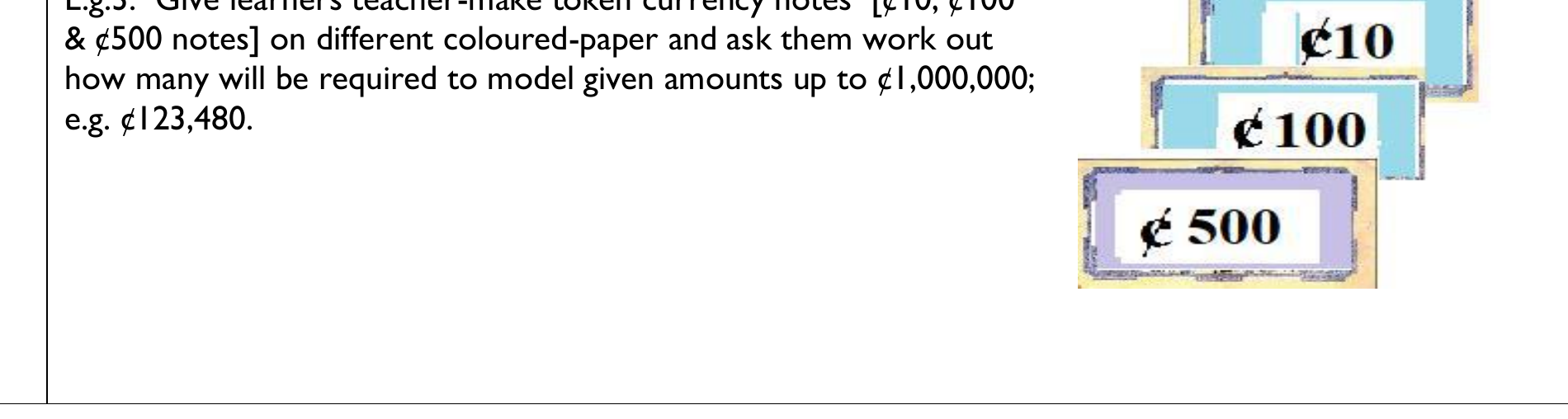
E.g.3. Give learners teacher-make token currency notes [¢10, ¢100 & ¢500 notes] on different coloured-paper and ask them work out how many will be required to model given amounts up to ¢1,000,000;
e.g. ¢123,480.