B3 Mathematics · Term 1, Week 2
Counting, Representation, Cardinality & Ordinality
Lesson notes
Learning Objectives
Indicator: B3.1.1.1.3 - Describe numbers and the relationship between numbers from 0 to 10,000 in equivalent ways using the place value concept
By the end of the lesson, learners can:
- Identify and state the place value and value of each digit in numbers up to 10,000 using a place value chart (Thousands, Hundreds, Tens, Ones).
- Model numbers up to 10,000 using multi-base materials (unit cube = 1, rod = 10, flat = 100, block = 1000).
- Decompose numbers up to 10,000 into expanded form expressions, for example 4036 = 4000 + 30 + 6.
- Explain, using their own words, why the value of a digit changes when its position in a numeral changes.
- Represent the same number in at least two equivalent ways (materials, expanded form, or place value chart) and justify that the representations show the same quantity.
Sign in with your phone number to read the full note and download the GES plan - free.
Sign in with phone numberCurriculum details
- Strand
- Number (Strand 1)
- Sub-strand
- Counting, Representation, Cardinality & Ordinality (1.1)
- Content standard
- B3.1.1.1 - Count and estimate quantities from 0 to 10,000
- Indicator
- B3.1.1.1.3 - Describe numbers and the relationship between numbers from 0 to 10,000 in equivalent ways using the place value concept
- Suggested placement
-
Term 1, Week 2
(Week 2 of the year)
Our suggestion, laid out in curriculum order across three terms of twelve weeks. NaCCA does not fix the week, so follow your school's scheme of learning.
- Source document note
-
The official curriculum document has a fault in this entry, so the curriculum text above is transcribed exactly as printed:
- exemplars - p.44
- Curriculum reference
-
Mathematics Curriculum for Primary Schools (Basic 1-3), 2019, p. 43
Transcribed from the official NaCCA publication. Check this page against the source.
Exemplars (from the NaCCA curriculum)
E.g. 1. Demonstrate a conceptual understanding of place value of whole numbers between 100 and 10,000 by:
- explaining and showing - with bundles of hundreds, tens and ones - the meaning of each digit in a given 3-digit number (when the three digits are different, as well as when two or more of the digits are the same) and representing the number in a hundreds frame
- explaining why the value of a digit depends upon its placement within a numeral.
- using other possible representations of place value which include manipulatives such as threaded 100s, 10s, and loose bottle caps; and multi-base ten material (units, flats and squares)
E.g.2 Ask pupils to model number quantities up to 10,000 using square grid paper or multi-base materials. For instance, with multi-base block, a cube = 1 unit; a rod = 10; a flat = 100 and a block = 1000; learners model 327 with the appropriate materials.
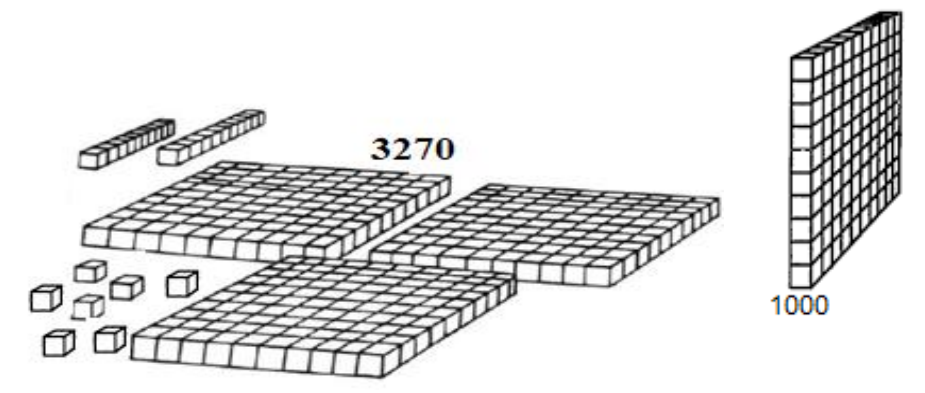
E.g. 3. Decompose numbers up to 1000 into 100s, 10s, and 1s expressions (e.g.: 5000 = 1000 + 1000 + 1000 + 1000 + 1000 or 4036 = 4000 + 30 + 6; etc.)
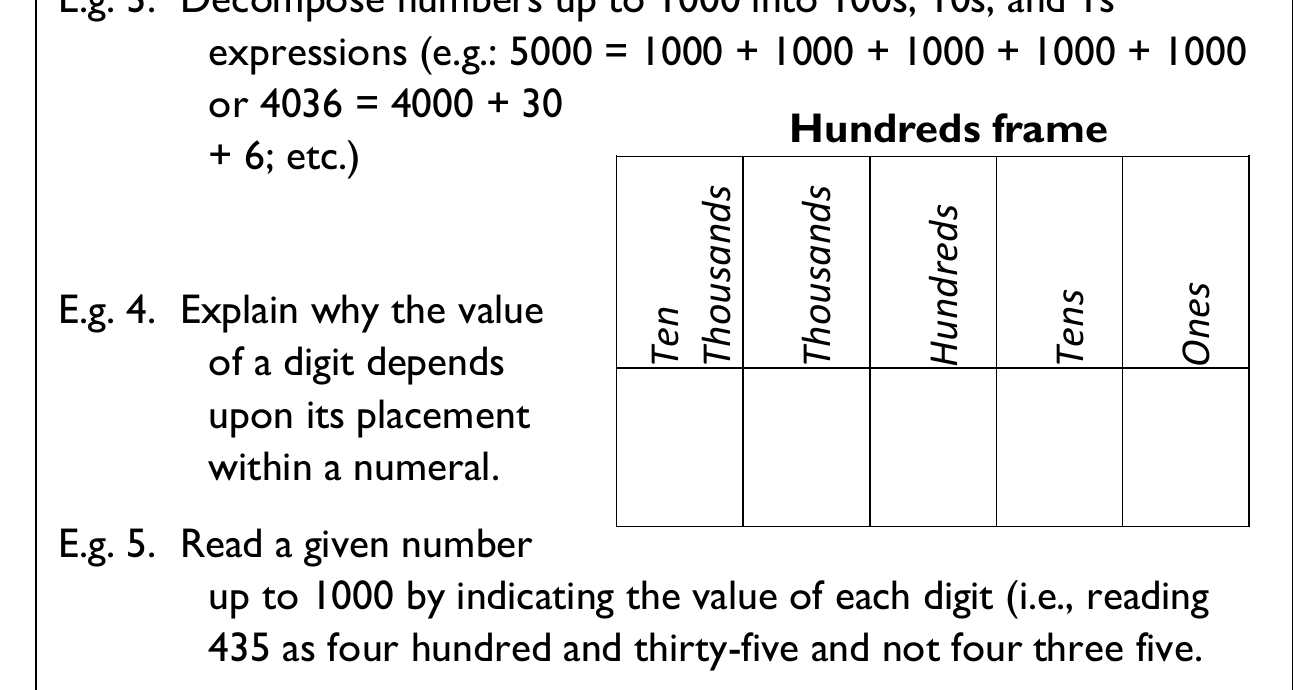
E.g. 4. Explain why the value of a digit depends upon its placement within a numeral.
E.g. 5. Read a given number up to 1000 by indicating the value of each digit (i.e., reading 435 as four hundred and thirty-five and not four three five. The "Hundreds frame" table is set beside E.g. 3 to E.g. 5 and its words interleave with theirs in the text layer. Its column headings read Ten Thousands, Thousands, Hundreds, Tens, Ones and its cells are blank; figure p44-2.png shows it.