B5 Mathematics · Term 1, Week 6
Counting, Representation & Cardinality
Lesson notes
Learning Objectives
Indicator: B5.1.1.3.3 - Identify even and odd numbers between 1 and 100 as numbers that can be arrayed in twos array and those which cannot
By the end of the lesson, learners can:
- Arrange given quantities of objects (from 1 to 100) into pairs or twos arrays to determine whether a number is even or odd.
- Identify even and odd numbers between 1 and 100 using the twos-array method and explain their reasoning.
- Generate even numbers by skip counting in twos starting from 2, and odd numbers by skip counting in twos starting from 1.
- Classify numbers from 1 to 100 as even or odd and justify their classification using the pairing rule (no leftovers vs. one leftover).
- Apply the concept of even and odd numbers to solve simple real-life problems involving pairing and sharing.
Sign in with your phone number to read the full note and download the GES plan - free.
Sign in with phone numberCurriculum details
- Strand
- Number (Strand 1)
- Sub-strand
- Counting, Representation & Cardinality (1.1)
- Content standard
- B5.1.1.3 - Demonstrate an understanding of factors, multiples of numbers including composite, even, odd and prime numbers from 1 to 100
- Indicator
- B5.1.1.3.3 - Identify even and odd numbers between 1 and 100 as number that can be arrayed in twos array and those which cannot
- Suggested placement
-
Term 1, Week 6
(Week 6 of the year)
Our suggestion, laid out in curriculum order across three terms of twelve weeks. NaCCA does not fix the week, so follow your school's scheme of learning.
- Curriculum reference
-
Mathematics Curriculum for Primary Schools (Basic 4-6), 2019, p. 62
Transcribed from the official NaCCA publication. Check this page against the source.
Exemplars (from the NaCCA curriculum)
E.g. 1 Ask learners to use arrangements of twos arrays of objects to find even and odd numbers between 1 and 100
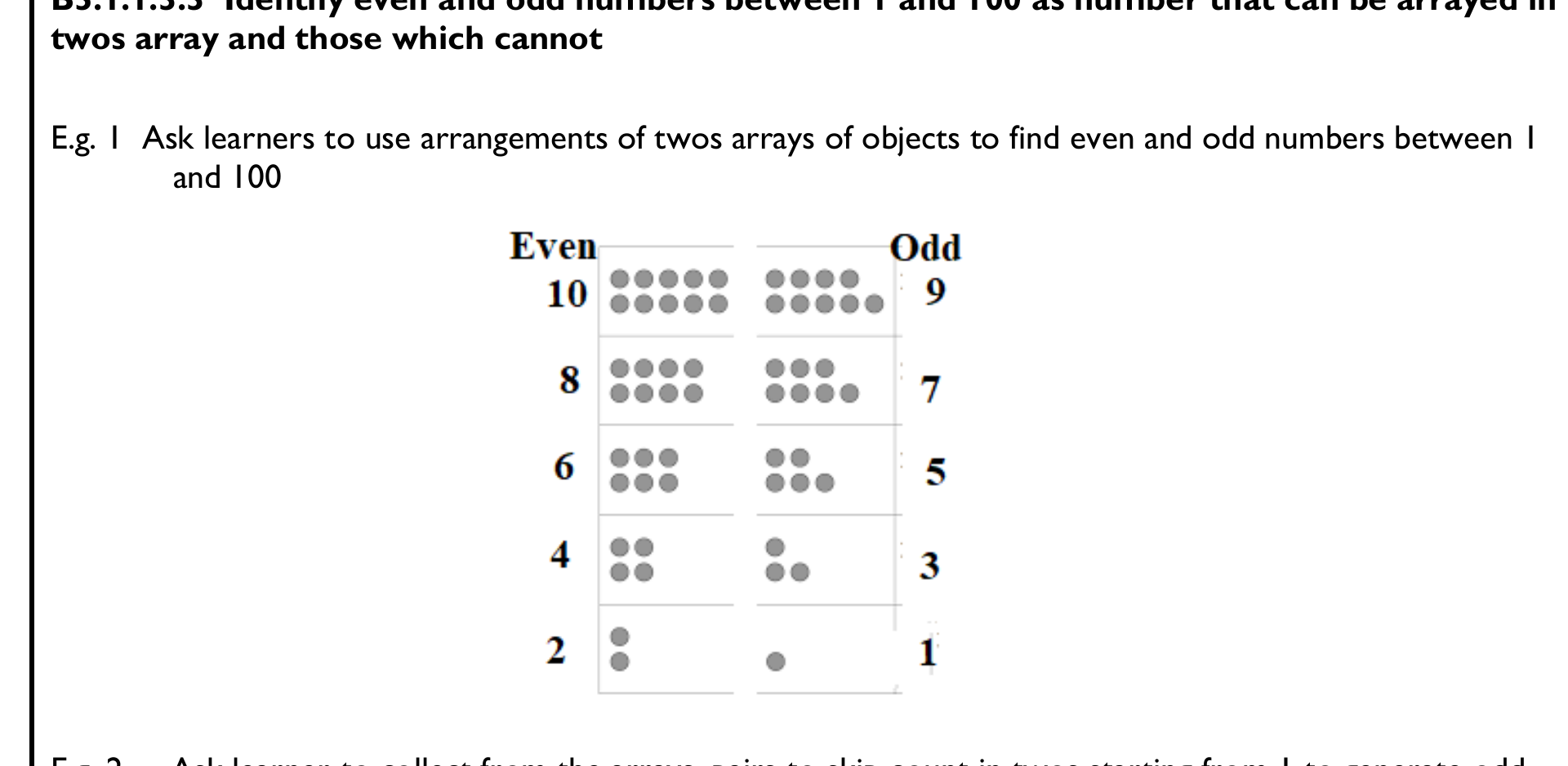
E.g. 2 Ask learner to collect from the arrays, pairs to skip count in twos starting from 1 to generate odd numbers, and skip count in twos starting from 2 to generate even numbers