B4 Mathematics · Term 1, Week 5
Counting, Representation & Cardinality
Lesson notes
Learning Objectives
Indicator: B4.1.1.3.1 - Determine set of factors of a given numbers up to 50
By the end of the lesson, learners can:
- Form equal groupings from a given quantity of objects and record the pairs of numbers that make each grouping.
- Identify all the factors of a number up to 50 by listing factor pairs in an organised way.
- Write the set of factors of a given number using set notation, for example, factors of 12 = {1, 2, 3, 4, 6, 12}.
- Justify why a number is or is not a factor of another number by showing the multiplication or division fact.
- Solve simple word problems that require finding factors of numbers up to 50 in everyday Ghanaian situations.
Sign in with your phone number to read the full note and download the GES plan - free.
Sign in with phone numberCurriculum details
- Strand
- Number (Strand 1)
- Sub-strand
- Counting, Representation & Cardinality (1.1)
- Content standard
- B4.1.1.3 - Demonstrate an understanding of factors, multiples and squared numbers
- Indicator
- B4.1.1.3.1 - Determine set of factors of a given numbers up to 50
- Suggested placement
-
Term 1, Week 5
(Week 5 of the year)
Our suggestion, laid out in curriculum order across three terms of twelve weeks. NaCCA does not fix the week, so follow your school's scheme of learning.
- Curriculum reference
-
Mathematics Curriculum for Primary Schools (Basic 4-6), 2019, p. 9
Transcribed from the official NaCCA publication. Check this page against the source.
Exemplars (from the NaCCA curriculum)
E.g. 1 Learners make formation of sets of equal object from a given quantity. For example with 12 straws Learners make groupings such as: 3 groups of 4 ⇒ 3, 4 4 groups of 3 ⇒ 4, 3 2 groups of 6 ⇒ 2, 6
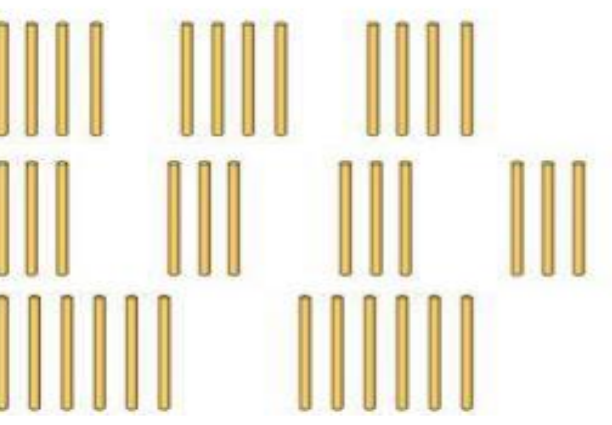
E.g. 2 Learners pair grouping and the number of equal objects for each formation as factors; 4 groups of 3 straws (4, 3) 3 groups of 4 straws (3, 4) 6 groups of 2 straws (6, 2) 2 groups of 6 straws (2, 6) 1 group of 12 straws (1, 12) 12 groups of 1 straw (12, 1)
E.g. 3 Learners collect from the pairs and form a set as the factors of the given number. For example the set of factors of 12 = {1, 2, 3, 4, 6, 12}